
Best email greetings for business: 20 examples that work
"Hi \[First Name\]," is the safest default for cold B2B email, and "Hey \[First Name\]," suits casual audiences. In Boomerang's analysis of over 300,000 public
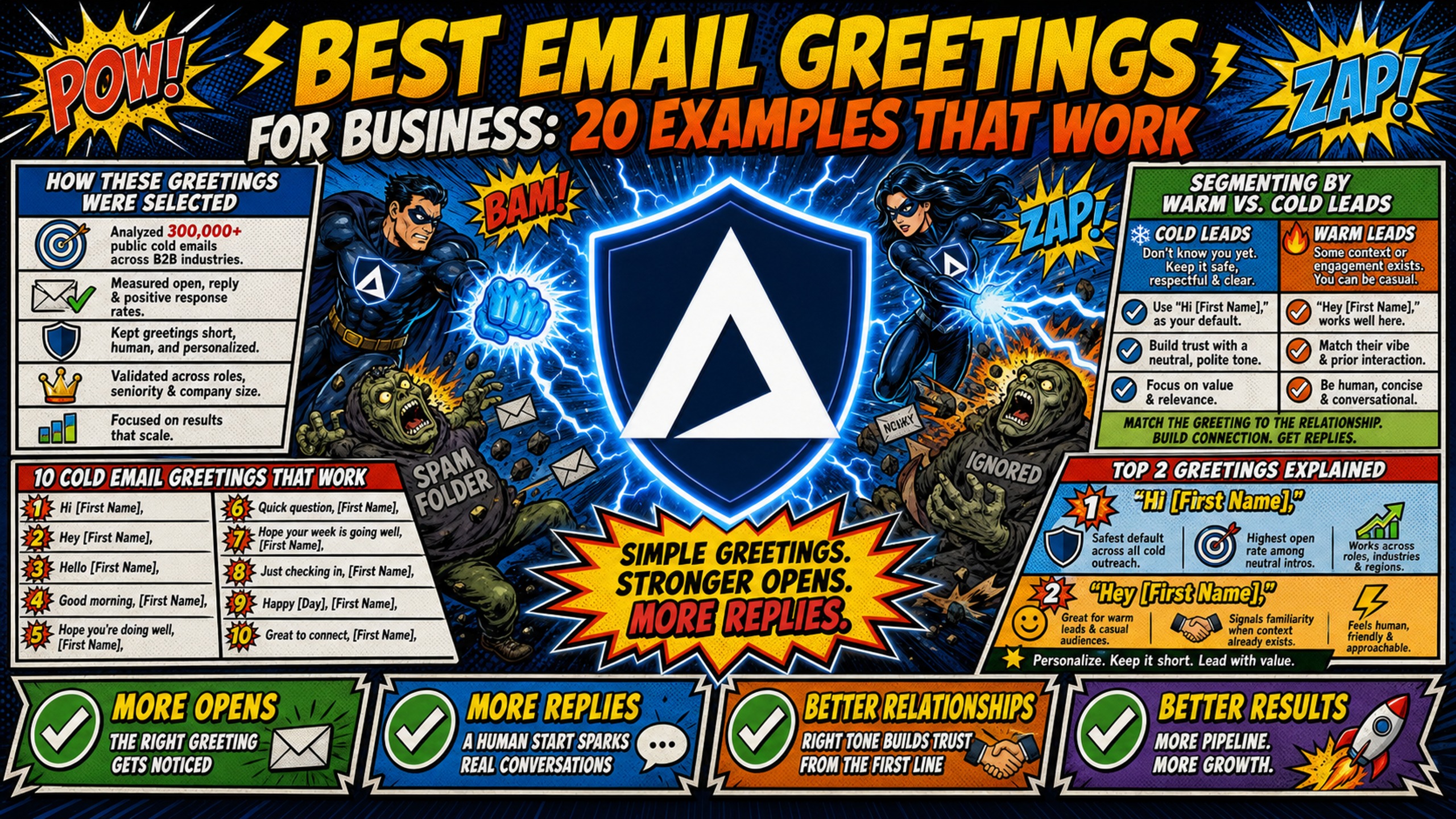
TL;DR: "Hi [First Name]," is the safest default for cold B2B email, and "Hey [First Name]," suits casual audiences. In Boomerang's analysis of over 300,000 public community email threads, "Hey" (64%), "Hello" (63.6%), and "Hi" (62.7%) drew near-identical reply rates, while "Dear" trailed at 56.5%, though it remains the norm for legal and healthcare prospects. Follow-ups should name the prior touchpoint, and nameless openers like "To whom it may concern" should go. Because greeting gaps are small, a reliable test changes only the greeting, runs the full sequence, and needs about 14,000 prospects per variant at a 3% reply rate (mid-range for SaaS). Inframail's flat $147/month Unlimited Plan (plus domains and external warmup) means the platform fee does not scale with inbox count.
Changing a greeting can shift reply rates in some campaigns and do nothing in others. Most "best email greeting" lists present a fixed set of winners. In practice, each greeting works in a specific context, and the notes below explain when to use each one and how to confirm it in your own campaigns.
This guide presents 20 business email greeting examples organized by cold and warm outreach. Each example includes a performance note explaining the available evidence, or lack thereof, behind the recommendation. The guide also shows how flat-rate infrastructure makes large-scale greeting testing financially viable. The goal is to give you a working default for each situation and a simple way to confirm it.
The appropriate greeting format varies by relationship type and formality level, as this overview shows.
| Relationship type | Formal | Semi-formal | Casual |
|---|---|---|---|
| Cold | Dear [Title] [Last Name], | Hi [First Name], | Hey [First Name], |
| Warm | Dear [Title] [Last Name], | Hi [First Name], following up on... | [First Name], |
How these greetings were selected
The greeting recommendations below are built on two evaluation criteria: how audience type shapes the right approach and how industry context filters what is appropriate.
This guide uses Boomerang's published greeting data where it exists and common cold outreach practice for the rest.
Segmenting by warm vs. cold leads
Cold and warm outreach require different greeting strategies. Cold emails need to establish relevance fast since the recipient has no prior context. Warm emails can reference shared history directly. The level of formality and personalization should match the existing relationship depth.
10 cold email greetings that work
Cold email greetings need to signal individual attention and establish relevance fast. Cold outreach has no prior relationship to fall back on. Only #1 ("Hi") and #2 ("Hey") have large-sample published data, so the other notes explain when each greeting works and how to test it. The 10 examples below are organized by cold email scenario, with notes on when each approach tends to perform and what to test.
1. "Hi [First Name],"
This is the baseline to test against. It signals individual attention without over-familiarity, making it the safest starting point for cold outreach.
Performance note: A neutral, widely used opener. Use it as your control variant when testing any other greeting.
2. "Hey [First Name],"
Slightly more casual than "Hi," and backed by published data, though not from cold email. Boomerang's analysis of over 300,000 email threads from public online communities found that "Hey," "Hello," and "Hi" got replies 64%, 63.6%, and 62.7% of the time. This is not cold email data, so test whether it holds in your B2B segment.
Performance note: Along with #1, the only greeting here with large-sample published data, though it comes from community email threads, not cold outreach. Boomerang measured the opening word only, so the data does not confirm how "Hey [First Name]," or "Hi [First Name]," perform compared to the word alone. The margin between "Hey" (64%), "Hello" (63.6%), and "Hi" (62.7%) is small, and the study is from 2017. Treat as directional and confirm with your own A/B test.
3. "Hi [First Name], I noticed..."
Pairing the greeting with an immediate observation signals research effort. Keep the email short. Inframail's guide to B2B email sequence design recommends 75 to 100 words for the opening email.
Performance note: Works when the observation is specific to this prospect or company and is something they could confirm themselves. Confirm it against your "Hi [First Name]," baseline.
4. "Good morning [First Name],"
Time-based greetings add a layer of personalization without requiring research, but only when your sending platform can localize send times to the recipient's timezone. Test this against the simpler "Hi [First Name]" to measure whether the added specificity helps or hurts.
Performance note: No large-sample benchmark isolates this from "Hi [First Name]," so confirm it against the baseline before you scale.
5. "[First Name],"
Dropping the "Hi" entirely creates a direct, almost internal-email feel. This works well for short, text-based cold emails where you want to mimic how colleagues write to each other. The risk is coming across as abrupt if the rest of your email doesn't match the casual tone. Pair this with a conversational first sentence.
Performance note: No large-sample benchmark exists for this approach. Confirm it against "Hi [First Name]" before deploying at scale.
6. "Hi [First Name], quick question:"
The direct inquiry greeting sets expectations immediately. You are telling the recipient this will be short and you want something specific.
Performance note: Works when the email body genuinely contains a single, direct question. Mismatching the greeting's implied brevity with a long body copy is likely to hurt performance. No large-sample benchmark isolates this phrasing, so confirm against your standard opener.
7. "Hi [First Name], saw your post about [topic]..."
This combines the greeting with a specific, verifiable observation. The key is referencing something the prospect actually posted or shared recently, not a generic company observation.
Performance note: No large-sample benchmark isolates this phrasing. Confirm it against your "Hi [First Name]," baseline.
8. "Hi [First Name], [Mutual Connection] suggested I reach out..."
Referral greetings use existing trust. When legitimate, test this greeting against your standard cold opener to measure the referral lift.
Performance note: No large-sample benchmark isolates referral greetings in cold outreach. Confirm it against your standard cold opener before scaling.
9. "Hi [First Name], fellow [industry/role] here..."
Identity-based greetings can help establish connection. This works well when you genuinely share a professional identity with the recipient (same role, same industry, same challenge). The greeting signals "I understand your world" before you make any claims.
Performance note: No large-sample benchmark exists for this approach. Confirm against your standard baseline before deploying at scale.
10. "Hi [First Name], [Company Name] caught my attention because..."
Company-specific greetings show you have done research beyond the individual level. This can be effective for account-based outreach where the company context matters as much as the person. Consider pairing this with a specific observation about the company's recent activity, funding, product launch, or hiring pattern.
Performance note: No large-sample benchmark isolates this phrasing. Confirm it against your baseline before scaling.
10 follow-up and warm email greetings
Warm email greetings can reference shared history, prior conversations, or mutual context. These 10 examples cover follow-ups within a sequence, re-engagement, and ongoing threads.
To see how these greetings fit into full sequences, browse these cold email sequence examples with reply rates from Inframail.
1. "Hi [First Name], following up on..."
This is the standard follow-up greeting, so keep the same tone as your initial email while being more direct with your ask. This greeting works because it provides immediate context without requiring the recipient to search their inbox. For timing, see this guide on when and how to send a cold email follow-up.
Performance note: Works for any first follow-up. Maintain consistent tone from the initial send and reference the prior email explicitly.
2. "Hi [First Name], circling back on..."
Slightly more casual than "following up," this greeting acknowledges time has passed without being apologetic. It works well for later follow-ups when you want to stay persistent without sounding robotic.
Performance note: Works for second and later follow-ups, when "following up" starts to feel repetitive. Confirm it against "following up on" in your own sequences.
3. "Hi [First Name], [relevant update] made me think of you..."
This greeting works as a value-first re-engagement when you have a genuine reason to reconnect: a relevant article, a company announcement, or an industry development.
Performance note: No large-sample benchmark isolates this phrasing. Effectiveness drops if the update is a rephrased version of your original pitch, so confirm it against a standard follow-up before scaling.
4. "Hi [First Name], thanks for [specific action]..."
Gratitude-based greetings work well after a meeting, demo, or content download. The specificity matters: "thanks for taking the time yesterday" can outperform "thanks for your time" because it anchors to a specific moment.
Performance note: No benchmark isolates specific versus generic thanks. Confirm the specific version against a generic alternative in your own sequences.
5. "Hi [First Name], quick update on..."
This greeting signals you are providing value, not asking for something. Consider using this when you have new information that advances the conversation: a case study, a pricing update, or a relevant feature release.
Performance note: No large-sample benchmark isolates this phrasing. Using this framing to repeat an earlier ask without new content risks being read as a template, so confirm it against a standard follow-up.
6. "[First Name], checking in..."
The ultra-casual check-in can work for prospects you have already exchanged multiple emails with. Dropping the "Hi" may signal familiarity. Consider avoiding this for first follow-ups or prospects who have not responded yet since it presumes a relationship that may not exist.
Performance note: No large-sample benchmark isolates this phrasing. Confirm it against "Hi [First Name]," in later-sequence touches before deploying at scale.
7. "Hi [First Name], wanted to reconnect on..."
This is a re-engagement greeting for prospects who went cold, and it acknowledges the gap without making it awkward. Consider pairing this with a new angle or updated offer rather than repeating your original pitch.
Performance note: No large-sample benchmark isolates this phrasing. Without something new, it reads as a repeated ask with changed wording, so confirm it against a standard follow-up before scaling.
8. "Hi [First Name], before I close your file..."
The breakup greeting signals this is the last email in the sequence. Consider using this as a last-touch email when you are about to stop outreach. Test whether this final-attempt framing lifts reply rates on prospects who ignored earlier touches. Plan where the breakup email lands with this Inframail guide to email sequence cadence.
Performance note: No large-sample benchmark exists for breakup emails specifically. Confirm whether the implied finality lifts replies by A/B testing against a standard follow-up.
9. "Hi [First Name], our conversation about [topic] stuck with me..."
This greeting picks up a prior exchange directly, signaling the sender was paying attention rather than running through a template sequence. Works well for prospects who engaged in an earlier thread but went quiet before a decision was made. Pair it with a single sentence advancing the topic, not repeating the original pitch.
Performance note: Works when there was genuine prior two-way exchange and the topic you reference is specific. Avoid using this if the "conversation" was a one-sided send that received no reply, as it misrepresents the relationship.
10. "Hi [First Name], congrats on [new role/milestone]..."
A milestone-based greeting leads with something positive that is publicly verifiable: a promotion, a funding announcement, a product launch, or a company award. It signals research without making an immediate ask, which lowers the recipient's guard before the pitch lands. Works best when the milestone is recent and specific enough that it could not apply to anyone else.
Performance note: No large-sample benchmark isolates this phrasing. Avoid repurposing old announcements or vague compliments like "congrats on your growth," which read as templates, and confirm it against your "Hi [First Name]" baseline before scaling.
Adapting greetings by industry
Industry norms shape greeting expectations. What works in tech sales may feel out of place in legal or healthcare outreach. For reply rate differences by sector, see Inframail's article on email sequence benchmarks by industry and role.
| Industry | Formality level | Recommended greeting |
|---|---|---|
| Tech/SaaS | Casual to semi-formal | Hi [First Name], |
| Legal | Formal | Dear [Title] [Last Name], |
| Healthcare | Formal | Dear [Title] [Last Name], |
| Consulting / Agency / Professional services | Semi-formal | Hi [First Name], |
Tech sales greeting preferences
Tech buyers often respond to direct, low-formality openers, and "Hi [First Name]" paired with a product or technical observation works well.
Legal industry greeting norms
Legal professionals often expect formality, so open with "Dear [Title] [Last Name]," until the recipient switches to first names.
Healthcare greeting conventions
Healthcare outreach requires extra caution around perceived familiarity. Stick with "Dear [Title] [Last Name]" for initial outreach to medical professionals. Avoid casual openers like "Hey" in healthcare contexts.
Client-facing role greetings
When emailing prospects in consulting, agency, or professional services roles, semi-formal greetings balance professionalism with approachability. "Hi [First Name]" works well, especially when paired with a reference to shared context or a mutual connection.
Avoid these 7 unprofessional email openers
Some openers signal mass email and cost you replies. These 7 openers should be removed from your templates.
"Dear Sir/Madam,"
Openers like "Dear Sir/Madam" are classic mass-mail patterns, so recipients read them as a blast before the second sentence.
"I hope this email finds you well"
This line is a widely recognized template opener in B2B. Recipients recognize it immediately as template language, and it signals mass email before they read your second sentence. Delete it from every sequence.
"To whom it may concern"
"To whom it may concern" is an old-fashioned greeting that may give the impression that you have not done basic research on who you are contacting. Generic greetings fall flat in cold outreach where personalization matters.
"Yo" and "Sup"
Overly casual openers like "Yo" or "Sup" may work in some consumer contexts but generally fail in B2B.
"Hello," or "Hi there," without a name
Nameless greetings like "Hello," or "Hi there," read as mass email in cold outreach. Boomerang's figures count the opening word only, so add the recipient's name.
"Greetings" as a standalone opener
In Boomerang's data, "Greetings" drew replies 57.2% of the time versus 62.7% to 64% for "Hi," "Hello," and "Hey." Without a name attached, it also reads as impersonal or automated.
"Good morning" or "Good afternoon" without timezone awareness
Time-based greetings without localization can look automated when they arrive at the wrong time. If you cannot guarantee timezone accuracy, skip the time reference entirely.
Set up greetings for clean test results
Placement, domain warmup, and preview text all affect whether a greeting test gives you a clean result.
Where to place your email greetings
The greeting should be the first line of your email body. Every template in Inframail's email sequence templates opens with "Hi [First Name]," on the first line. Some senders experiment with skipping the greeting entirely in ultra-short emails, but this typically only works in rapid-fire ongoing threads, not first-touch cold emails.
Domain age and deliverability impact
New domains with low sender reputation face higher scrutiny from spam filters. Inframail's deliverability monitoring dashboard tracks domain and IP health with blacklist monitoring. New domains need several weeks of warmup before launching live campaigns. Run greeting tests only on fully warmed domains, or warmup-stage deliverability will skew your results. Follow this guide on how to warm up an email domain before running any greeting test.
Syncing preview text and greetings
In plain-text cold email, the preview snippet is usually your greeting plus your first sentence. Make that first sentence carry the reason for the email, since it is what recipients see before they open.
How to A/B test your email greetings
The only way to know which greeting works for your audience is to test. Here is the framework.
Setting up greeting tests by platform
Most sending platforms support A/B testing at the sequence level. Instantly gates this feature to the Hypergrowth plan and above, so confirm your plan includes it before building your test. Create two variants of your first email with only the greeting changed, keeping subject line, body copy, and CTA identical across both to isolate the variable.
Calculating minimum test sizes
Inframail's A/B testing framework sets a minimum of 1,000 prospects per variant and a 95% confidence threshold, with tests running the full sequence length (30 days or more for a 4-email sequence, 45 days or more for 7+ steps). However, at a 3% reply rate (mid-range for SaaS), detecting a 20% relative lift takes about 14,000 prospects per variant at 95% confidence and 80% power (you can check this with Evan Miller's A/B test sample size calculator). That 1,000-prospect minimum suits big changes such as a new offer. Greeting differences are smaller.
Key engagement signals to monitor
Track reply rate as your primary metric, but also monitor open rate (to ensure deliverability is stable) and spam complaint rate (to catch tone problems early). See Inframail's spam detection guide for reference on metric benchmarks.
Greeting testing checklist
- Define hypothesis: State which greeting you expect to win and why.
- Select variants: Choose a manageable number of greetings to test at once.
- Calculate sample size: about 14,000 prospects per variant to detect a 20% lift reliably at a 3% reply rate. Smaller samples of 1,000 to 1,500 only detect lifts of roughly two-thirds or more.
- Split traffic evenly: Equal distribution across variants.
- Run for the full sequence length: At least 30 days for a 4-email sequence, 45 days or more for 7+ steps. Avoid ending tests early based on partial data.
- Monitor engagement signals: Reply rate, open rate, spam complaints.
- Analyze results: 95% confidence threshold before declaring a winner.
- Document learnings: Record what worked for future campaigns.
Run greeting tests at scale with Inframail
Inframail is a flat-rate Microsoft email infrastructure platform for agencies and SDR teams running cold email across 50-200 domains. Running greeting tests across multiple domains requires infrastructure that does not penalize you for volume, and Google Workspace per-seat pricing adds up quickly when testing across many inboxes.
The Unlimited Plan at $147/month covers unlimited inboxes, automated DNS configuration, and dedicated IP infrastructure, removing the per-seat cost barrier that makes large-scale greeting tests expensive on Google Workspace. Inframail reports 98%+ deliverability and a 68.3% blacklist delisting success rate within 48 hours.
Inframail is Microsoft-only and does not include built-in warmup, so budget for an external warmup tool alongside the platform fee. For 50 inboxes, Google Workspace Business Starter costs $420/month at $8.40 per seat on the Flexible Plan. Inframail's platform fee is $147/month flat, a $273/month difference, or $3,276 a year. Domain costs ($5 to $16 per domain per year) and warmup tools (typically $15 to $50 per inbox per month) apply on both sides and are not included in this comparison.
In this case study video, see how Inframail helped the client build reliable cold email infrastructure that generated responses quickly, ran for over a year without problems, and supported $42,000 in new sales in just four weeks.
Sign up to Inframail and get started today.
FAQs
What are the best email greetings for business cold emails?
"Hi [First Name]," is the safest default for cold outreach. It reads as personal without being overly familiar. Pair it with a specific observation about the prospect.
Should I use Hi or Hey in professional emails?
Either works. In Boomerang's analysis of over 300,000 email threads, "Hey" (64%), "Hello" (63.6%), and "Hi" (62.7%) performed almost the same. "Hi" is the safer default for a first cold touch.
Do email greetings actually affect reply rates?
Sometimes. In Boomerang's data, "Hey," "Hello," and "Hi" were within 1.3 points of each other, while "Dear" trailed "Hey" by 7.5 points. Swapping one common opener for another rarely moves reply rates much, so test before you standardize.
When should I skip the greeting entirely?
Keep the greeting in first-touch cold emails. In fast, ongoing threads with someone who already replies to you, dropping it reads as natural.
How do I test which greeting works best?
At a 3% reply rate (mid-range for SaaS), detecting a 20% relative lift reliably takes about 14,000 prospects per variant at 95% confidence.
Key terms glossary
Inbox warmup: The process of gradually increasing send volume from a new domain or IP address over several weeks to build a positive sending history with email service providers. Skipping warmup on new domains significantly increases the likelihood that emails land in spam, regardless of greeting or copy quality.
Dedicated IP: An IP address assigned exclusively to one sender rather than shared across multiple senders on the same platform. Dedicated IPs mean your sending behavior alone determines your IP reputation. Shared IPs expose your deliverability to the behavior of other senders on the same range.
Preview text: The short snippet of body copy displayed in an inbox list view beneath or alongside the subject line. In plain-text cold email, inbox clients pull this directly from the first line of the email body, which is typically your greeting and the sentence immediately following it.
Sequence position: The numerical order of an email within a multi-touch campaign. First emails are position 1, follow-ups are positions 2, 3, and so on. Adapting your greeting approach as the sequence progresses can be effective.
Sender reputation: A score assigned by email service providers based on sending behavior, engagement rates, and spam complaints. Sender reputation is a major factor in deliverability, alongside authentication (SPF, DKIM, DMARC) and content. Low sender reputation significantly increases the likelihood emails land in spam.
SPF/DKIM/DMARC: Three DNS authentication records that verify a sender is authorized to send email from a given domain. SPF specifies which servers can send on behalf of the domain, DKIM adds a cryptographic signature to outgoing mail, and DMARC tells receiving servers how to handle messages that fail either check. Missing or misconfigured records are a common cause of cold email landing in spam.