
What is founder-led sales? A complete guide for SaaS founders
: Founder-led sales is a go-to-market motion where the founder personally drives revenue through outreach, demos, and deal closing instead of handing selling to
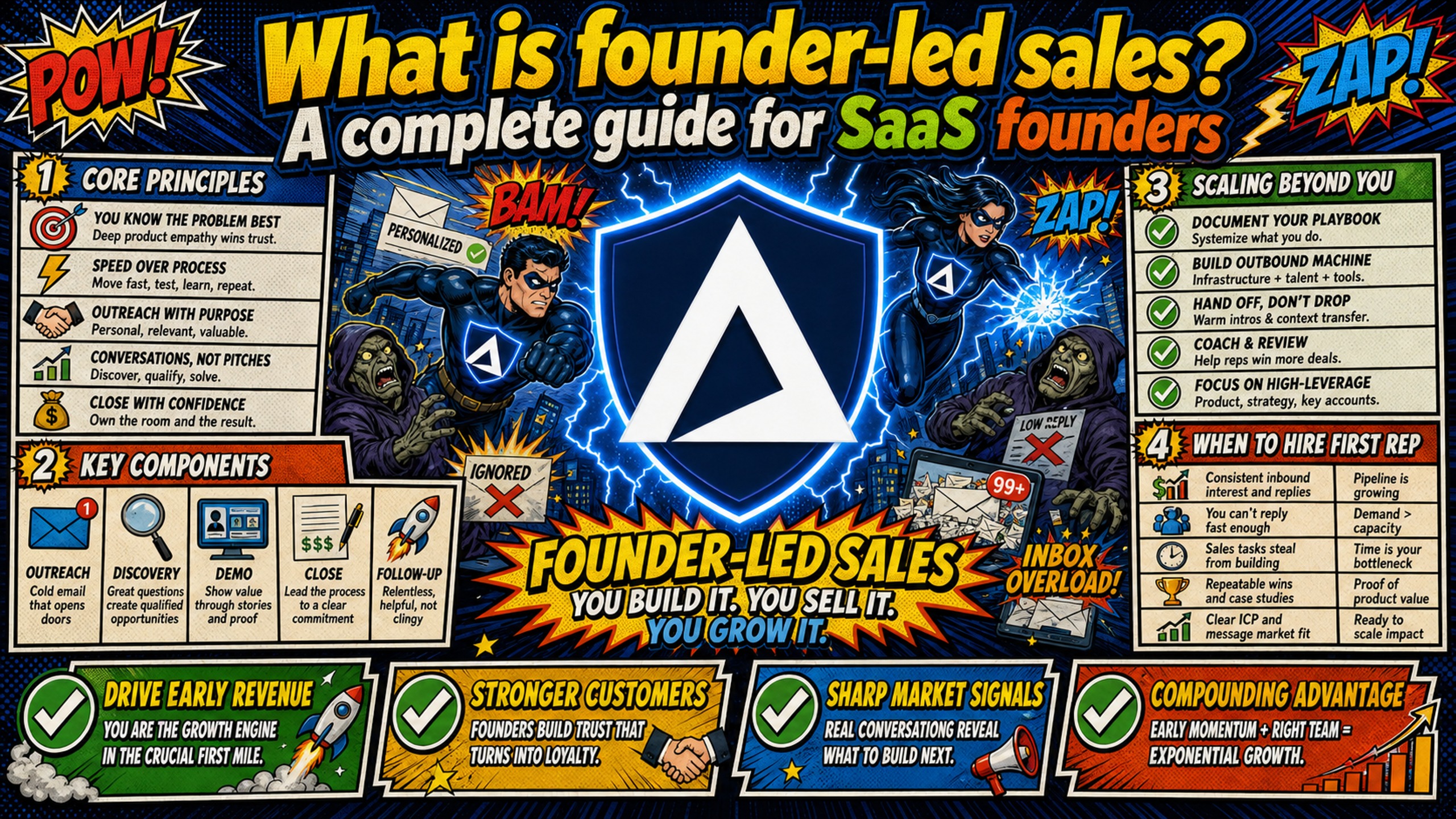
TL;DR: Founder-led sales is a go-to-market motion where the founder personally drives revenue through outreach, demos, and deal closing instead of handing selling to a hired team. It works best from pre-seed through early Series A, when every conversation doubles as product-market-fit research. The transition to hired sales hinges on repeatability, not revenue. Founders typically reach it after 50+ demos, a documented playbook, and win rates around 15-25% on first meetings, and when they can step away for 30 days while deals keep moving. At that stage, 50 cold email inboxes cost $147/month flat on Inframail versus $420/month on Google Workspace Business Starter's Flexible Plan, before domains and warmup tools.
Founder-led sales is the primary research and validation engine that determines whether a startup has a repeatable sales motion worth scaling. Many SaaS founders close their first customers themselves, and the ones who skip this step usually build the wrong product. This guide defines the founder-led sales motion, contrasts it with hired sales teams, and provides a stage-appropriate framework for execution.
Core principles of founder-led sales
The core principle is that, in the early stages, founder-led sales is mostly an exercise in gathering information rather than generating revenue. The four components below show how founders put that principle into practice.
Key components of founder-led sales
This guide breaks founder-led sales into four practical components. They are a working summary of how early-stage founders run the motion, not an established industry framework:
- Direct prospect interaction: Founders handle every stage from first outreach to signed contract. No documented process exists because the founder is the process.
- Market truth extraction: Every conversation becomes usable data about pricing sensitivity, feature gaps, and messaging resonance that hired reps lack product context to recognize.
- Rapid iteration on messaging: Founders test positioning in real time and adjust pitch language based on what lands, in days rather than quarters.
- Personal accountability for revenue: The founder owns the number with no sales manager to blame and no playbook to follow when deals stall.
| Dimension | Founder-Led Sales | Hired Sales Motion |
|---|---|---|
| Primary goal | Build sales process from scratch while developing product | Scale documented playbooks across multiple reps |
| Key strength | Fast learning and high-potential conversion rates | Volume and repeatability |
| Typical stage | Pre-seed through early Series A | Post-repeatability, scaling ARR |
| Infrastructure needs | Flexible, low-cost, quick to deploy | Standardized, integrated with CRM and reporting |
Scaling beyond the founder sales phase
Scaling means repeatability, not headcount. A startup achieves repeatability when the founder converts first meetings into customers at a consistent rate over a meaningful sample, according to Sellerant's hiring analysis. The founder-led sales motion becomes scalable when founders document their instincts, messaging, and tactics into a written playbook that others can execute.
When to hire your first sales rep
The transition trigger is repeatability, not a specific ARR number. Founders should meet the demo and win-rate thresholds in the handoff metrics table (see the hiring section below) before hiring their first sales rep. The founder should also be able to step away from selling while active deals keep moving, according to Dave Rubinstein's hiring framework.
Founder-led sales: driving early revenue
Founder-led sales exists to validate demand before scaling spend. The motion produces revenue as a byproduct of learning what customers actually want.
How founders validate early demand
Discovery calls function as validation engines. Patrick Thompson, Co-Founder at Clarify, frames sales as "a core research initiative that keeps you close to your target market" in Clarify's sales call guide. Founders who treat every call as a research interview extract signal about who buys, why they buy, and what objections block deals.
Early-stage SaaS founders running cold outreach typically see reply rates between 3-5%, and above 8% is exceptional, per reply rate benchmarks. The average response rate for cold email campaigns sits at 5.1%, down from 7% the prior year, per Pipeful's 2024 study.
Translating conversations into features
Pattern recognition from sales calls feeds directly into product roadmap decisions. When three prospects in one week ask for the same integration or report the same workflow blocker, that's a signal worth prioritizing. Founders capture objections and feature requests that hired reps would route through a product manager filter, losing nuance and urgency.
Speeding up your sales motion
Reducing time from lead to conversation matters more than optimizing individual email copy. Infrastructure speed becomes a lever when founders can spin up new outreach domains in minutes instead of hours. Early on, a founder may only need a handful of domains. Once the motion is repeatable and outreach scales to 50 domains, manual DNS configuration takes 12+ hours of logging into registrar panels, creating SPF/DKIM/DMARC records, and waiting for propagation. Automated setup eliminates that bottleneck.
Scaling sales without hiring costs
The economic case for founder-led sales becomes clear at the repeatability stage, when a founder scaling outreach compares infrastructure costs against hired AE compensation. A founding account executive typically costs $140,000-$220,000 per year in on-target earnings (salary plus commission), or $11,667-$18,333 per month, according to Scalerr's hiring analysis. That cost comes before the infrastructure to support their outreach.
The comparison below assumes a scaled outreach program of 50 cold email inboxes, not a founder's first 10 customers. At that size, Google Workspace Business Starter costs $420/month at $8.40 per user monthly on the Flexible Plan. Inframail's flat-rate model charges $147/month for unlimited inboxes, dropping infrastructure spend to $1,764 annually versus $5,040 for Google Workspace.
Domain costs run $5-16 per year each, and, per industry estimates, external warmup tools like Warmbox or Lemwarm add $15-50 per inbox per month. Even with those additions, founder-led sales infrastructure for 50 inboxes starts around $931/month once warmup spend is included, compared to a single AE's fully-loaded cost exceeding $10,000/month.
| Cost Component | Founder-Led (Inframail) | Hired AE (Google Workspace) |
|---|---|---|
| Platform fee | $147/month flat (Unlimited plan) | $420/month (50 seats, Business Starter Flexible Plan at $8.40/user) |
| Domains (50) | ~$34/month amortized (about $8 per domain per year, within the $5-16 range) | ~$34/month amortized (about $8 per domain per year, within the $5-16 range) |
| Warmup tools | $750-2,500/month (50 inboxes at $15-50 each) | $750-2,500/month (50 inboxes at $15-50 each) |
| Total infrastructure only (platform + domains + warmup, excludes AE pay) | $931-2,681/month ($147 + $34 + $750-2,500) | $1,204-2,954/month ($420 + $34 + $750-2,500) |
| Salary + commission (founding AE, OTE) | $0 | $11,667-18,333/month ($140,000-220,000 per year, per Scalerr) |
Step-by-step founder sales playbook
The founder sales playbook breaks into four operational phases: sourcing leads, crafting outreach, running discovery calls, and closing deals.
How to source your first leads
Founders source early leads through three primary channels:
- Founder networks and communities: Other founders, accelerator cohorts, and industry Slack groups provide warm introductions to early adopters.
- Outbound cold email: Cold email is one of the highest-impact channels for early-stage B2B SaaS because it scales without ad spend or event budgets. Founders can spin up domains and launch campaigns within hours instead of weeks.
- Inbound content and SEO: Publishing technical content attracts prospects already searching for solutions, but this channel takes months to produce consistent lead flow.
Crafting your outreach strategy
Effective cold outreach starts with technical infrastructure that protects sender reputation. The three-step domain health checklist:
- Configure SPF/DKIM/DMARC: SPF (Sender Policy Framework) lists servers allowed to send email on behalf of your domain. DKIM (DomainKeys Identified Mail) adds a cryptographic signature verifying the email came from your domain and wasn't altered in transit. DMARC tells mailbox providers what to do when authentication fails.
- Use dedicated IPs: A dedicated IP is a private email-sending address assigned exclusively to one sender. Shared IP pools work like carpool lanes where you're affected by other drivers. One bad actor spamming gets the whole range flagged. Inframail's dedicated IP approach isolates sender reputation.
- Monitor blacklist status: Track domain and IP health proactively. Inframail's platform auto-submits delisting requests when domains are flagged, with a 68.3% success rate within 48 hours.
Short, specific, value-first emails outperform long feature dumps. Email opener psychology matters because prospects decide whether to engage within the first sentence. A/B testing openers helps founders identify which hooks resonate with their ICP. Meeting rates from cold email average 0.5-1.5% across B2B campaigns, with 1.5-3% considered good performance, per RevenueFlow's 2026 conversion benchmarks.
Running high-conversion discovery calls
Discovery calls work when founders ask questions instead of pitching. The goal is extracting market truth, not convincing the prospect to buy. Questions that surface useful signal:
- "What happens if you don't solve this problem in the next 90 days?"
- "How are you handling this today, and what's broken about that approach?"
- "What would make this a must-have instead of a nice-to-have?"
- "Who else cares about this problem inside your company?"
Founders who treat calls as research interviews are better positioned to close deals because they understand the actual buying criteria.
Finalizing the founder-led sale
Closing requires clear next steps and direct pricing conversations. Founders sometimes hesitate to ask for the sale, often because they have less formal sales training than professional reps. The transition from discovery to close follows a simple pattern:
- Summarize what you heard and confirm you understand the problem
- Show how the product solves that specific problem (not every feature)
- State the price and ask if it works for their budget
- Define the next step with a specific date and deliverable
Opportunity rates from cold email average 0.15-0.5% across B2B campaigns, per RevenueFlow's 2026 conversion benchmarks. The consensus win rate for B2B SaaS lands around 20-25% once a prospect reaches the demo stage.
Scaling founder-led sales for maximum impact
Founder-led sales scales when founders apply the motion strategically rather than trying to close every deal personally.
Before you have product-market fit
Founder-led sales functions as the product-market fit discovery engine. Every call either validates or invalidates assumptions about who buys and why. Hiring before repeatability exists doesn't accelerate growth, it stalls it, according to Sellerant's analysis. Companies that hired a VP of Sales before achieving a repeatable motion churned that leader within 12 to 15 months at a cost exceeding $400,000, according to Scalerr's placement data.
Handling complex sales motions
Deals requiring multiple stakeholders still benefit from founder involvement because founder credibility carries weight in enterprise conversations. Technical founders can answer architecture questions and integration concerns that hired reps would need to escalate. The founder's presence signals that the company takes the deal seriously.
When to use high-touch sales motions
High annual contract value (ACV) deals and strategic accounts justify founder time because the revenue impact and reference value exceed the opportunity cost. A $50,000 annual contract that becomes a strong case study can be worth far more than its face value in future deals. Founder time becomes the highest-impact resource when deployed on deals that define the company's trajectory.
When to target niche markets
Narrow focus speeds up repeatability. Founder-led sales works best in defined niches where the founder can develop pattern recognition quickly. Selling to "B2B SaaS companies" produces scattered feedback. Selling to "Series A DevOps tools companies with 10-50 engineers" produces consistent objections, use cases, and buying criteria.
Signs your founder-led sales motion is stalling
The founder-led sales motion breaks when manual processes or product scope create bottlenecks that prevent scaling.
Scaling past manual outreach limits
Manual email sends cap out quickly before quality degrades, and infrastructure automation removes the technical ceiling. Founders can export IMAP/SMTP credentials to CSV and import directly into sending platforms like Instantly or Smartlead, scaling outreach without hiring.
The automation handles domain configuration, inbox provisioning, and credential generation without DNS panel work.
Defining a repeatable sales workflow
A complete sales playbook includes ideal customer profiles, messaging frameworks, call scripts, cadence schedules, objection responses, CRM workflows, and performance KPIs. The difference between repeatable and ad hoc:
- Repeatable: Every prospect hears the same core positioning, objections get documented responses, and close rates stay consistent across 50+ deals
- Ad hoc: Every call is improvised, messaging changes weekly, and close rates fluctuate wildly
Why founder time becomes a bottleneck
Every hour spent on DNS configuration or inbox provisioning is an hour not spent on discovery calls. Once outreach scales to 50 domains, manual DNS setup consumes 12+ hours of logging into registrar panels and waiting for propagation. Automated infrastructure tools eliminate that overhead. Inframail automates SPF/DKIM/DMARC configuration and provisions unlimited Microsoft inboxes under dedicated US-based IPs at $147/month flat.
The impact of product scope on sales
Broad product scope makes messaging hard because the value proposition changes for every prospect. Narrow scope speeds up founder-led sales because the founder can test one positioning hypothesis across 100 prospects and know within two weeks whether it resonates. Startups selling "productivity software for everyone" struggle to repeat messaging. Startups selling "time-tracking for remote engineering teams" can refine one pitch until it converts consistently.
When to hire your first outbound sales rep
The transition from founder-led to hired sales depends on documented repeatability, not arbitrary revenue milestones.
Codify your founder-led sales motion
Write down the playbook before hiring. Document scripts, objection responses, close patterns, and the exact sequence from first touch to signed contract. A B2B startup should make its first sales hire only when the founder can step away from selling for 30 days and active deals keep moving, according to Dave Rubinstein's hiring framework. That hire should usually be a Founding AE who closes deals while turning the founder's motion into a written playbook.
Evaluating your first sales rep hire
Look for curiosity and listening skills over closing experience. The first rep inherits the founder's motion and needs to understand why it works, not just execute it mechanically. Hiring a VP of Sales before the motion is repeatable fails 60-70% of the time within 18 months because there's no playbook for them to run, according to Scalerr's hiring analysis.
Develop your core sales collateral
Collateral codifies what the founder learned:
- Case studies: Document 3-5 customer wins with specific metrics and use cases
- One-pagers: Summarize the value proposition, pricing, and differentiation in one page
- Demo scripts: Record the founder's demo flow and document which features to show for which use cases
- Objection responses: List the top 10 objections and the responses that overcome them
Set clear sales handoff metrics
Define what "ready to hire" means with specific thresholds:
| Metric | Founder-Led (Pre-Hire) | Hired Sales (Post-Hire) |
|---|---|---|
| Win rate | Roughly 15-25% on first meetings | Rep sustains a consistent win rate |
| Sales cycle | Documented and consistent, with the founder able to step away for 30 days | Rep runs the cycle without founder involvement |
| Playbook status | Documented in writing before the hire | Rep follows the written playbook |
| Demos completed | 50+ by founder | Rep works from the founder's recorded demo script |
Set up your outreach infrastructure with Inframail
Inframail is a flat-rate Microsoft email infrastructure provider for teams running cold email domains. It automates SPF/DKIM/DMARC configuration and includes dedicated IP infrastructure, with the Unlimited plan priced at $147/month for unlimited inboxes. Domain costs ($5-16 per domain per year) and external warmup tools (estimated at $15-50 per inbox per month) are additional.
Watch this case study video and see how Inframail helped a client send high-volume cold emails with strong deliverability, achieve a 20–35% positive reply rate, and generate 4–5 sales with an estimated 10x+ ROI.
Sign up to Inframail and get started today.
FAQs
How long should founders do sales themselves?
Founders should lead sales until they achieve a repeatable motion that meets the thresholds in the handoff metrics table above and have a documented playbook. The trigger is repeatability, not a specific ARR figure or time threshold.
Can non-technical founders do founder-led sales for technical products?
Yes, but they need to develop enough product fluency to answer architecture and integration questions credibly. Many non-technical founders pair with a technical co-founder or advisor on complex discovery calls while they build the fluency to handle objections independently.
What's the biggest mistake founders make in founder-led sales?
The biggest mistake is hiring a sales rep before documenting a repeatable playbook. The average bad B2B sales hire costs an estimated $177,171, according to SalesAndMarketing research.
Should both co-founders be involved in sales?
One common approach is for a single founder to own sales while the other owns product, which keeps accountability clear. Both founders can join early discovery calls to capture signal, but splitting sales responsibility 50/50 dilutes accountability and slows pattern recognition.
How many deals should a founder close before hiring sales?
Founders should meet the demo and win-rate thresholds in the handoff metrics table above and close their first customers before hiring the first rep. The sample size matters more than the absolute number because repeatability requires pattern consistency.
Key terms glossary
Founder-led sales: A go-to-market motion where the founder personally drives revenue through outreach, demos, and closing deals. Used by early-stage startups to validate product-market fit before building a scalable sales team.
Product-market fit: The stage where a product consistently solves a real problem for a defined customer segment. Measured by repeatability signals like consistent win rates, short sales cycles, and customer retention.
Repeatable sales motion: A documented process from lead sourcing to deal closing that produces consistent results across multiple prospects. Requires consistent win rates, written playbooks, and predictable sales cycles.
Inbox placement rate: The percentage of sent emails that land in the recipient's primary inbox instead of spam or promotions folders. Inframail reports a 98%+ deliverability rate across its cold email infrastructure.
Dedicated IP: A private email-sending address assigned exclusively to one sender. Isolates sender reputation from other users on shared IP pools, preventing contamination from other senders' behavior.
SPF/DKIM/DMARC: Email authentication protocols that verify a sender's identity. SPF lists authorized sending servers, DKIM adds cryptographic signatures, and DMARC tells mailbox providers how to handle authentication failures.