
Reminder email vs follow-up email: what's the difference?
A reminder email prompts action on something the recipient already agreed to do, like signing a contract, paying an invoice, or attending a meeting. A follow-up
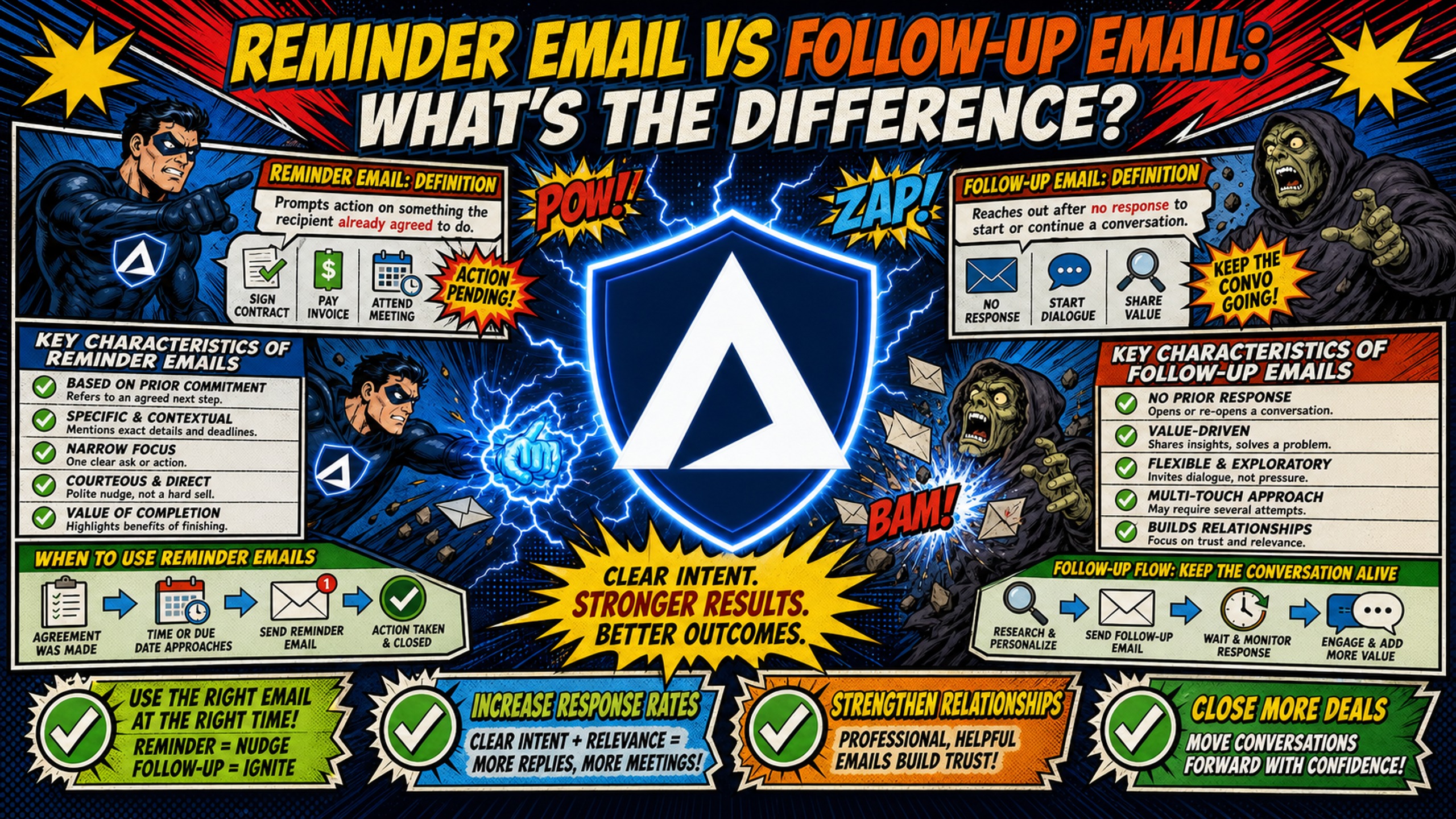
TL;DR: A reminder email prompts action on something the recipient already agreed to do, like signing a contract, paying an invoice, or attending a meeting. A follow-up email continues a conversation where no prior commitment exists, typically in cold outreach or post-proposal nurturing. The distinction matters because the two workflows require different infrastructure approaches. Agencies running both workflows on the same IP pool risk reputation contamination, making technical separation a smart choice, especially once a mid-funnel deal moves from "still deciding" to "has a deadline."
Many B2B agencies treat reminders and follow-ups as interchangeable. Sending a reminder to a cold prospect who never agreed to anything can read as presumptuous. Sending a soft follow-up when a signed contract deadline has passed can look disorganized and lose the deal. The gap between the two is wide, and this guide draws a clear line between both.
Reminder email: definition
A reminder email is a short, professional message sent to prompt someone to complete an action or acknowledge something previously discussed. The key word is "previously." A reminder typically makes most sense when the recipient has already agreed to take a specific action and a deadline tied to that action exists.
A reminder generally works through accountability, not persuasion. You're typically not asking the recipient to make a new decision. You're nudging them to follow through on a decision they already made. That distinction changes the tone, the structure, and the acceptable frequency of the message entirely.
Key characteristics of reminder emails
Reminder emails share a consistent set of structural markers that separate them from follow-ups:
- Clear deadline reference: The email typically names a specific date, time, or event.
- Specific call-to-action: Generally one action only, sign here, pay this invoice, attend this call.
- Transactional tone: Often direct and neutral, not conversational or exploratory.
- Reference to a prior agreement: The email often explicitly connects back to something already confirmed.
- Short body copy: Usually no additional selling, just the nudge toward the agreed action.
Phrases like "Just a quick reminder" or "Following up on [project name]" can create a neutral, professional tone. Including the word "Reminder" in the subject line can signal importance when an email carries real urgency.
When to use reminder emails
Use a reminder email in these specific scenarios:
Reminder emails typically fit these specific scenarios:
- A signed proposal requires payment by a stated date and the due date is approaching.
- A prospect confirmed a discovery call but hasn't sent calendar confirmation.
- A client needs to return signed onboarding documents before campaign setup begins.
- A contract renewal date is 48 hours away and no action has been taken.
- A scheduled onboarding deadline is approaching and no confirmation has been received.
In every case, the recipient has already said yes to something. The reminder typically exists because life gets busy, not because a decision is still open.
Follow-up email: definition
A follow-up email continues a conversation rather than referencing a deadline or agreed-upon action. It adds momentum to an ongoing dialogue, introduces new value, or resurfaces a cold thread to elicit a response where none has come. Unlike a reminder, it typically does not require a prior commitment from the recipient.
The psychological mechanism here differs from a reminder. A follow-up often asks the recipient to make a new micro-decision: is this worth responding to? That means the email needs to earn its place in the inbox by adding something new, whether that's a relevant case study, a sharper version of the original ask, or a simpler path to a yes. Many practitioners recommend opening with brief context from the prior message so the recipient can orient themselves, even without a formal commitment behind that prior exchange.
Boomerang's sequence logic captures a key protection mechanism: if the person replies to your original email, Boomerang detects the response and stops the sequence. If they don't reply, the follow-up sends automatically. That reply-detection behavior is fundamental to protecting sender reputation, because a follow-up that sends after a reply has already arrived degrades engagement metrics and looks like automated pressure rather than genuine outreach.
Key characteristics of follow-up emails
Follow-up emails operate on different principles than reminders:
- Value-first approach: The email often opens with something useful, a data point, a relevant result, or a sharper angle on the original pitch.
- Conversational tone: Generally warmer and less transactional, designed to feel like a continuation of dialogue.
- Specific, low-friction ask: A direct question or clear next step that the recipient can answer in seconds performs better than open-ended requests like "what are your thoughts?" which are expensive to produce and reduce reply rates.
- Flexible timing: Typically spaced to maintain momentum without feeling like automated pressure.
- No prior commitment: There is usually no agreed-upon action. The follow-up often acknowledges that the recipient hasn't made a decision yet, though it typically references the prior conversation for context.
Backlinko and Pitchbox's 12-million-email outreach study found that a single follow-up lifts reply rates by 65.8%, making a structured sequence essential for any agency running outreach at scale. Inframail's B2B cold email response rate guide covers what separates average campaigns from top performers.
When to use follow-up emails
Follow-ups fit these scenarios well:
Follow-ups typically fit these scenarios well:
- You sent a cold outreach email 3-5 days ago and received no reply.
- A prospect asked for time to think after a discovery call but hasn't responded since.
- You sent a proposal and the decision window has passed without feedback.
- A warm lead went quiet after showing initial interest.
- You're nurturing a contact who isn't ready to buy yet but fits your ideal customer profile (ICP). The common thread: no prior commitment exists. You're continuing a conversation, not enforcing an agreement.
Reminder vs follow-up: side-by-side comparison
The table below compares the two formats across the metrics that matter most for agency outreach planning.
| Metric | Reminder email | Follow-up email |
|---|---|---|
| Average response rate | Varies by context and relationship | Follow-ups consistently improve reply rates compared to single-send campaigns. Exact figures vary by industry and list quality |
| Typical delay between sends | Often 24-48 hours before deadline | Commonly 3-5 business days between touches |
| Primary goal | Prompt a committed action | Continue a conversation, earn a response |
| Tone | Direct, transactional | Conversational, value-driven |
| Prior commitment required | Yes | No |
| Sequence length | Often 2-3 maximum before escalating | 2-3 across the full cadence |
| Spam risk | Low when used correctly | Higher if poorly timed or over-sequenced |
Tone and purpose
The tone difference between these two formats reflects a fundamentally different relationship with the recipient. A reminder references an agreement, which typically makes a direct, transactional tone appropriate.
A follow-up carries no such authority. The sender is still earning attention. A follow-up written in a reminder tone ("As discussed, I'm checking in on your decision...") when no discussion actually happened can damage credibility, and genuine cold outreach depends on the email feeling like a person-to-person message rather than automated pressure.
Timing and context
Reminders are deadline-anchored. Sending a polite reminder two to three business days before the action is due, with a final nudge 24 hours before, is commonly recommended. Sending earlier can dilute urgency, and sending after a missed deadline without acknowledgment can signal poor account management.
Follow-ups run on a different clock. Space them 3-5 days apart to maintain presence without triggering spam filters from high-frequency sends. Belkins' 2025 B2B follow-up study shows that 2-3 follow-ups deliver the highest reply rates, while sequences beyond that point see diminishing returns and increased spam complaint risk.
Expected recipient action
A reminder expects a binary action: sign the document, transfer the funds, or click to confirm the meeting. The ask is specific, the path is clear, and the recipient has already committed to taking it.
A follow-up invites a specific response. A 304,000-email study by GrowLeads found that open-ended requests like "what are your thoughts?" fail because they are expensive to produce, while narrowing the ask to one decision the reader can make in seconds performs better. A direct question or clear next step works better than vague exploration. A follow-up written with a binary demand when no prior agreement exists can push cold prospects away and may elevate spam report risk.
How to choose the right format
The decision between a reminder and a follow-up comes down to one question: has the recipient already agreed to take a specific action?
| Scenario | Sales cycle stage | Right format | Reason |
|---|---|---|---|
| Signed proposal, invoice pending | Post-close | Reminder | Prior commitment exists |
| Cold outreach, no reply | Top of funnel | Follow-up | No prior agreement |
| Discovery call confirmed, no calendar invite | Pre-call | Reminder | Action already agreed |
| Proposal sent, no decision | Mid-funnel | Follow-up | Decision still open |
| Contract sent, deadline approaching | Late-stage | Reminder | Deadline tied to agreement |
| Warm lead gone quiet | Nurture | Follow-up | Re-engage without pressure |
| Onboarding docs pending signature | Post-sale | Reminder | Required action, prior agreement |
| Post-proposal check-in, no urgency | Mid-funnel | Follow-up | Conversational momentum needed |
When the recipient already agreed
When a recipient has committed to a specific action, only a reminder is appropriate. Using a follow-up in this scenario ("Just wanted to check in on where things stand...") can signal that you've lost track of the conversation and don't remember they already said yes. That can erode trust faster than a missed deadline. A reminder is the professional choice because it reflects that you took the original agreement seriously.
When you're continuing a conversation
Follow-ups carry a relationship-building function that reminders can't replicate. When no prior commitment exists, adding value to each touch is the only way to justify continued contact. A relevant case study, a sharper version of the original ask, or a reference to something specific about the recipient's business all perform better than a generic "just bumping this." The Inframail channel covers how to structure cold email calls to action (CTAs) that move conversations forward without feeling pushy.
When you're waiting on a decision
Mid-funnel prospects who've seen a proposal but haven't responded occupy the grey zone where the line between reminder and follow-up blurs. The deciding factor is whether a specific deadline exists. If a proposal expiry date was set and agreed to, a reminder is appropriate as that date approaches. If no deadline was set, a follow-up that adds context, addresses a likely objection, or offers a lower-commitment next step works better. Defaulting to a reminder tone when the decision is still genuinely open pushes mid-funnel prospects away rather than pulling them closer.
Example: the same message as a reminder
A prospect confirmed an onboarding call for Tuesday at 2pm but hasn't sent a calendar confirmation. Here's how that message looks as a reminder.
Subject: Onboarding call Tuesday 2pm - calendar confirmation
Hi [First Name],
Quick note to confirm our onboarding call scheduled for Tuesday, [Date] at 2:00pm ET. Please [use this link] to add it to your calendar and confirm your attendance.
If Tuesday no longer works, reply here and we'll find a time that does.
Looking forward to it.
[Signature]
Reminder subject line approach
Keeping reminder subject lines 3-7 words and under 30 characters where possible can help ensure the full line appears on mobile. The example above names the event and the date directly, which is the core function of a reminder subject line: orient the recipient immediately to what requires their action. No curiosity gap. No teaser. Just the fact.
Reminder body structure
The body does three things and nothing else: confirm the commitment, provide the action path, and offer an escape valve if the original time no longer works. A well-structured reminder avoids sounding rude or desperate by keeping the tone neutral and forward-looking rather than pressuring or apologetic.
Example: the same message as a follow-up
The same core situation, a prospect who hasn't confirmed the next step, rewritten as a follow-up for a cold lead who expressed interest but made no commitment.
Subject: Quick result worth sharing
Hi [First Name],
After your message last week, I pulled one result worth sharing: Steven, who runs an agency in a comparable space, doubled his MRR in 60 days after switching his cold email infrastructure.
If that's a problem you're also running into, a 20-minute call could be worth the time. Happy to work around your schedule this week or next.
[Signature]
Follow-up subject line approach
Curiosity-driven subject lines often outperform direct ones in cold outreach because they earn the open rather than demanding it. The example above uses a trigger-event reference without giving everything away in the subject, which pushes the open rate while the body delivers the value. For top cold email subject line structures, Chris Bussing's breakdown of B2B tech subject lines is worth reviewing alongside this framework.
Follow-up body structure
The body leads with a specific result tied to a problem the prospect is likely facing, then makes a single, low-commitment ask. No deadline. No urgency. The open-ended close ("If that's a problem you're also running into...") invites a reply without demanding a binary decision. That structure aligns with Jeremy Miner's non-pushy outreach approach: give before you ask.
Common mistakes to avoid
The most expensive mistakes in email sequencing happen when agencies treat reminders and follow-ups as format options rather than distinct tools. Getting this wrong doesn't just hurt individual campaigns. It damages sender reputation at the infrastructure level, which cascades across every client campaign running on the same IP.
The global average inbox placement rate sits around 83% according to Validity's 2025 benchmark report, meaning roughly 1 in 6 emails never reaches the inbox even from established senders. A properly warmed domain with correct setup achieves substantially higher inbox placement and reply rates than a new domain with no warmup, with the gap large enough to make warmup a non-optional step before any live campaign. Poor sequence logic accelerates that decline by generating spam complaints that train mailbox providers to distrust the sending domain.
Using a reminder when no action was agreed
Sending a reminder to a cold prospect who never agreed to anything can generate spam complaints. The message implies an obligation that doesn't exist, which reads as either a mistake or a deliberate manipulation tactic. Cold prospects don't owe you a response. A message that assumes otherwise creates a gap between expectation and reality that many recipients resolve by clicking "Report spam" rather than simply ignoring it.
The same Validity report also shows that Microsoft's 75.6% placement rate lags well behind Europe's 89.1%, meaning infrastructure failures reduce campaign effectiveness before a single word of copy is changed.
Using a follow-up for time-sensitive commitments
A soft, conversational follow-up doesn't fit when a hard deadline is on the line. If an invoice is 10 days overdue and the message reads "Just wanted to check in and see where things stand," it doesn't match the urgency of the situation. A missed payment, an unsigned contract, or an expired domain authorization code requires a direct reminder, not an open-ended conversation starter.
Transactional emails need to be treated differently at the infrastructure level, not just the copy level, because their performance signals land differently with mailbox providers than cold outreach signals do.
Mixing both styles in one email
Combining reminder language ("As a reminder, we spoke last Tuesday about...") with follow-up logic ("I wanted to add some context that might help your decision...") in the same email creates confusion. The recipient can't tell whether they're being held to an obligation or invited into a conversation, so the call-to-action loses its clarity.
This mixing problem has a technical dimension that most agencies miss. Running transactional reminders and high-volume cold follow-ups on the same IP pool can mean that spam complaints from cold outreach directly contaminate the sender reputation tied to transactional messages. As Inframail's shared IP pool breakdown explains, when a bad actor on a shared pool hits spam traps or generates high complaint rates, the entire IP range can absorb the damage.
Inframail's dedicated IP infrastructure addresses this at the platform level. The Unlimited Plan ($129/month) provides 1 dedicated US-based IP, and the Agency Pack ($327/month) provides 3. Agencies can configure separate domains and inboxes for transactional reminder workflows and cold follow-up sequences, keeping the sending reputation of each isolated from the other. The platform auto-configures SPF, DKIM, and DMARC records (the DNS authentication records that verify sender identity and prevent spoofing) for every domain added, eliminating the 12+ hours of manual DNS panel work that typically blocks rapid domain provisioning.
For agencies currently on Google Workspace, the cost math is direct: 50 inboxes on Google Workspace costs $350-420/month at $7-8.40 per seat per Google's current pricing. Inframail's infrastructure drops that to $163/month (platform fee plus amortized domain costs), and a full total cost of ownership (TCO) breakdown shows $2,244-3,084 in annual savings at 50 inboxes before factoring in the time cost of manual DNS configuration. Warmup tools are a separate line item on both platforms, budgeted at $15-50/month per inbox depending on the tool.
Inframail integrates directly with Smartlead, Instantly.ai, and Reachinbox via IMAP (Internet Message Access Protocol) and SMTP (Simple Mail Transfer Protocol) credentials exported to CSV, so separate sending profiles for reminder and follow-up workflows can be segmented at the sequencer level while maintaining IP-level isolation at the infrastructure layer. Stopping sequences automatically upon reply, as Boomerang's mechanism demonstrates, is the final protection layer against sending follow-ups into threads that have already received a response.
Inframail's blacklist monitoring and automated delisting process reports a 68.3% delisting success rate within 48 hours. For agencies managing cold follow-up sequences at volume, that monitoring layer catches domain health issues before a client campaign goes dark. The Inframail infrastructure monitoring guide walks through how to set up health checks and alerts across a multi-domain portfolio.
For a current cost comparison across seven infrastructure platforms, Inframail's cold email infrastructure cost breakdown provides pricing benchmarks across Maildoso, Mailscale, and others. The dedicated vs. shared IP breakdown covers exactly how shared pools affect inbox placement rates relative to dedicated configurations. The Starter-Bench Rule video covers how to structure domain rotation to avoid triggering spam filters across high-volume cold follow-up sequences. Sign up to Inframail and get started today.
FAQs
Can a follow-up email include a reminder?
A follow-up can reference a previously agreed-upon resource or scheduled call, but the primary frame should remain conversational. If the reminder component takes over the tone, the email loses the open-ended quality that makes follow-ups effective.
How many reminders should you send?
Send 2-3 reminders for a single commitment before escalating to a direct conversation or a different channel. Beyond that threshold, continuing to send strains the relationship and increases the risk of spam complaints from transactional message fatigue.
What's the best timing for each type?
Send reminders 24-48 hours before the deadline, with an optional second reminder the morning of the due date. Space cold follow-ups 3-5 days apart, and keep the total cadence to 2-3 follow-ups, which Belkins' 2025 B2B follow-up study shows delivers the highest reply rates before diminishing returns set in.
Key terms glossary
Dedicated IP: An IP address used exclusively by one sender, ensuring their sending reputation is entirely under their own control and isn't affected by other senders on a shared pool.
Flat-rate pricing: A billing model where a single monthly fee covers unlimited usage, preventing infrastructure costs from scaling linearly with inbox or domain volume.
SPF/DKIM/DMARC: Technical DNS records that verify a sender's identity, prevent email spoofing, and protect inbox placement rates by signaling to mailbox providers that outgoing email is legitimate.