
Polite reminder email: How to write one without sounding pushy
A polite reminder email reportedly works not by apologizing more, but by removing friction from the recipient's decision to reply. The Easy Out technique (using
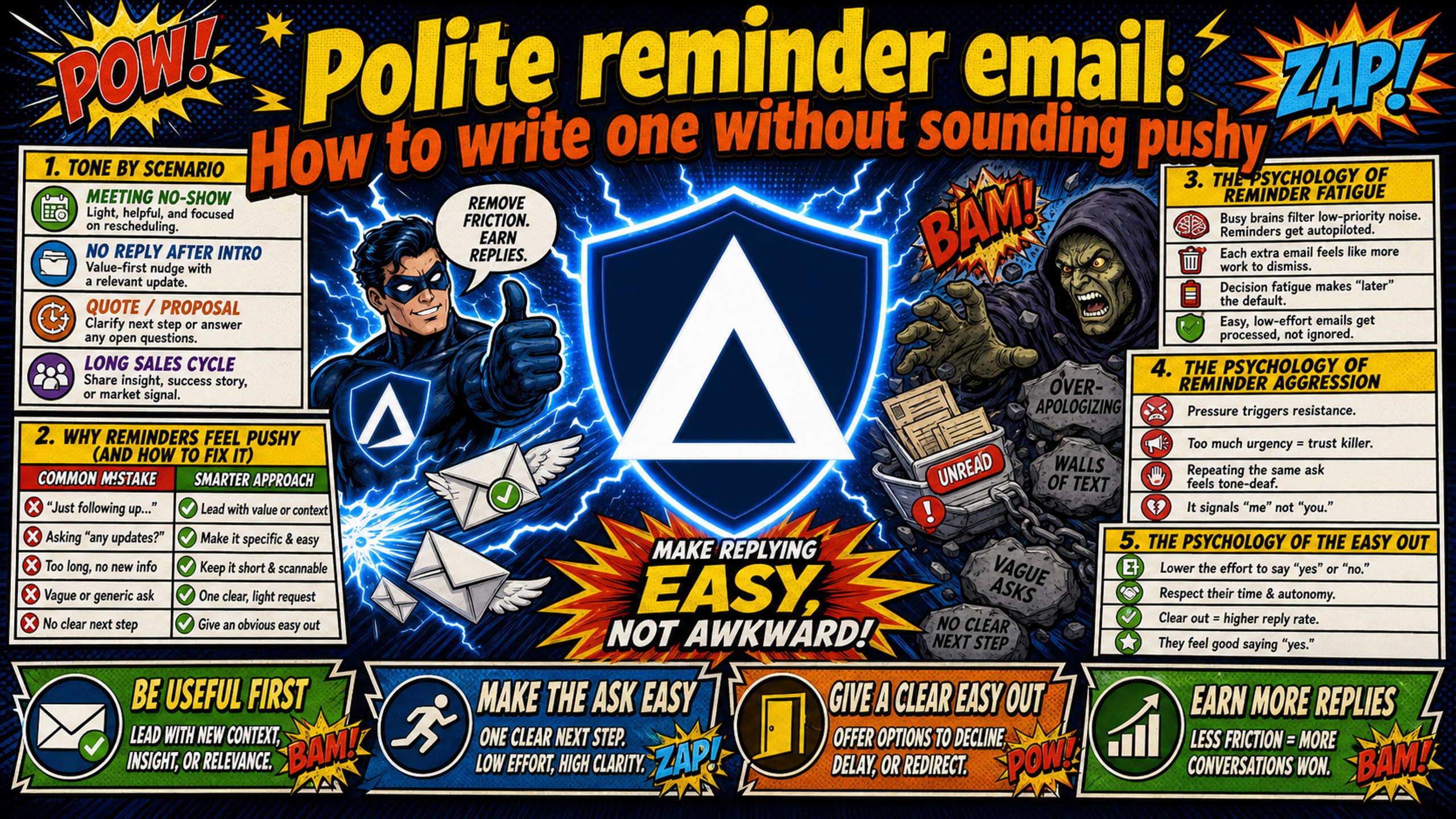
TL;DR: A polite reminder email reportedly works not by apologizing more, but by removing friction from the recipient's decision to reply. The Easy Out technique (using phrases like "Should I hold off on this for now?") is designed to reduce guilt-driven avoidance and potentially increase response rates. Keep follow-ups in the original thread to preserve context, and limit sequences to three touches over 2-3 weeks. Running those sequences across 50 inboxes on Google Workspace costs $350-$420/month in infrastructure. Inframail's flat-rate model at $129/month keeps that cost fixed regardless of inbox count, which matters when sequences are running across dozens of client accounts simultaneously.
Most reminder emails fail at the first word. The sender either over-apologizes, which signals the message isn't worth reading, or leans on urgency that hasn't been earned, which triggers avoidance. The fix isn't a better subject line or a warmer sign-off. It's understanding what makes a recipient want to reply, and removing every obstacle between them and that response. This guide covers the psychological mechanics behind why reminders fail, provides copy-pasteable templates for client, vendor, and internal scenarios, and explains how agencies running multi-step sequences at scale can protect margins with flat-rate infrastructure.
Tone by scenario
The table below maps the right tone to the most common follow-up scenarios agencies encounter across client management, vendor coordination, and cold outreach sequences.
| Interval | Scenario | Tone focus | Example |
|---|---|---|---|
| 2-3 days | Urgent project blockers or time-sensitive client requests | Direct, action-oriented, low-pressure | "Just bringing this to the top of your inbox in case it slipped through." |
| 3-5 business days | Standard client follow-ups or non-urgent deliverables | Supportive, collaborative, structured | "Checking in to see if you need any additional data from our end to complete this." |
| Final touch | Cold outreach follow-ups or inactive leads | Low-friction, Easy Out framing | "Should I hold off on this project for now?" |
Every unreplied reminder represents a leak in your agency's client acquisition pipeline. The same friction that kills a cold outreach sequence also stalls a client deliverable request or a vendor follow-up, and agencies managing these threads across multiple accounts feel that cost multiply fast.
Why reminder emails feel pushy, and how to fix it
Two factors drive the pushiness problem: the psychological weight recipients place on unread messages, and the specific language patterns that trigger defensiveness. Both are fixable.
The psychology of reminder fatigue
Each unread message represents an unresolved social obligation. Research on unread email guilt and inbox anxiety shows constant email checkers report stress levels of 5.3 out of 10, compared to 4.4 for non-checkers. When a follow-up reads like a demand, even a politely worded one, the recipient enters avoidance mode. There's no clear upside to replying, so they don't. Understanding how no-response reminders trigger avoidance helps reframe the ask entirely.
The psychology of reminder aggression
Certain phrases signal frustration while maintaining plausible politeness. According to Preply's survey of 1,000 workers, "per my last email" is the single most passive-aggressive phrase in professional communication, with 83% of workers reporting they've received a passive-aggressive email at work. "As I already mentioned" and "just to clarify" carry the same undercurrent. These phrases feel polite but read as hostile, triggering defensiveness and reducing reply likelihood.
Artificial urgency compounds the problem. Starting a new email chain for each reminder can strip context, potentially forcing the recipient to reconstruct history and adding cognitive friction. Keeping follow-ups threaded in the original conversation may preserve context without adding work for the reader.
The psychology of the Easy Out
The most effective shift in reminder strategy is replacing nudges with exits. Giving someone a polite way to exit or defer reduces the guilt that drives avoidance. For a practical demonstration of how soft CTAs outperform hard ones, this cold email CTA breakdown from Inframail covers the mechanics directly.
The anatomy of a polite reminder email
Every element of a reminder email, from subject line to closing, either reduces friction or adds to it. The following breakdown covers each component in order.
Subject line best practices
A low-pressure subject line sets the tone before the recipient opens the email. Avoid subject lines that imply urgency you haven't earned. These five variations use the Easy Out principle to reduce friction at the first touchpoint:
- Quick update: [Project Name] (or should we pause?)
- [First Name], should we hold off on this for now?
- Following up on [Topic] / No rush
- Next steps for [Project Name] (when you have a moment)
- Checking in on [Topic] (is this still a priority?)
For more subject line frameworks built specifically for B2B outreach, this cold email subject line breakdown covers what works across different buyer types.
Opening lines that soften the ask
The opening line either validates the send or confirms the recipient's instinct to ignore it. Phrases like "I know you're busy" or "sorry to bother you again" can position the sender as a nuisance rather than a peer. The recipient may read that framing as confirmation that even the sender doesn't believe the message is worth their time.
Replace apologetic openers with context-setting openers: "Just bringing this to the top of your inbox" or "Wanted to make sure this didn't get buried" sets intent without guilt.
Body structure and tone
A polite reminder email has five components. Use this as a copy-paste template structure:
- Subject line: Low-pressure, contextual, Easy Out framing.
- Greeting: Professional and warm. First name only.
- Context: One sentence referencing the previous email or request.
- CTA: A single, low-friction action step or an explicit Easy Out.
- Sign-off: Short, professional, no pressure language.
Closing without pressure
The best closings make a small, specific ask or offer the reader an Easy Out. "Would you be open to a 15-minute conversation next week?" may perform better than "Let me know your thoughts" because it gives the recipient a defined action to approve or decline. Always reply within the original email thread. Starting a fresh chain for each follow-up removes context the recipient needs and adds friction that makes non-response easier.
Phrasing alternatives for common reminder scenarios
The right tone depends on the relationship and the stakes. Agencies managing reminder sequences across multiple clients and vendors need language that's consistent enough to scale but flexible enough to protect individual relationships. With long-term clients, you can be more direct. With new relationships or vendors you depend on, softer framing protects the partnership.
Client reminders: For outstanding invoices, skip the passive framing. Replace "Just a gentle reminder that your invoice is due" with "I've attached invoice #102 for your review. Let me know if you need any billing adjustments before the due date." The revised version removes the passive-aggressive implication and gives the client something specific to act on.
Vendor reminders: When chasing vendor updates, stay collaborative. "Any update on this?" can read as impatient. "When you have a moment, can you confirm where things stand on [deliverable]? Happy to provide any additional context from our end if it helps" shifts the dynamic to partnership rather than pressure.
Internal reminders: Internal reminders fail when they imply incompetence. "You still haven't sent the report" can create defensiveness. "Flagging [report name] for this afternoon, let me know if you're blocked on anything and I can help clear it" creates collaboration instead.
Tone comparison table
| Avoid this (passive, guilt-inducing) | Use this instead (professional, direct) | Why it works |
|---|---|---|
| "Just a gentle reminder that your invoice is due." | "I've attached invoice #102. Let me know if you need any billing adjustments." | Removes passive framing, focuses on helpful action. |
| "Checking in to see if you saw my last email." | "Bringing this to the top of your inbox. Should we hold off for now?" | Easy Out reduces recipient guilt and increases reply rates. |
| "Any update on this?" | "When you have a moment, let me know if you need additional data from our end." | Shifts burden back to sender, making it collaborative rather than demanding. |
Language patterns that maintain professional relationships
The difference between a reminder that preserves a relationship and one that strains it usually comes down to a handful of word choices. Below are the patterns that work and the ones to cut.
Softening phrases to use
Certain phrases signal respect for the recipient's time without apologizing for the outreach itself. These work across client, vendor, and internal contexts:
- "When you have a moment..."
- "No rush on this, but wanted to flag it..."
- "Happy to adjust timing if this week is difficult..."
- "Just bringing this back to your inbox in case it got buried..."
Words and phrases to avoid
Run every reminder draft against this checklist before sending:
- "As per my last email" - often signals frustration, not professionalism
- "I've already mentioned this" - can read as passive-aggressive and create defensiveness
- "Why haven't you responded?" - hostile framing that may increase avoidance
- "Sorry to bother you again" - apologizing for contacting a prospect is described as "poisonous" to follow-up emails, communicating that the sender's time is less valuable than the recipient's
- "I hate to keep emailing you" - may position your outreach as a nuisance before the recipient has formed that opinion
- "Just following up" as the entire opener - often vague, adds no context or value
This professional email authority piece is worth reading for anyone who defaults to sorry-heavy language in outreach. Jeremy Miner's sales training on non-response also covers the authority framing issue directly.
Acknowledging time constraints
Show awareness of the recipient's workload without making it the centerpiece of the email. One sentence is enough: "I know things get busy." After that, move directly to the ask or the Easy Out. Dwelling on their schedule signals that you don't expect a response, which becomes self-fulfilling.
When and how often to send reminders
Timing and frequency directly affect both reply rates and domain reputation. The guidelines below cover when to send, how long to wait between touches, and when to stop.
Timing your first reminder
For urgent project blockers or time-sensitive requests, follow up within 2-3 days. For standard deliverable requests or non-urgent client follow-ups, 3-5 business days gives the recipient time to act before the reminder arrives. For cold outreach, common verified cadences include the widening gap structure (Day 0, Day 3, Day 7, Day 14) and the 3-7-7 pattern (Day 3, Day 10, Day 17), which research suggests captures approximately 93% of total replies by Day 10.
Spacing between follow-ups
Beyond three total touches, engagement drops sharply and spam complaint rates rise. Each follow-up after the third sees roughly a 30% drop in effectiveness compared to the one before it, and a fourth or fifth touch measurably increases the likelihood of a spam flag, a pattern Apollo.io's reply rate research describes as a net-negative investment with lower reply probability and higher spam complaint risk. Avoiding aggressive follow-up sequences (five or more emails in rapid succession) may also help reduce unsubscribe rates, which protects domain reputation across active campaigns.
Stopping the sequence
The break-up email is the final touch in a sequence, and it generates better response rates than most senders expect. Final emails positioned as boundary-setting rather than desperation regularly re-engage prospects who were interested but hadn't prioritized replying, a pattern BillionVerify's cold email research describes as closing the loop professionally to trigger responses from prospects who intended to reply but hadn't. The structure that works: acknowledge you've reached out multiple times, validate their potential lack of interest, state this is your final email for now, and leave the door genuinely open.
For agency founders scaling multi-step sequences: High-volume follow-ups on per-seat accounts like Google Workspace Business Starter at $7-$8.40 per inbox compress margins fast. At 50 inboxes, that's $350-$420/month in infrastructure alone. As Inframail's cold email infrastructure pricing comparison details, scaling to 200 inboxes on Google Workspace pushes that to $1,400-$1,680/month, while Inframail's flat-rate Unlimited Plan at $129/month covers unlimited inboxes regardless of volume.
For monitoring inbox health across campaigns at scale, Inframail's infrastructure monitoring guide covers the health check framework agencies use to catch deliverability issues before clients do.
Polite reminder email templates you can use
These four templates cover the most common scenarios agencies face, with tone calibrated to the recipient relationship and stakes.
Template: Client payment reminder
Subject: Invoice #102 for [Project Name] (let me know if adjustments needed)
Hi [First Name],
Attaching invoice #102 for [project] here. Let me know if you need any changes before the due date, happy to adjust. If timing is an issue this month, just say the word and we can work something out.
[Your name]
Template: Waiting on client feedback
Subject: [Deliverable] ready for your review / no rush
Hi [First Name],
Bringing [deliverable] back to the top of your inbox. No pressure on timing, but once you have a moment to review, let me know if anything needs adjusting before we move to the next phase.
[Your name]
Template: Vendor response needed
Subject: Checking on [deliverable] status
Hi [First Name],
Just checking where things stand on [deliverable]. Happy to provide any additional context from our end if it helps move things forward. Let me know what works best for you.
[Your name]
Template: Internal team deadline
Subject: [Report name] for this afternoon
Hi [First Name],
Flagging [report] for today's deadline. If you're blocked on anything, let me know and I can help clear it. Otherwise, just confirming we're on track.
[Your name]
For more on improving the B2B cold email response rates that these sequences drive and a breakdown of sales email automation tools that handle multi-step cadences at scale, Inframail's blog covers both in detail. Scaling these sequences efficiently also means connecting infrastructure to a sending platform, and how to connect Inframail to Smartlead walks through that integration step by step.
Users running high-volume sequences on Inframail's infrastructure report strong deliverability performance when DNS configuration is properly managed from the start.
That deliverability performance depends on the underlying DNS (Domain Name System) configuration being correct from the start. Multi-step reminder sequences only protect domain reputation when SPF (Sender Policy Framework), DKIM (DomainKeys Identified Mail), and DMARC (Domain-based Message Authentication, Reporting, and Conformance) records are properly set up across every sending domain. Provisioning 50 domains manually takes 12+ hours of DNS panel work. Inframail automates that configuration entirely, covering the records that directly affect whether reminders land in inbox or spam.
Common mistakes that damage relationships
Certain habits show up repeatedly in reminder emails that underperform or damage working relationships. These are the most common ones and how to avoid them.
Being too apologetic
Phrases like "sorry to bother you again" and "I know I've been emailing you a lot" don't soften the ask. They tell the recipient that you doubt your own message's value, and HubSpot's sales blog confirms this positioning reduces perceived authority, noting it communicates that the sender's time is less valuable than the recipient's. State the ask, offer the Easy Out, and move on.
Using passive-aggressive language
Phrases that appear polite but carry frustration are more damaging than direct language because they create a negative emotional reaction the recipient can't quite name. Common passive-aggressive phrases include "per my last email" and "as previously mentioned," both listed in Preply's passive-aggressive email research. "Going forward, please..." in a corrective context carries the same weight, translated by Coburg Banks as a thinly veiled "you messed up, don't do it again." Replace blame-focused framing with action-focused framing: instead of "as I already mentioned," try "to make sure we're aligned, here's the key point."
Copying too many people
Adding a manager or additional stakeholder to a reminder CC line to create pressure triggers the bystander effect: each recipient assumes someone else will respond, so no one does. Worse, it permanently damages the working relationship with the primary contact. Keep reminders one-to-one unless the situation genuinely requires escalation.
Polite reminders that actually get replies come down to three things: removing guilt from the recipient's decision, keeping the ask specific and low-friction, and stopping before the sequence damages the relationship. Agencies that get this right and run these sequences at volume across dozens of client accounts need infrastructure that doesn't punish growth. Per-seat pricing on Google Workspace turns a well-executed reminder strategy into a margin problem as inbox counts grow.
Sign up to Inframail and get started today to run multi-step reminder sequences on flat-rate infrastructure, without per-seat costs scaling against your growth.
FAQs
How long should I wait before sending a reminder?
For urgent requests, waiting 2-3 days is commonly recommended. For standard deliverables and non-urgent follow-ups, 3-5 business days is a typical interval before the first reminder.
Should I apologize in a reminder email?
No. Phrases like "sorry to bother you" can reduce perceived sender authority and signal the message isn't worth the recipient's time. Use context-setting language instead, such as "bringing this back to your inbox."
How many follow-up emails should I send before stopping?
Three total touches is the standard ceiling for most B2B sequences. Beyond three follow-ups, engagement typically drops and spam complaints may rise, which can directly damage domain reputation across active campaigns.
What if they still don't respond?
Send a break-up email after your third or fourth touch. Acknowledge you've reached out multiple times, validate their potential lack of interest, state this is your last message for now, and leave the door open. Break-up emails can generate strong response rates from prospects who were interested but hadn't prioritized replying.
Key terms
Easy Out: A low-pressure phrase in a reminder email that gives the recipient a polite way to defer or decline, designed to reduce guilt-driven avoidance and potentially increase reply rates.
Recipient guilt: The anxiety often created by unresolved social obligations (unread or unreplied messages) that may lead recipients to avoid responding rather than engage.
Domain reputation: A measure of inbox placement trustworthiness assigned to a sending domain by email providers, directly affected by sending frequency, spam complaints, and DNS configuration (SPF, DKIM, DMARC).
Break-up email: A final message in a follow-up sequence that acknowledges non-response and signals the sender will not follow up again, often designed to trigger replies from interested but non-responsive prospects. Break-up emails can generate strong response rates, with BillionVerify's cold email research noting they trigger responses from prospects who intended to reply but hadn't prioritized it.