
Signs your startup has outgrown founder-led sales
: Founder-led sales has hit its ceiling when three measurable capacity signals appear: the founder spends 15 or more hours weekly on sales, deals involve 5 or m
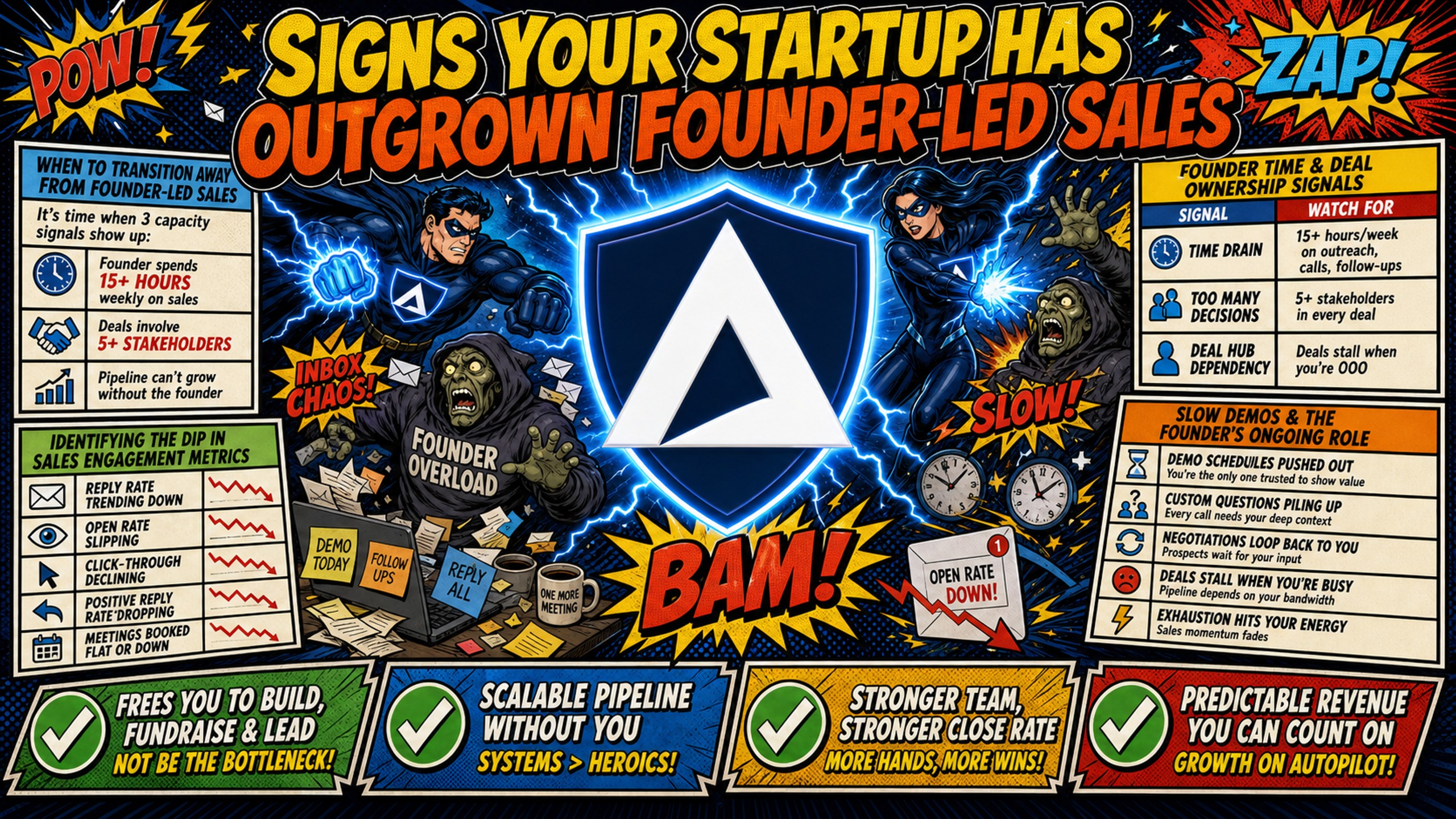
TL;DR: Founder-led sales has hit its ceiling when three measurable capacity signals appear: the founder spends 15 or more hours weekly on sales, deals involve 5 or more stakeholders or run past 90 days, and pipeline demand exceeds founder capacity. A reply rate below 3% while list quality stays constant is a separate signal. It should trigger a deliverability check first, because inbox placement and sender reputation problems are not fixed by hiring. Check the self-assessment below. If three or more capacity boxes apply, the bottleneck is your operating model, not your messaging, and the fix is adding capacity through a first rep backed by infrastructure that can spin up inboxes in minutes. Inframail automates SPF/DKIM/DMARC setup and prices inboxes flat at $147/month, so a new rep can start provisioning inboxes within minutes, without manual DNS work. Warmup still gates sending volume.
Founder-led sales works until the founder becomes the bottleneck, and the bottleneck shows up in the metrics before it shows up in the bank account. Most founders think they need better messaging when they actually need a better handoff.
This article gives you a diagnostic framework to recognize when founder-led sales has hit its ceiling, a self-assessment checklist with specific thresholds, and the infrastructure readiness steps you need before a new rep can start sending.
When to transition away from founder-led sales
Founder-led sales is a phase, not a permanent operating model. You'll know it's time to restructure when the founder's calendar becomes the constraint on growth, not market demand or product fit.
Founder time and deal ownership signals
Fifteen or more hours weekly on sales activities (about 37% of a 40-hour week) is the early warning threshold. If prospecting, outreach, discovery calls, demos, and closing consume that much time, the founder has become a salesperson who occasionally does founder things. Founders spending 60% or more of their week on sales activities (about 24 hours) have reached a severe capacity bottleneck, and the motion stops scaling.
Past roughly $1.5M ARR, founders still personally close the large majority of new business, but the time cost becomes unsustainable. The signal to act is when adding one more deal to the pipeline means pushing a product roadmap decision or skipping a key hire interview.
Slow demos and the founder's ongoing role
Move past founder-led sales when the founder's involvement in every deal creates more drag than value. If prospects regularly wait several days for a demo slot because the founder is the only one who can run it, deals are likely slowing down and you risk losing revenue to faster competitors.
The transition doesn't mean the founder exits sales entirely. SaaStr recommends staying involved in the biggest opportunities where founder credibility closes deals that a rep can't. The goal is adding capacity, not replacing judgment.
Identifying the dip in sales engagement metrics
Engagement metrics decline before revenue does. When reply rates and meeting bookings drop, founders often look at messaging first. The actual cause is often infrastructure and capacity limits.
Declining engagement in founder sales
The B2B cold email benchmark average sits at a 27.7% open rate and 3.43% reply rate in 2026. A reply rate above 5% puts you ahead of most senders, but if your reply rate drops below 3% while your list quality stays constant, check inbox placement and sending infrastructure before rewriting your copy.
Declining engagement often traces to inbox placement issues. When a founder runs outreach from a single domain or shared IP, sender reputation degrades as volume climbs. Inframail's 98%+ deliverability rate holds because the platform provisions dedicated IPs and automates blacklist monitoring with a 68.3% delisting success rate within 48 hours.
Sales friction from manual processes
Manual DNS configuration creates drag every time you add a domain or inbox. Setting up SPF, DKIM, and DMARC records manually takes about 45 minutes per domain, with most of that time spent waiting for propagation.
For 10 domains, that represents approximately 7.5 hours of combined setup and propagation time, although active configuration time may be lower. Inframail automates SPF/DKIM/DMARC configuration, and customer testimonials report 10 inboxes operational in 2 minutes. The time savings compound each time you add domains for a new rep, since manual setup repeats the same 45 minutes per domain.
Fewer meetings from qualified leads
If qualified leads stop converting to meetings, check your inbox placement rate before rewriting your pitch. A drop in meetings often signals that emails are landing in spam, not that prospects lost interest.
New inboxes often start around 10 to 20 sends a day and ramp up over four to eight weeks before reaching the safe daily ceiling. If you're sending from a single domain or a shared IP pool, your sender reputation is exposed to factors outside your control.
Scaling outbound sales beyond your personal reach
Outbound sales hits a ceiling when the founder's calendar can't absorb more meetings and manual processes can't keep pace with pipeline volume.
Scaling outbound when calendars hit capacity
A single inbox can sustain 30 to 40 cold emails per day at week 5 and beyond without triggering spam filters. If you need to send 200 emails daily to hit meeting targets, you need 5 to 7 warmed inboxes.
Founders often try to scale volume by pushing a single inbox harder, which degrades sender reputation and drops inbox placement. The safe ceiling for a single inbox is 30-40 emails per day at week 5 and beyond. Scaling means adding inboxes and domains, not increasing per-inbox volume.
Founder bandwidth stifles hiring speed
When the founder spends 15+ hours weekly on sales, there's no time left to recruit, interview, and onboard a first sales hire. The irony is that founder-led sales blocks the transition away from founder-led sales.
The average SaaS SDR base salary ranges from $50,000 to $68,000 in 2026. That works out to roughly $24 to $33 per hour in base pay (salary divided by 2,080 working hours, before benefits and taxes). If the founder's effective hourly rate (based on equity value and alternative uses of time) exceeds $150 per hour, every hour spent on prospecting costs more than delegating it to a rep.
When pipeline hygiene becomes a bottleneck
Pipeline hygiene breaks down when the founder relies on memory or scattered notes, and a spreadsheet can only work as a transitional tool. Missed follow-ups, stale CRM records, and unclear next steps signal that the founder can't manage volume manually anymore.
The shift from 10 active conversations to 30 requires a system, not more founder hours. If follow-up emails slip by 48 hours because the founder was in back-to-back demos, pipeline velocity drops and prospects go cold.
Why sophisticated deals demand new tactics
Enterprise deals require multi-threading, longer cycles, and coordinated follow-up across stakeholders. A founder running solo can manage that complexity at small volumes, but it gets harder as the number of active deals and stakeholders grows.
Why enterprise buyers demand sales teams
Buying committees have grown to an average of 6-10 stakeholders per deal, and 77% of buyers describe their evaluation as complex. Enterprise sales cycles can extend up to 6 to 12 months for enterprise-level contracts, with multi-threaded relationships across the buying committee.
Multi-threaded deals close at 30% versus 5% for single-thread deals. A founder who owns every relationship can't build parallel connections across finance, IT, operations, and end users while also running the company.
Why complex deals need a sales team
Complex deals need a sales team because different stakeholders require different conversations at different times. The CFO wants ROI proof, the CTO wants integration docs, and the end user wants a demo. A founder can deliver all three across 15 active opportunities, but at 30 active opportunities deals start slipping.
When deal size crosses $50,000 annually, buyers expect a dedicated account executive, a solutions engineer for technical validation, and a customer success manager for onboarding. A founder wearing all three hats creates a single point of failure.
When to hire for high-touch selling
Hire for high-touch selling when deal complexity requires parallel workstreams. If a single deal demands a technical deep-dive, a business case review, and a security audit within the same two-week window, you need more than one person on the account.
The signal is when the founder starts dropping balls. If a prospect asks for a reference call and it takes several days to schedule because the founder is closing another deal, you risk losing momentum to competitors with dedicated teams.
Missing quotas: a trigger to scale outbound
Missing quota isn't always a messaging problem. When outbound volume caps below the level required to hit meeting targets, the constraint is infrastructure capacity, not copy quality.
Outbound volume hits a scaling wall
The safe strategy is to send 30 to 40 cold emails per day per warmed inbox and scale by adding inboxes and domains instead of pushing single-inbox volume. If you need 500 daily sends to hit 10 meetings weekly, you need 13 to 17 warmed inboxes.
Google Workspace charges $8.40 per user per month on the Flexible Plan. For 50 inboxes, that's $420/month. For 200 inboxes, it's $1,680/month. Inframail's flat-rate pricing is $147/month for unlimited inboxes, so infrastructure cost stays flat as volume scales.
| Inboxes | Google Workspace (Flexible) | Inframail (Flat-Rate) | Monthly Savings |
|---|---|---|---|
| 50 | $420/month ($8.40 × 50) | $147/month | $273 |
| 100 | $840/month ($8.40 × 100) | $147/month | $693 |
| 200 | $1,680/month ($8.40 × 200) | $147/month | $1,533 |
Domain costs ($5 to $16 per domain per year) and warmup tools (typically $15 to $50 per inbox per month) apply on both sides and are not included in this comparison.
Why manual lead vetting breaks down
Manual lead vetting breaks down when the founder reviews every prospect before adding them to a sequence. At 50 leads weekly, that's manageable. At 200 leads weekly, it consumes 6 to 8 hours of founder time.
The fix is codifying qualification criteria so a rep can vet leads against a checklist. If the founder can't articulate what makes a lead qualified in under 60 seconds, the criteria aren't ready to hand off.
Fix pipeline gaps to scale revenue
Pipeline gaps appear when outbound volume can't keep pace with churn and deal velocity. If you need 15 new opportunities monthly to hit growth targets and the founder can only generate 8, the gap widens every month.
The tactical fix is adding sending capacity before hiring a closer. A first SDR can run outbound sequences and book meetings for the founder to close, which adds pipeline volume without requiring the founder to exit sales immediately.
5 signs you must transition away from founder sales
Use this self-assessment checklist to identify where founder-led sales is breaking. If you check three or more capacity boxes, the bottleneck is structural, not temporary. Treat a reply rate drop as a prompt to investigate deliverability, not as proof that you need to hire.
Founder bottlenecks in outbound
The founder becomes the bottleneck when every deal requires founder involvement to advance. If prospects won't take a meeting unless the founder is on the call, you've built a dependency that caps growth.
Founders bring unique credibility to enterprise deals, but that credibility should close deals, not open them. A first rep can run discovery and qualification, freeing the founder to join at the demo or proposal stage.
Identifying sales conversion bottlenecks
Sales conversion bottlenecks show up in stage-to-stage conversion rates. If discovery-to-demo conversion is 60% but demo-to-proposal is 15%, the drop signals a handoff problem or a skill gap, not a lead quality issue.
Track conversion by stage weekly. When the founder is the only one running demos, calendar availability becomes the constraint. Adding a rep who can run first demos can raise throughput without adding founder hours, though the size of the gain depends on your deal volume and how well the handoff works.
Identifying deal friction and buyer intent
Deal friction appears when prospects ask for something the founder can't deliver quickly. Common friction points: technical validation calls, reference requests, security reviews, and procurement processes.
Buyer intent signals (reply speed, meeting acceptance rate, stakeholder additions) tell you when a deal is real. If the founder can't respond to high-intent signals within 24 hours because of competing priorities, deals stall and competitors step in.
Checklist for hiring your first rep
Use this checklist to decide if you're ready to hire. As a rule of thumb, if you answer yes to three or more of the capacity items, it's likely time to start recruiting. Count the engagement dip only after inbox placement and sender reputation checks come back healthy.
- Engagement dip (investigate first): Reply rate below 3% for two consecutive weeks while list quality stays constant. Check inbox placement and sender reputation before counting this item, since deliverability problems are not solved by hiring.
- Founder bandwidth: Founder spending 15+ hours weekly on sales activities.
- Deal complexity: Average deal involves 5+ stakeholders or cycle length exceeds 90 days.
- Pipeline volume: Need 20+ meetings monthly to hit growth targets but founder capacity caps at 12.
- Infrastructure readiness: Can provision 10 inboxes in under 48 hours, with authentication configured and warmup initiated before scaling sending volume.
Before your first rep starts, confirm infrastructure readiness. Inframail's automated DNS setup configures SPF, DKIM, and DMARC records without manual panel work, so a new rep can get infrastructure operational on dedicated IPs within minutes, not weeks. Sending volume still ramps up through warmup.
"We spent months hunting for a reliable cold-emailing stack. After repeated failures with another provider, we trialled two options Inframail and a competitor. We chose the competitor. A month later, we switched back to Inframail. Zero issues since. Rock-solid infrastructure, sharp support, genuinely dependable. Highly recommended." - Verified user review of Inframail
Get your outbound infrastructure ready
Inframail is a flat-rate Microsoft email infrastructure provider for teams running cold email at scale. The platform automates SPF/DKIM/DMARC configuration and includes dedicated IP infrastructure. Pricing is $147/month for unlimited inboxes (before domain and warmup costs).
In this case study video, watch how Inframail helped a client quickly set up domains and improve cold email deliverability across three agencies and their clients, supporting a lead generation operation that books 5–7 appointments per day.
Sign up to Inframail and get started today.
FAQs
What are the signs you need to hire sales?
The signs you need to hire sales are: founder spending 15+ hours weekly on sales, deals requiring 5+ stakeholders, pipeline demand exceeding founder capacity, and infrastructure that can't spin up new inboxes in under 48 hours. Reply rates below 3% for two weeks should trigger a deliverability check first, since inbox placement and sender reputation problems are not solved by hiring.
When should a founder stop doing sales?
A founder should stop doing sales when the founder's calendar becomes the constraint on growth. Fifteen or more hours weekly on sales is the early warning, and more than 60% of working hours signals a severe capacity bottleneck. Deal complexity that requires parallel workstreams a single person can't manage is another trigger.
Can founder-led sales work at scale?
Founder-led sales works at scale only if the founder transitions from running every deal to closing the biggest deals while a team handles discovery, qualification, and multi-threading across buying committees of 6-10 stakeholders.
How do I know if my outbound sales problem is messaging or infrastructure?
If reply rates drop below 3% while list quality and messaging stay constant, the problem is likely infrastructure (inbox placement, sender reputation, or DNS configuration), not copy. Test by checking inbox placement rate before rewriting sequences.
What does it cost to add a sales rep compared to founder time?
The average SaaS SDR base salary is $50,000 to $68,000 annually (roughly $24 to $33 per hour in base pay, before benefits and taxes), while a founder's effective hourly rate based on equity value often exceeds $150 per hour. At those rates, delegating prospecting and qualification work saves roughly $117 to $126 for every hour handed off.
Key terms glossary
Reply rate: The percentage of cold emails that receive a response. The 2026 B2B benchmark average is 3.43%, with 5% or higher considered strong performance.
Inbox placement rate: The percentage of sent emails that land in the recipient's primary inbox rather than spam or promotions folders. Inframail publishes a 98%+ deliverability rate based on dedicated IP infrastructure and automated blacklist monitoring.
SPF/DKIM/DMARC: Three DNS authentication records that verify sender identity and prevent spoofing. SPF specifies which servers can send for your domain, DKIM adds a cryptographic signature, and DMARC tells receiving servers how to handle failures.
Dedicated IP: An IP address used exclusively by one sender, isolating sender reputation from other users. Shared IP pools expose your reputation to the behavior of other senders on the same IP range.
Warmup: The process of gradually increasing send volume from a new inbox over 2-4 weeks to build sender reputation before launching full campaigns. External warmup tools typically cost $15-50 per inbox per month.