
Professional email opening phrases that don't sound robotic
Non-robotic openers work because they read as written by a human for one specific recipient, not a mail merge. Four types perform consistently: observation-base
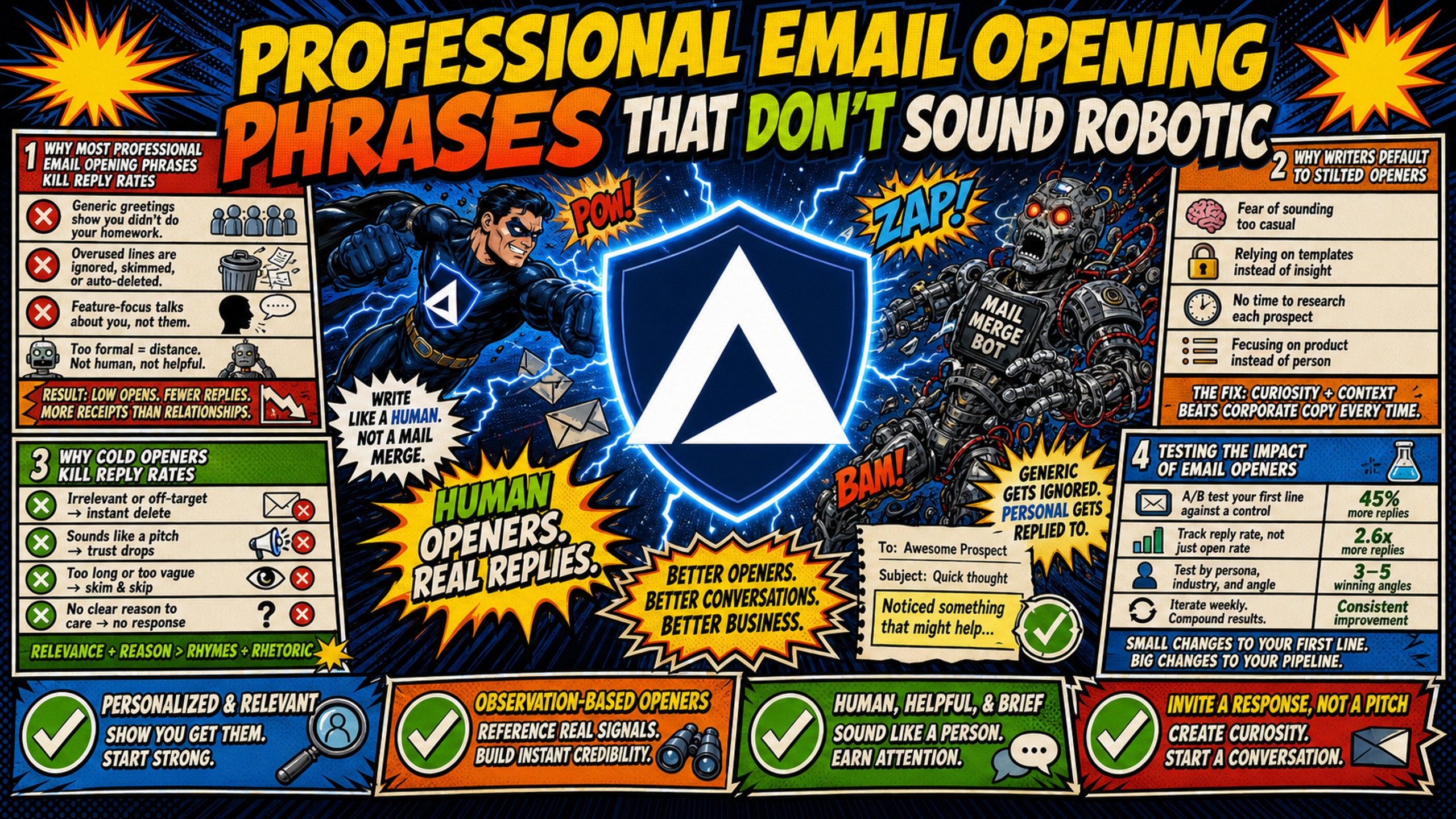
TL;DR: Non-robotic openers work because they read as written by a human for one specific recipient, not a mail merge. Four types perform consistently: observation-based openers that reference something real about the prospect, warm introductions built on genuine shared context, timely hooks tied to recent news or funding, and value-first questions that state the pitch immediately. Generic greetings like "Dear Sir/Madam" and filler phrases like "I hope this finds you well" read as mass outreach and trigger both recipient skepticism and ESP spam filtering. The only reliable way to know which opener works for a given audience is to A/B test it against a real baseline, and Inframail's flat-rate unlimited-inbox model lets campaign managers run that testing across dedicated inboxes without per-seat costs eating into the results.
Most professional email openers read like they were written by a compliance team, and reply rates show it. When you send thousands of cold emails across multiple domains, the opening line is often the first thing a prospect sees, and the first thing that triggers a mental spam filter. The difference between a 3% reply rate and a 6% reply rate can come down to whether your opener sounds like a human or a mail merge.
The opener is not the most important part of your email, but it is the part most likely to get you marked as spam before the body is read. Most opener advice treats this as an etiquette problem (be warmer, be more personal). That misses the point. Generic greetings reportedly signal mass outreach, trigger recipient skepticism, and damage your sender reputation before your value proposition ever gets a chance. This is a deliverability and conversion problem, and the fix is not more formality.
The fix is scenario-specific openers that lead with value or observation, tested systematically across your sending infrastructure to find what actually lifts reply rates.
Why most professional email opening phrases kill reply rates
These are the patterns that consistently suppress reply rates. Each section below covers a specific failure mode, what causes it, and the evidence behind the drop.
Why writers default to stilted openers
Writers default to formal templates under pressure, especially when launching a campaign for a new client or spinning up 50 domains for a product line. The temptation is to reach for the safest, most professional-sounding opener because it feels risk-averse. The cost is that formal openers read as mass outreach, and mass outreach reads as spam to both ESPs and human recipients.
Why cold openers kill reply rates
Cold openers signal low effort on two levels, according to deliverability research. First, generic mass-sent emails that get ignored or reported push senders toward Google's spam-rate thresholds, and Gmail's sender guidelines are explicit that sustained complaint rates above the safe 0.1% threshold move senders toward the 0.3% hard limit Google enforces. Second, recipients overwhelmed by generic emails become annoyed and ignore, delete, or mark emails as spam, which increases spam complaints and hurts deliverability, as GetResponse's spam trigger analysis explains.
When recipients frequently ignore or delete emails, Internet Service Providers interpret this as a sign that content is unwanted, according to GetResponse's spam trigger analysis. High spam complaints are toxic to sender reputation. Gmail's sender guidelines set 0.1% as the safe complaint threshold and treat 0.3% as the hard limit senders should never reach, so even a fraction of a percent in complaints is a real risk.
Testing the impact of email openers
Conversational greetings outperform generic ones by up to 18% in open rates. This is an industry benchmark, not a universal truth, but it demonstrates the measurable impact of opener choice.
Teams using specific, signal-grounded personalization can reach reply rates well above the 3.43% average, Salesmotion states, though the figures cited across sources vary and should be treated as directional rather than benchmarks. Generic openers like "Greetings," "Salutations," and "Dear Valued Customer" sound robotic across all industries, as Instantly's email greeting mistakes guide documents.
What are professional email opening phrases that actually work?
Professional email opening phrases are typically the first sentence or two of your email that establish context, credibility, or curiosity without sounding like a template. They work because they signal that a human wrote this specific email for this specific recipient, not that a mail merge fired off to 10,000 contacts.
Establishing credibility through empathy
Openers that acknowledge the recipient's context without flattery work because they demonstrate awareness without desperation. The key is specificity.
Natural email openers that drive replies
Effective openers fall into four categories, each mapped to a specific outreach scenario. Use this framework as a starting point to map opener type to your outreach scenario:
| Opener Type | Scenario | Example Phrase |
|---|---|---|
| Observation-based | Cold outreach | "I noticed your team just expanded into the enterprise segment" |
| Warm introduction | Mutual connection | "We have something in common, we both are Brown alumni" |
| Timely hook | Trigger event | "Congrats on the recent Series B funding" |
| Value-first | Direct pitch | "Quick question: Are you finding that your current onboarding process is scaling effectively?" |
Stiff email openers to cut from your sequences
Certain openers appear in cold email sequences so often they have stopped working entirely. The sections below cover the specific phrases to cut and what to replace them with.
Why generic greetings kill reply rates
"Dear Sir/Madam" and "To whom it may concern" signal mass outreach and immediately put your reader on the defensive. These greetings communicate, with certainty, that the sender does not know who the recipient is, which is the fastest way to lose a reply before the body is read.
Why 'reaching out' kills reply rates
According to Serif's guide on email openers, "I'm reaching out" delays the value proposition and can signal low effort. "I hope you're doing well" signals nothing about the relationship and adds no value.
Why filler phrases hurt deliverability
"I hope this finds you well" reads like the official opening line of robots, 19th-century aristocrats, and people who have no idea who you are, according to Topo's analysis of AI email generation. Cold email opening lines that include pleasantries and generic follow-up phrases waste real estate, add no value, and activate recipients' mental spam filters, according to Mixmax's cold email analysis.
Excessive filler can trigger spam filters because it matches patterns to known mass outreach templates. When the same generic email is sent as a blast and recipients ignore or report it, senders move toward the complaint thresholds Google's sender guidelines identify as the boundary between inbox delivery and blacklisting.
Better alternatives to circling back
Replace "circling back" with a specific reference to prior context. "Just following up," "touching base," and "checking in" are overused to the point of invisibility, according to Prospeo's follow-up email guide. They should be replaced with a specific purpose for writing.
How to sound human when following up
Follow-up openers that reference the previous touchpoint naturally work better than generic check-ins. "Just checking in!" is vacuous on its own and should be replaced with specific detail like "Just checking in on the contract, any movement?" according to SayMail's opening lines alternatives.
6 humanized openers to boost campaign response
Each opener type below maps to a specific outreach scenario. Use them as a starting point, then A/B test against your baseline to confirm which drives replies for your audience.
Using observation to build rapport
Opener examples based on a prospect's recent activity or content work because they demonstrate genuine interest. "I saw your recent post about the challenges of scaling SDR teams and it resonated with what we're seeing across our client base" is specific, relevant, and human. Observation beats flattery because it shows you did your homework, and according to Growbots' cold email opener analysis, observation-based openers that reference specific facts about the prospect's organization outperform generic greetings.
Using warm introductions in cold email
Referencing a mutual connection or shared context works when done naturally. According to Growbots' research, effective phrases include "We have something in common, both are Brown alumni!" or "I wanted to reach out because I noticed that you are also a member of [industry group]." These work because they establish common ground without name-dropping awkwardly.
Opening emails with timely hooks
News, funding announcements, or industry events as openers work because they are timely and relevant. A recent promotion or award is a natural opening, according to Growbots, because LinkedIn makes this easy by updating contacts' recent job changes and promotions.
The relevance window matters because stale hooks signal that you are using old data or a template. Practitioners typically recommend referencing recent events to maintain credibility, and according to Sendr's cold email analysis, timely hooks can shift a generic cold email into a consultative conversation that lands clients more effectively.
Crafting openers that state your value fast
Value-first openers that lead with the outcome work for B2B SaaS and agency contexts. "Quick question: With your recent expansion into the Enterprise segment, are you finding that your current customer onboarding process is scaling effectively, or are you seeing bottlenecks?" is an example from Fundraise Insider's guide.
The key is to make the value proposition clear in the first sentence. Starting a cold email with a question can spark prospect interest and immediately signal that this is not a generic blast.
Warm follow-up openers that drive replies
Follow-up context is different from cold outreach. The openers that work here reference the prior touchpoint specifically rather than defaulting to check-in language that signals low effort.
Humanizing post-meeting email openers
Openers that reference the meeting naturally without "great speaking with you" work because they show you were paying attention to specific details, not just going through the motions. According to Prospeo's follow-up email guide, an effective structure is: "Great conversation yesterday, especially your question about [specific topic they raised]. I pulled together a short case study from a similar team that cut their [metric] by 30% after implementing."
How to sound authentic in follow-ups
Specificity wins in follow-ups because it shows you remember the context. According to Serif's guide, effective phrases include "I'm following up on my note from [date] about [subject]" or "Checking in on [project/request], has anything changed on your end?" Soft openers like "circling back gently" or "keeping this on your radar" read as warm without being pushy, as Continuas' polite follow-up guide documents.
How to open referral follow-up emails
Openers that acknowledge the referral source without awkwardness work best. "I saw [something about them, a LinkedIn post, a company announcement, an article they wrote] and wanted to reach out" or "We haven't talked since [context], I hope [whatever was happening then] went well" are examples from Serif's guide.
For meeting scheduling follow-ups, use a real constraint without sounding pushy: "I'm finalizing my schedule for next week. Would Thursday at 2 PM work to walk through pricing together?" The phrase "finalizing my schedule" creates a real constraint without sounding pushy, according to Prospeo.
Non-robotic email greetings for re-engagement sequences
Re-engagement openers carry a different job than first-touch outreach. The goal is low-friction re-entry, acknowledging the lapse without pressure or guilt.
Authentic openers for dormant leads
Openers that acknowledge the lapse without guilt-tripping can be effective. "Did we lose you?" is disarming because it sounds like genuine concern rather than a sales push, and according to Digistorms' re-engagement email analysis, the lowest-friction re-engagement openers read like a friend asking, not a brand demanding.
Getting consent for follow-up emails
Openers that ask permission without sounding desperate can be effective. The minimalist approach is effective, according to Prospeo's cold lead re-engagement guide: Subject: [First Name], Body: "Do you still need help with [outcome]?" with no sign-off and no pitch, just a gentle prod.
Acknowledge the subscriber's distance while demonstrating genuine interest in their experience. It feels personal, conversational, and respectful with no pressure to convert, only an invitation to reconnect, according to Octopus Digital's re-engagement analysis.
How to offer value in follow-ups
Leading with a resource or insight rather than a check-in works because it gives the recipient a reason to re-engage. According to Digistorms' re-engagement analysis, effective strategies include reminding them what they're missing (a specific feature, integration, or workflow they haven't yet used) or lowering the cost of returning with a trial extension, discount, or "we saved your data" reassurance.
How to validate opener impact on reply rates
Testing opener performance removes guesswork from sequence decisions. The sections below cover sample size requirements, testing duration, and tools for measuring opener-level reply rates.
Validating your best email hooks
Intuition can be unreliable for opener selection. What sounds good to you might not resonate with your audience, and what feels too casual might actually drive the highest reply rates. Systematic testing helps surface what actually works: conversational greetings outperform generic ones by up to 18% in open rates, according to practitioner research on AI outreach.
Calculating minimum sample sizes
Practitioners often recommend at least 250 contacts per variant, ideally 500+, to detect meaningful differences, according to Instantly's A/B testing guide. At a 5% baseline reply rate, applying the formula above with a 95% confidence level and a 1 percentage point minimum detectable effect puts the per-variant send requirement in the range of 2,000 to 8,000 contacts, depending on the statistical power threshold you set. Running your specific inputs through Evan Miller's calculator before launch gives you a concrete send target.
The formula (n = (Z^2 * p * (1-p)) / E^2, where Z is 1.96 for 95% confidence, p is your baseline reply rate, and E is the minimum detectable effect) is available in most A/B testing calculators, and Evan Miller's sample size calculator makes this straightforward before you launch.
Run tests for 48-72 hours minimum for open and initial reply metrics, while reply rate and meeting booked tests may require 5-7 days. For campaigns with smaller sample sizes or notable day-of-week variability, general A/B testing guidance (such as grow-conversions.com's test duration framework) recommends running for two full business cycles (typically 14 days) to filter out one-off spikes. Instantly's own guidance ties duration to reaching a statistically significant sample size, not a fixed calendar minimum.
Measuring reply rates by opener type
Tag and track openers in Instantly or Smartlead using their native A/B testing features. Instantly's A/Z testing lets you run up to 26 variants in a single campaign step and auto-pauses losers while surfacing reply rate data in one dashboard, available on the Hypergrowth plan and above, according to Instantly's A/B testing guide.
Smartlead offers an AI Auto Adjust A/B Testing feature that shifts traffic to better-performing variants in real time, according to Smartlead's A/B testing documentation. To test opening lines, CTA, or email body, you need to create a different version of the same email in the next variant, as Smartlead's blog explains.
Using Inframail's unlimited inboxes for testing makes this affordable at scale. For 50 inboxes, Google Workspace costs $350-420/month on per-seat pricing, and Inframail's flat-rate model is $147/month for unlimited inboxes, so you can spin up dedicated inboxes for each opener variant without per-seat penalties eating into your margin. (Domain costs and external warmup tools apply on both sides and are not included in this comparison.)
Test more openers with Inframail
Inframail is a flat-rate Microsoft email infrastructure provider built for agencies running cold email at scale across 50 to 200 domains. DNS configuration is automated, dedicated IPs are included (1 IP on the Unlimited plan, 3 IPs on the Agency Pack), and the platform fee is $147/month regardless of inbox count.
For 50 inboxes, Google Workspace on the Flexible Plan costs $420/month. Inframail's platform fee is $147/month flat, a saving of $291/month in platform costs alone, or $3,492 annually. (Domain costs and external warmup tools apply on both sides and are not included in this comparison.) Inframail maintains a 98%+ deliverability rate and a 68.3% blacklist delisting success rate within 48 hours.
In this case study video, Inframail helped a coaching client scale cold email outreach and generate $18K in cash collected from three paid-in-full customers within 35 days.
Sign up to Inframail and get started today.
FAQs
Should I personalize every email opening phrase?
No, but you should personalize the opener for each segment or persona using dynamic variables for industry, role, or company size. Segment-level personalization is more scalable than full 1:1 personalization and can drive reply rates higher than generic greetings.
How long should a professional email opener be?
Typically one to two sentences maximum. The opener should establish context or curiosity quickly, then get out of the way for the value proposition.
Do formal greetings hurt reply rates in B2B?
Yes, formal greetings like "Dear Sir/Madam" generally underperform conversational openers in B2B reply rates. Practitioner research on AI outreach found conversational greetings outperform generic ones by up to 18% in open rates.
What's the best email opener for cold outreach?
The best cold outreach opener is observation-based, referencing something specific about the prospect's company, role, or recent activity. Example: "I noticed your team just expanded into the enterprise segment."
How do I avoid sounding too casual in business emails?
Use a professional but conversational tone. Avoid slang and excessive informality, but also avoid stiff formalities like "I hope this finds you well." The sweet spot is specific, relevant, and human.
Key terms glossary
SPF (Sender Policy Framework): An email authentication technology that allows the owner of a domain to specify which IP addresses are authorized to send email on behalf of that domain, according to Mimecast's email authentication guide.
DKIM (DomainKeys Identified Mail): An email authentication technology that uses cryptographic signatures to verify the authenticity of email messages, ensuring the message has not been tampered with in transit, according to Mimecast.
DMARC (Domain-based Message Authentication, Reporting, and Conformance): An advanced email security protocol which adds reporting functionality to the protection offered by DKIM and SPF, allowing domain owners to set policies for how receiving mail servers should handle authentication failures.
Dedicated IP: An email sending IP address assigned exclusively to a single sender or domain, used to build sender reputation independent from shared IP pools.
Blacklist (Blocklist): A list of domains or IP addresses known to send spam or malicious emails, used by email providers to filter unwanted messages, according to Mindbody's deliverability glossary.
Inbox Placement Rate: The percentage of sent emails that successfully reach a recipient's primary inbox folder rather than spam, junk, or promotional folders, calculated as (emails in inbox ÷ emails delivered) × 100.
Reply Rate: The percentage of sent emails that receive a reply from the recipient, calculated as (replies ÷ emails delivered) × 100. This is a primary metric for measuring opener effectiveness in cold email campaigns.