
Personalized vs generic email openers: reply rate data
81% of sales and marketing decision-makers say they engage with cold outreach when it's customized to their company, yet most campaign managers still ship gener
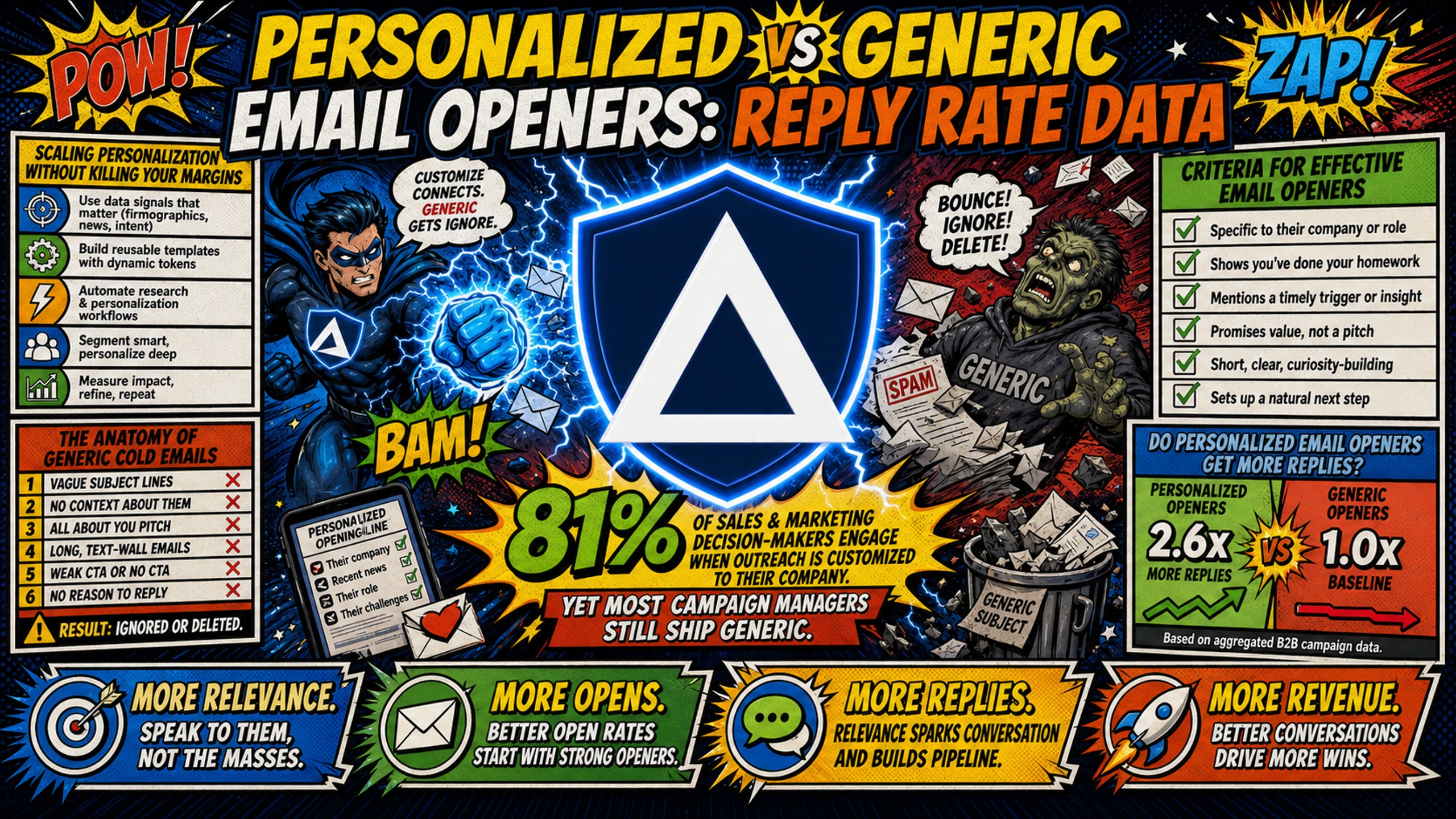
TL;DR: Personalized openers get more replies than generic ones, and personalization depth decides how many. Woodpecker's 2026 data puts deep personalization (an opener built on a trigger such as a job change, hiring move, or funding round) at 17-18% reply rates, against 7-9% for basic or no personalization. Sopro puts most cold email campaigns at 1-5%, and generic openers sit at the low end of that range. The trade-off is time. Unify puts deep manual research at 15-20 minutes per email, which is 12.5-16.5 hours a week at 50 emails. Unify's model puts AI-assisted research, human review included, at under 2 minutes per email. Manual depth fits 10 emails a week, a hybrid fits 25, and AI-assisted workflows become the practical choice at 50+. Manual DNS setup for 50 domains adds another 12+ hours, enough time for 36-48 deeply personalized openers.
81% of sales and marketing decision-makers say they engage with cold outreach when it's customized to their company, yet most campaign managers still ship generic openers because they can't afford the time. That tension defines the real personalization debate, and it's a time-budget problem, not a philosophy problem.
The sections below break down reply-rate data by personalization depth, the time cost of manual versus AI-assisted workflows, and cold email personalization ROI at 10, 25, and 50+ emails per week. Throughout this article, "sequence" refers to a single outbound campaign with 3-7 emails per prospect, and "volume" refers to the total number of emails sent over a defined period. The goal is simple: give you the numbers to decide how many minutes per email personalization deserves, and to defend that decision to leadership.
Scaling personalization without killing your margins
The framing of personalization vs generic cold email usually gets stuck on "personalize more" versus "send more volume." Both sides miss the operational question: where do the hours come from? A campaign manager running 10+ sequences per month operates within a fixed time budget, and every hour spent on DNS panels, inbox provisioning, and warmup tracking is an hour not spent on opener quality.
Criteria for effective email openers
An opener earns its keep when it does three things in one or two sentences:
- Relevance: references something specific to the recipient (a trigger event, a role change, a company initiative).
- Plausibility: reads like a human wrote it for one person, not a template with a merge tag.
- Bridge: connects the observation to a reason for the email, not a generic pitch.
The anatomy of generic cold emails
Generic openers follow a recognizable pattern: "Hi {first_name}, I hope this email finds you well. I help companies like {company}..." They scale infinitely and cost almost nothing per send, which is why they remain the default. The trade-off shows up in reply rates, which the next section quantifies.
Do personalized email openers get more replies?
Yes, measurably. Advanced personalization roughly doubles reply rates, 18% versus 9% for generic emails. The open question isn't whether personalization works. It's which depth pays back the time.
Key findings across industry datasets
Across the personalization datasets below, a consistent pattern emerges:
| Opener type | Reply rate range | Primary driver | Time per email |
|---|---|---|---|
| Deep personalization | 17-18% | Trigger events, specific pain points | 15-20 min |
| Surface tokens | mid-single digits | Name, company, static mentions | Under 1 min |
| Generic openers | 1-5% (all-campaign range) | Volume and list quality | Minimal |
Deep personalization: 17% reply rate
Emails referencing industry-specific pain points, recent triggers, or company news reach reply rates of 17-18%, against 7-9% for basic sends, per Woodpecker's cold email statistics page. A separate Woodpecker breakdown puts advanced personalization at 17% against about 7% without it.
Surface tokens: mid-single digit reply rates
Name-only and company-only openers sit in the middle. They beat pure generic sends but fall well short of trigger-based openers, and the lift shrinks as recipients grow numb to obvious merge tags. If your "personalization" is a first name and a scraped company description, expect single-digit replies at best.
Why generic openers land in low single digits
Most cold email campaigns land between 1% and 5% reply rates, and generic openers sit at the low end of that range. A tight list and a strong offer can push this toward the higher end of that range, but targeting quality has a ceiling without personalization. Personalization is the multiplier on top of targeting, not a substitute for it.
Time cost: manual vs. automated personalization
Reply rates are only half the equation. The other half is what each opener costs in minutes.
Deep personalization: is the ROI there?
Deep manual personalization takes 15 to 20 minutes per email, which works out to about 3 to 4 emails per hour. The time investment is substantial, and against a 17% reply rate, deep personalization generates significantly more replies than generic approaches. A generic opener at near-zero labor and a lower reply rate costs less per email but produces fewer meetings, because the reply pool is smaller.
The ROI of quick custom openers
AI-assisted workflows change the math. AI-assisted workflows can cut research-to-send time to under 2 minutes per prospect, human review included, per Unify's workflow model. For 50 emails per week, that's under 1.7 hours with AI-assisted research versus 12.5-16.5 hours manually. The quality caveat is real: AI output still needs a human pass to catch awkward phrasing and factual misses, but significant time reductions with quality review beat pure manual research for most teams.
Why static email intros decay
Static intros (the same "I noticed you're hiring" line applied to every prospect) decay fast. Recipients in the same industry compare notes, and token-stuffed subject lines with shallow personalization can score worse with modern spam filters than a clean, single-token approach. One well-placed token plus richer body content is the safer pattern.
| Workflow | Minutes per email | 50 emails/week |
|---|---|---|
| Manual deep personalization | 15-20 | 12.5-16.5 hours |
| AI-assisted with human review | Under 2 | Under 1.7 hours |
| Surface tokens only | Minimal | Minimal time |
Cold email personalization ROI by campaign volume
The right personalization depth depends on how many personalized emails you send each week. Here's the math at three volume tiers.
The cost of personalizing 10 emails per week
At 10 emails per week (roughly 40 per month), manual deep personalization costs about 10-13 hours per month at 15-20 minutes per email. That's affordable for almost any team, and at this volume deep personalization delivers the highest ROI available. Prioritize your highest-value accounts and go deep.
25 emails per week: generic vs custom openers
At 25 emails per week, manual deep personalization eats 6.25-8.3 hours weekly. This is the tier where AI-assisted research starts paying for itself, cutting the load to under an hour. A hybrid model works well here: deep personalization for tier-one accounts, AI-drafted openers with human QA for the rest.
50+ emails per week: the time cost
At 50+ emails per week, manual deep personalization at 15 minutes per email means 12.5+ hours weekly on openers alone. That's a part-time job, and it's why this tier forces a decision: AI-assisted workflows, surface tokens on lower-value segments, or fewer personalized sends. The practitioners arguing that volume beats personalization are usually describing this tier, and they're half right. Volume wins only if deliverability holds, which is where infrastructure enters the picture.
"I send high volumes consistently and even with .info domains, which aren't the best for deliverability, I'm still hitting approximately 99% deliverability across the board." - Verified user review of Inframail
Quantifying your manual outreach effort
Before deciding, audit where your hours go. DNS setup for 50 domains manually takes 12+ hours, and deliverability monitoring adds recurring weekly time that grows with mailbox count. For context on what healthy infrastructure monitoring looks like, Inframail's guide on campaign spam and healthy metrics covers the baseline numbers to watch.
Measuring the impact of specific email hooks
Not all personalization triggers perform equally. The data points to a clear hierarchy.
Converting career pivots into replies
Trigger-based outreach tied to real buying signals is one of the strongest personalization tactics available. Job changes, hiring moves, and promotions signal new budgets and new priorities, and openers referencing them fall into the advanced-personalization bracket that Woodpecker measured at 17-18%.
Testing lead-specific email openers
Signal-based personalization (a specific trigger event plus a specific value prop) drives 17-18% reply rates, the top of the range for personalized approaches. The practical test: if the opener sentence could be sent to 500 other people unchanged, it isn't lead-specific.
Impact of recent activity on reply rates
Trigger-based personalization referencing a funding round, hiring move, or product launch consistently outperforms basic merge tags. Recency matters as much as relevance. A funding announcement from last week is a trigger, but one from eight months ago is trivia.
Networking triggers in email copy
Mutual connections, shared events, and community overlap sit between triggers and tokens. They lift replies above generic sends but below true signal-based openers, and they work best as a supporting detail in the second sentence rather than the opener itself.
Signs your custom opener strategy is stalling
First line personalization fails in predictable ways. Watch for these four patterns in your reply data.
Why broken tokens trigger spam filters
Name-only openers become a deliverability risk when tokens break or repeat across emails. Broken tokens make an email look automated, and token-heavy emails can score worse with spam filters than a clean, single-token approach. Dedicated IPs limit the blast radius here. On a shared pool, one bad actor can drag down your placement too, a trade-off covered in this dedicated IP vs shared pools breakdown.
Why static brand mentions don't convert
"Mention the company's latest product launch" works once per prospect pool. When every sender scrapes the same news item, the opener becomes a fingerprint of automation, and reply rates slide back toward generic levels.
Reply rate costs of generic openers
Generic openers cost more than they save once you price replies instead of emails. Halving your reply rate roughly doubles your cost per meeting at constant infrastructure spend.
Why profile mentions don't boost replies
"I saw on your LinkedIn that you went to X university" is personalization theater. It proves you looked at a profile, not that you understand the prospect's situation, and recipients have learned to ignore it.
Mapping personalization tactics to your goals
Match depth to segment value, and protect the time to do it.
Personalized openers: ROI for key leads
For top-tier accounts, deep manual personalization is worth 15-20 minutes per email. The reply lift from 8% to 17% more than doubles expected meetings per send, and on high-value deals a single booked meeting justifies hours of research.
When to use targeted mid-market openers
For mid-market segments, AI-assisted openers with human QA can deliver most of the lift at a fraction of the time cost. A recent hiring post, product update, or other verifiable trigger can be used to draft an opener quickly, then reviewed by a writer or editor before sending. This gives teams a more scalable alternative to the 15-20 minutes of manual research typically required for deep personalization.
Infrastructure costs on large lists
On large lists, infrastructure costs decide how much time is left for personalization. Google Workspace Business Starter costs $420/month for 50 inboxes at $8.40 per seat on the Flexible Plan, while Inframail's flat-rate Unlimited Plan is $129/month for unlimited inboxes on 1 dedicated US-based IP. That's $291/month in platform savings.
Separately, automated DNS setup removes the 12+ hours that manual configuration takes for 50 domains, and that time can go into opener research instead. Domain costs ($5 to $16 per domain per year) and warmup tools (typically $15 to $50 per inbox per month) apply on both sides and are not included in this comparison.
On shared IP pools, one high-volume sender dragging down placement can push even well-personalized campaigns into lower reply-rate territory, a trade-off covered in this dedicated IP vs shared pools breakdown.
Pre-import personalization audit checklist
Before importing a personalized list into Instantly or Smartlead, run this audit to prevent token errors that tank deliverability:
- Token integrity: Spot-check 20 rows for broken merge fields, empty variables, and encoding artifacts.
- Fallback values: Confirm every token has a fallback that reads naturally if the field is blank.
- Recency check: Verify trigger events are recent and relevant.
- Uniqueness test: Dedupe opener lines so no two prospects in the same company get identical first lines.
- Spam-filter pass: Send a test batch and check placement using a healthy metrics baseline before full launch.
- Capacity check: Confirm your sending plan covers the volume using a sending capacity calculation.
Get back the hours that infrastructure setup costs you
Inframail is a flat-rate Microsoft email infrastructure provider for agencies running 50-200 cold email domains. Automated DNS configuration removes the 12+ hours of manual setup for 50 domains, and customer testimonials report 10 inboxes operational in 2 minutes. Dedicated US-based IPs keep sending reputation isolated from other senders, and the Unlimited Plan is $129/month for unlimited inboxes whether a team runs 50 inboxes or 500. Those reclaimed hours go directly into opener research instead.
Inframail reports a 98%+ deliverability rate and a 68.3% blacklist delisting success rate within 48 hours. Inframail is Microsoft-only and does not include built-in warmup, so budget for an external warmup tool.
Watch this case study video to see how Inframail helped this client scale cold email across around 75 accounts, book more calls than ever before, and more than double MRR in roughly 60 days.
"InfraMail makes it remarkably easy to purchase domains, configure them correctly, and create inboxes. The level of automation is exceptional and clearly designed for serious operators; it removes friction and allows you to focus on execution rather than setup." - Verified user review of Inframail
Sign up to Inframail and get started today.
FAQs
How much does first line personalization actually improve reply rates?
Deep personalization reaches 17-18% reply rates versus 7-9% for basic personalization and low single digits for generic sends, roughly a 2x multiplier. The lift depends on referencing specific triggers rather than name and company tokens alone.
Can AI tools match manual personalization quality?
AI tools cut research-to-send time from 15-20 minutes to under 2 minutes per email in Unify's workflow model, but output still needs a human QA pass for accuracy and tone. AI-assisted workflows with review match most of the manual quality at a fraction of the time cost.
What's the minimum personalization that still works?
One well-placed, accurate token plus a relevant body sentence outperforms token-stuffed templates. Surface tokens alone typically reach mid-single-digit reply rates, so treat them as the floor, not the strategy.
Does personalization affect deliverability or spam rates?
Yes, in both directions. Broken tokens and template-pattern text trigger spam filters, while genuine personalization improves engagement signals that tell inbox providers your domain is trustworthy.
Key terms glossary
Deep personalization: Opener content built on specific, recent triggers like job changes, funding rounds, or company initiatives. Drives the highest reply rates at 17-18% but costs 15-20 minutes per email manually.
Surface tokens: Merge fields like first name, company name, or job title inserted into a template. Cheap to produce, but reply rates remain in the single digits and overuse can trigger spam filters.
Reply rate: The percentage of delivered emails that receive any response. Calculated as replies divided by delivered emails, and the primary metric for judging opener quality.
Time-to-personalize: The minutes required to research and write one personalized opener. Ranges from under 1 minute for tokens to 15-20 minutes for manual deep personalization, and under 2 minutes with AI assistance.
Personalization ROI: The reply-rate lift from personalization divided by its time and tool cost. Positive at low volumes for manual work, and at high volumes only when AI-assisted workflows or reclaimed infrastructure hours fund the effort.