
Microsoft 365 Cold Email Pricing: Per-User vs. Flat-Rate Infrastructure Cost Modeling
Compare Microsoft 365 per-user cold email pricing with Inframail flat-rate infrastructure costs across 28, 50, 100, and 200 inbox scenarios.
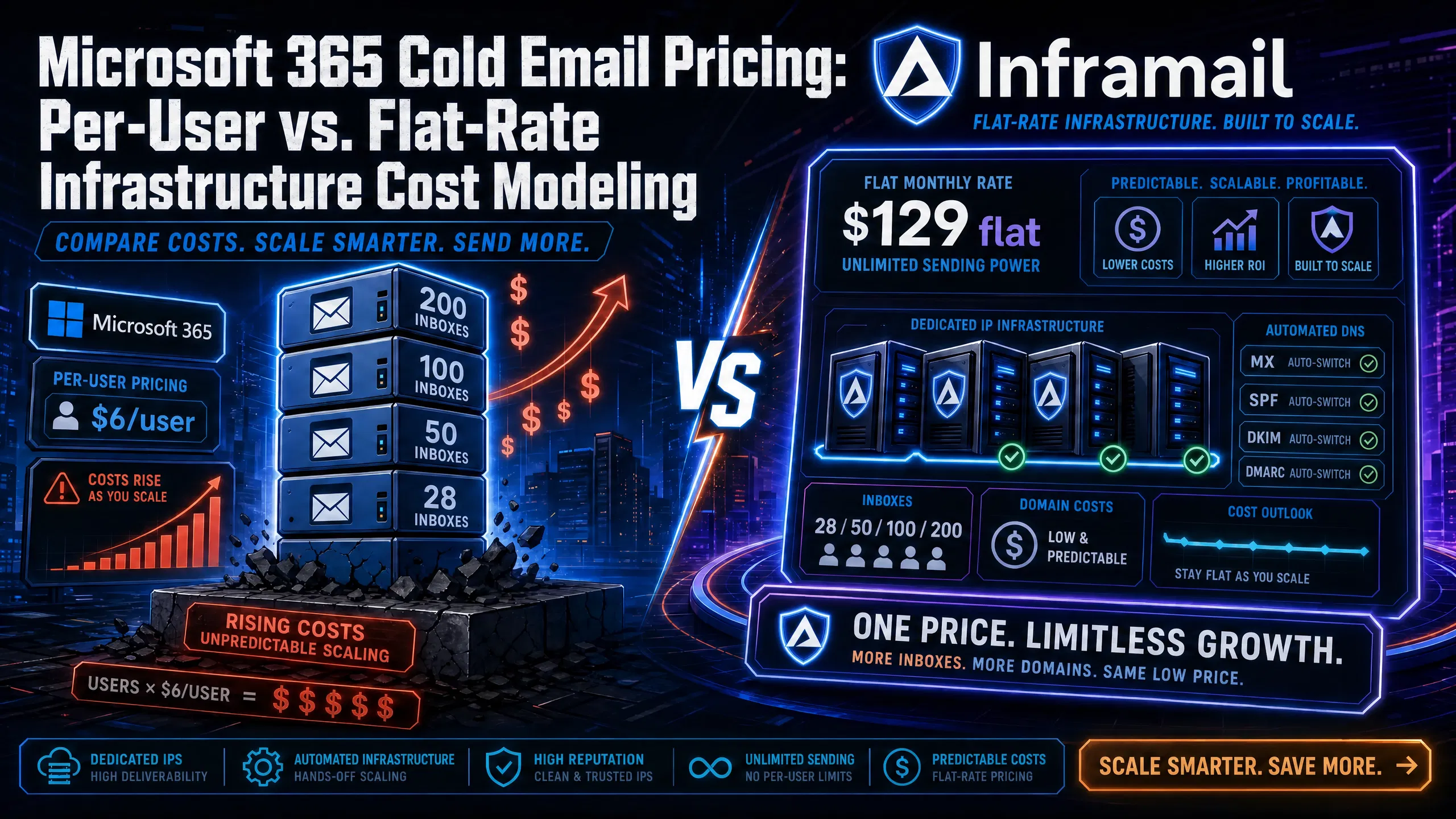
TL;DR: Microsoft 365's per-user licensing scales linearly with every inbox you add, which quietly destroys agency margins as client volume grows. At 50 inboxes, M365 Business Basic costs $300/month on annual billing (pre-July 2026 pricing). Inframail's flat-rate Unlimited Plan costs $129/month for unlimited inboxes on dedicated IPs, plus approximately $54/month in amortized domain costs using a mixed portfolio average of $13/year per domain, for a total of approximately $183/month. At 200 inboxes, the gap grows to over $900/month. This guide models total cost of ownership for 28, 50, 100, and 200 inbox scenarios so you can calculate your break-even, protect your margins, and decide which pricing model fits your agency.
Microsoft 365 is a solid productivity platform. But running high-volume cold email on its per-user licensing is a financial decision that compounds against you every time you sign a new client.
This guide breaks down the true cost of Microsoft 365 cold email infrastructure versus flat-rate alternatives. We model exact expenses across four inbox scenarios, show where the per-user model breaks, and give you the line-item math you need to take to your CFO.
Every agency running outbound at scale faces the same margin equation: per-user pricing turns infrastructure into a variable cost that scales with client count instead of a fixed cost you can plan around. The result is an infrastructure bill that compounds with every new client, every mid-campaign inbox expansion, and every retainer renewal.
M365 per-user: cold email cost
M365 Business Basic costs $6/user/month on annual billing as of December 2025, rising to $7/user/month on July 1, 2026. At 50 inboxes on Business Basic, that's $300/month on annual billing (50 × $6/user). At 100 inboxes, $600/month. Add a new client requiring 30 additional inboxes mid-quarter and your infrastructure bill climbs $180/month with no advance warning. Note that cost models in this guide use the pre-July 2026 rate of $6/user/month for consistency.
The math compounds faster than most agencies realize when they're signing clients, not auditing spreadsheets.
Boost margin with flat-rate email
Flat-rate infrastructure inverts this dynamic. You pay one fixed monthly fee regardless of how many inboxes you provision. When your agency scales from 18 to 28 clients in a quarter, your infrastructure bill stays flat. The per-client infrastructure cost drops with each new client you add, which directly improves unit economics instead of compressing them.
Watch out for hidden cold email costs
The base platform fee is only one component of your true cold email infrastructure cost. Additional layers significantly increase total operational spend beyond the base M365 plan price alone.
The full stack for any provider:
Email platform fee: The per-user or flat monthly cost
Domain registration and renewal: $8-20/year per .com at standard registrar rates (GoDaddy charges $21.99/year to renew a .com, Namecheap around $13.98/year)
Email warmup tools: Per-inbox tools like Lemwarm and Mailreach (Lemwarm from $24/inbox/month, Mailreach from $19.50/inbox/month) represent a significant line item at scale
Sending platform: Instantly.ai or Smartlead at their respective monthly rates
DNS configuration time: Whether you pay in staff hours or consultant fees, manual setup has a real cost
The Maildoso alternatives comparison breaks down how per-inbox models stack up across more providers.
Here's how the three main M365 business tiers affect your cold email infrastructure bill.
M365 Basic: what $6/user gets
Microsoft 365 Business Basic runs $6/user/month on annual billing, or $7.20/user/month billed monthly, using pre-July 2026 pricing. On July 1, 2026, the annual rate rises to $7/user/month ($8.40/user/month on monthly billing). At $7/user/month, the break-even inbox count against Inframail's $129/month flat fee drops from 22 inboxes to 19 inboxes, and every scenario modeled in this guide produces higher savings in favor of flat-rate pricing.
Each user gets a 50 GB Exchange mailbox and web-only Office apps. For cold email specifically, this tier provides functional inboxes with SMTP/IMAP access. Industry guidance suggests cold email send limits of 30-50 emails per day to maintain sender reputation. That means you need more inboxes as send volume grows, which directly drives your M365 bill upward.
Business Standard: $14/user cold email ROI
Business Standard costs approximately $12.50/user/month on annual billing currently (rising to $14/user/month July 1, 2026), and approximately $15/user/month billed monthly. This tier adds full desktop Office apps, which are irrelevant for cold email infrastructure, making the additional $6.50/user/month over Business Basic an unnecessary cost for agencies using inboxes solely for outreach. As a concrete example: an agency scaling from 50 to 75 inboxes mid-quarter on Business Standard pays an extra $312/month at current rates, with that cost repeating every month going forward.
M365 Premium: $22/mailbox impact
Business Premium at $22/user/month on annual billing includes advanced security and device management features. For a cold email inbox sending 30-50 personalized messages per day, you're paying for enterprise tooling you'll never use. Running 50 inboxes on Business Premium costs $1,100/month versus $300/month on Business Basic at current pre-July 2026 rates, for identical sending capability.
Real costs: domains and warmup for cold email
Domain costs add a consistent layer to any infrastructure bill. Standard .com domains typically run $13-20/year at renewal through major registrars. For an agency managing 50 active domains, that's approximately $650-1,000 per year ($54-83/month) in domain costs alone.
Warmup is non-negotiable. A new domain typically needs a minimum 14-day warmup period before scaling send volume, with 30 days often recommended for reliable results. Per-inbox warmup tools add $19.50-49/inbox/month, and this cost applies regardless of which email platform you use.
Flat-rate pricing fundamentally changes how infrastructure costs behave as your agency scales. Instead of watching your bill climb with every new inbox, you pay one predictable monthly fee regardless of portfolio size. Here's how the cost structure breaks down across platform fees, domains, and operational expenses.
Inframail's $129 flat platform fee
The Unlimited Plan is priced at $129/month. This covers unlimited email inboxes on 1 dedicated US-based IP, with automated SPF/DKIM/DMARC configuration, IMAP/SMTP credential generation, and CSV export built in. The Inframail pricing page shows the Agency Pack at $327/month monthly (or $228/month when billed annually) for 3 dedicated IPs and unlimited inboxes.
The flat fee structure means provisioning your 51st or 200th inbox costs the same as provisioning your first.
Domain expenses per client account
Domains through Inframail cost $5-16/year, with .com domains at approximately $16.44/year and .info domains at approximately $9.44/year. For planning purposes, use an average of $13/year for a mixed portfolio of .com, .net, and .co domains. At 50 domains, that's approximately $650/year or $54/month amortized. Domain costs scale with your portfolio, but slowly compared to per-user platform fees.
Warmup tool setup and costs
Inframail does not include a built-in warmup tool, so budget for an external service. Lemwarm ($24-40/inbox/month) and Mailreach ($19.50/inbox/month) are common choices. This cost applies equally to M365 users, so it doesn't change the relative comparison between platforms.
Connecting inboxes: hidden expenses
Inframail generates IMAP/SMTP credentials automatically and exports them to CSV. You import that CSV directly into Instantly.ai or Smartlead in minutes. The platform works natively with major cold email sending tools, removing the manual credential entry that burns time during M365 onboarding.
At 28 inboxes, you're at the threshold where flat-rate pricing begins to show meaningful savings over per-user models. This scenario represents a small to mid-size agency running 3-5 active clients with 5-8 inboxes per client. Here's the exact cost comparison with domains included.
Microsoft 365: 28 mailbox expense breakdown
Cost component | Annual billing | Monthly billing |
|---|---|---|
M365 Business Basic (28 × $6 or $7.20) | $168 | $202 |
Domains (28 × ~$13/yr amortized) | $30 | $30 |
Total platform + domains | $198 | $232 |
Note: These figures use pre-July 2026 pricing ($6/user annual, $7.20/user monthly). Domain costs assume approximately 28 domains at standard registrar rates. Warmup tool costs ($19.50-49/inbox/month) apply equally to both providers and are excluded from this comparison.
Inframail: flat-rate cost for 28 mailboxes
Cost component | Monthly |
|---|---|
Inframail Unlimited Plan | $129 |
Domains (28 × avg $13/yr amortized) | $30 |
Total platform + domains | $159 |
Note: Domain costs assume 28 domains at approximately $13/year average market rate. Warmup tool costs ($19.50-49/inbox/month) apply equally to both providers and are excluded from this comparison.
At 28 inboxes, Inframail costs approximately $159/month versus M365's $198-232/month. The savings run approximately $39-73/month, or $468-$876 annually. If you're running fewer than 21-22 inboxes, the $6/user M365 rate and the $129 flat fee are close enough that switching costs may not justify a migration. Above 22 inboxes, the flat-rate model wins and the gap widens with every inbox you add.
Before vs. after: infrastructure at 28 inboxes
Before (M365 manual) | After (Inframail automated) | |
|---|---|---|
DNS configuration | 12-15 hours per 50-domain client | Customer testimonials report 10 inboxes operational in under 2 minutes. |
Cost structure | Linear per-user | Flat regardless of inbox count |
Monthly cost | $198-232 | $159 |
Cost per inbox | $7.07-8.29 | $5.68 |
"So affordable that it will make your unit economics work, even for lower ticket b2b businesses like ours" - Verified user review of Inframail
Fifty inboxes represents a clear inflection point where per-user pricing starts to materially impact agency margins. At this scale, you're managing 8-12 active clients with typical inbox allocations of 4-6 per client. The cost gap between M365 and flat-rate infrastructure widens significantly, making this the scale where most agencies seriously evaluate alternatives.
Microsoft 365 per-user costs
Fifty inboxes on M365 Business Basic runs $300/month on annual billing or $360/month on monthly billing (using pre-July 2026 rates). Domain costs at approximately $13/year each add another $54/month, bringing the total to $354-414/month. At the current rate, $300/month in platform fees alone means infrastructure consumes a meaningful share of retainer revenue before you've paid a single salary.
Inframail: flat-rate cold email pricing
With Inframail, 50 inboxes costs the same as 28 inboxes: the flat $129/month platform fee. Add 50 domains at approximately $13/year each (the average market rate for a mixed domain portfolio): $54/month amortized. Total: approximately $183/month.
Provider | Platform fee | Domains (50) | Warmup tools (50 inboxes) | Total |
|---|---|---|---|---|
Inframail Unlimited | $129 | $54 | $19.50-49/inbox/mo (shared) | $183 |
M365 Business Basic (annual) | $300 | $54 | $19.50-49/inbox/mo (shared) | $354 |
M365 Business Basic (monthly) | $360 | $54 | $19.50-49/inbox/mo (shared) | $414 |
Note: All costs use pre-July 2026 M365 pricing. Domain costs assume approximately $13/year market average. Warmup tool costs ($19.50-49/inbox/month) are shown as a shared line item and apply equally to both providers. The Total column excludes warmup to isolate the platform and domain cost differential.
Calculating M365 payback period
The savings at 50 inboxes run approximately $171/month versus annual M365 billing, or $2,052 annually.
One hundred inboxes marks the scale where infrastructure becomes a material budget line item that shows up in monthly P&L reviews. At this tier, you're running 15-20 active clients or supporting a dedicated outbound team with significant daily send volume. The cost differential between per-user and flat-rate models now represents meaningful margin protection, enough to fund additional headcount or tooling investment.
Microsoft 365 per-mailbox pricing
At 100 inboxes, M365 Business Basic costs $600/month (annual) or $720/month (monthly) using pre-July 2026 rates. Domain costs at approximately $13/year add another $108/month (100 × $13/year ÷ 12), bringing the total to $708/month on annual billing. Adding even 10 inboxes mid-quarter adds $60-72/month permanently.
Inframail: optimize your monthly spend
Inframail at 100 inboxes still costs $129/month for the platform. Domain costs at 100 domains using approximately $13/year market average: $108/month amortized (100 × $13/year ÷ 12). Total: approximately $237/month. The platform fee hasn't moved from the 28-inbox scenario.
ROI for 100 cold email inboxes
Inboxes | M365 annual (incl. domains) | Inframail + domains | Monthly savings |
|---|---|---|---|
28 | $198 | $159 | $39 |
50 | $354 | $183 | $171 |
100 | $708 | $237 | $471 |
200 | $1,357-1,417 | $286-346 | $1,011-1,131 |
Note: All figures use pre-July 2026 M365 pricing. Domain costs use a range reflecting $9.44/year (.info) to $13/year (mixed portfolio average) per domain. Warmup tool costs ($19.50-49/inbox/month) apply equally to both providers and are excluded from all rows.
Inboxes | Annual savings | 3-year savings |
|---|---|---|
28 | $468 | $1,404 |
50 | $2,052 | $6,156 |
100 | $5,652 | $16,956 |
200 | $12,132-13,572 | $36,396-40,716 |
Note: Calculations based on pre-July 2026 M365 pricing. Range reflects domain cost mix from .info-heavy to .com-heavy portfolios.
Two hundred inboxes represents enterprise-scale cold email operations, typically supporting 25-40 active clients or a dedicated SDR team of 10-15 reps. At this scale, infrastructure costs under per-user pricing become one of your largest monthly expenses after payroll. The flat-rate model produces its largest savings here, with monthly reductions large enough to materially impact annual profitability.
Microsoft 365 cold email pricing breakdown
Two hundred inboxes on M365 Business Basic costs $1,200/month on annual billing or $1,440/month on monthly billing using pre-July 2026 rates. Domain costs at approximately $13/year add $217/month (200 × $13/year ÷ 12), bringing the annual billing total to $1,417/month. At this scale, infrastructure alone represents a material budget line before warmup tools or sending platform.
Inframail flat-rate pricing (200 mailboxes)
At 200 inboxes, Inframail still costs $129/month for the platform. Domain costs for 200 domains run $157-217/month depending on your domain mix (.info at $9.44/year versus .com at $16.44/year). Total: approximately $286-346/month. The cost-per-inbox on the platform fee alone drops to under $0.65 per inbox per month at this scale.
Predictable cost reduction for 200 mailboxes
At 200 inboxes, the flat-rate model shows its largest cost advantage. Compared to M365 Business Basic on annual billing, Inframail saves approximately $1,011-1,131/month, or $12,132-13,572 per year. Over three years, that's $36,396-40,716 in infrastructure savings at this inbox tier. That figure is large enough to fund one additional account executive or a meaningful tooling investment.
"I personally have over 1,000 email accounts with Inframail for one flat price. Adding all those records would have probably taken dozens of hours. Instead all records were added within 10 minutes." - Verified user review of Inframail
Break-even analysis determines the exact inbox count where flat-rate infrastructure becomes more cost-effective than per-user licensing. For most agencies using pre-July 2026 pricing, that threshold is approximately 22 inboxes. At the July 2026 rate of $7/user, it drops to 19 inboxes. Above that count, every additional inbox increases your monthly savings under flat-rate pricing. Here's how to calculate your specific break-even point and model the decision framework operations managers use to evaluate infrastructure changes.
How operations managers evaluate infrastructure decisions
Decision criterion | Evidence needed |
|---|---|
Total cost of ownership vs. current stack | 12-36 month cost model: platform fee + domains + warmup tools across 28, 50, and 100 inbox scenarios with line-item breakdowns |
Setup speed and DNS automation | Live screen-share showing domain provisioning with auto-DNS, inboxes created, CSV exported, and imported to Instantly |
Deliverability performance | 30-day pilot with inbox placement testing, 2-3 referenceable agencies sharing actual inbox rate data |
Integration with existing stack | Documentation proving IMAP/SMTP export works with Instantly.ai and Smartlead, testimonial from agency using identical sending platform |
Vendor stability and support quality | Revenue disclosure, support availability and response expectations, Microsoft partnership verification |
Compliance and security | Data residency confirmation, DPA template, CAN-SPAM compliance documentation |
Resolving M365 cold email cost concerns
The direct comparison between M365 per-user and flat-rate infrastructure depends on one variable: your inbox count. Below 21-22 inboxes, M365 Basic at approximately $126-132/month and Inframail at $129 are close enough that switching may not justify the migration effort. Above 22 inboxes, Inframail wins on pure infrastructure cost and the gap widens with every inbox you add.
Use this framework to calculate your current stack cost:
Platform fee: Number of inboxes × per-user rate (or flat fee)
Domain costs: Number of domains × avg $13-14/year ÷ 12
Warmup tools: Number of inboxes × per-inbox monthly rate
Sending platform: Flat or per-seat monthly fee
The delta between line 1 items is your direct monthly savings. Every inbox above 22 increases that delta.
Modeling your client unit costs
The metric that matters for margin protection is infrastructure cost per active client, not total infrastructure spend. Divide your total monthly infrastructure bill (platform + domains + warmup) by your active client count and track it monthly.
Infrastructure decisions extend beyond monthly platform costs. DNS configuration speed, deliverability architecture, vendor stability, and compliance requirements all affect total cost of ownership and operational risk. These factors don't show up on pricing pages but directly impact launch timelines, inbox placement rates, and long-term margin protection.
DNS setup and provisioning speed
Manual DNS configuration for SPF, DKIM, and DMARC across 50 domains takes 12-15 hours of active work. Each domain requires logging into a separate DNS panel, creating records with exact syntax, waiting for DNS propagation (typically 24-48 hours), and validating with tools like Mail-Tester. Microsoft 365 requires multiple DNS records per domain for proper authentication, adding steps per domain.
Inframail's automated DNS configuration reduces this to approximately 3 minutes per domain. SPF, DKIM, and DMARC records are generated and applied automatically, with no DNS panel access required. Export IMAP credentials to CSV, import to Instantly or Smartlead, and you're sending.
Deliverability and inbox placement rates
Deliverability is where M365 infrastructure debates get complicated. A few key points to understand:
Shared IP risk: Agencies on shared IP infrastructure can inherit deliverability damage from other senders on the same IP pool. Poor sender behavior on shared IPs can impact reputation scores across the pool.
Dedicated IP advantage: Inframail's dedicated US-based IPs mean your sending behavior alone determines your domain reputation.
Inframail's documented rates: We report 9.5/10 on Mail-Tester and 88% inbox placement rate via GMass testing. GMass independently confirmed Inframail as the first private cold email infrastructure company.
For monitoring domain and IP health across your full portfolio, the infrastructure monitoring guide covers the alert frameworks agencies use to catch blacklist issues before clients notice.
Avoiding vendor lock-in traps
Switching cold email infrastructure providers is more operationally complex than it appears from a pricing page. A full migration involves CSV export and import work, sequence retesting, warmup restart periods, and account manager retraining. That migration cost is real and often delays switching even when the pricing math clearly favors a change.
Inframail announced a publicly verified enterprise partnership with Microsoft in January 2024, providing infrastructure credibility and reducing the risk of platform-level disruptions taking client campaigns offline.
"We spent months hunting for a reliable cold-emailing stack. After repeated failures with another provider, we trialled two options, Inframail and a competitor. We chose the competitor. A month later, we switched back to Inframail. Zero issues since." - Verified user review of Inframail
Cold email compliance risks
Vendor stability matters as much as pricing. Evaluate these factors for any infrastructure provider: Does the vendor publish revenue disclosure demonstrating it's a real, funded business? What's the support availability, because email-only support with 24-48 hour response times creates serious risk when DNS breaks on a Friday afternoon? Inframail provides live chat support 16 hours a day from real team members.
Does data residency match your client requirements? Inframail's US-based infrastructure satisfies US client data residency needs. Cold email compliance requires proper CAN-SPAM adherence and authentication documentation.
If your agency is running more than 21-22 inboxes, the math favors a switch. Inframail's Unlimited Plan costs $129/month flat, whether you're provisioning 20 inboxes or 200, with automated SPF/DKIM/DMARC setup that cuts per-domain configuration from hours to minutes. Your infrastructure spend stays fixed while your client count grows. Sign up to Inframail and get started today.
What does Microsoft 365 cost per user for cold email inboxes?
M365 Business Basic costs $6/user/month on annual billing (increasing to $7/user/month on July 1, 2026) and $7.20/user/month on monthly billing. Business Standard adds desktop apps at $14/month annual, and Business Premium adds security features at $22/month annual, both of which are unnecessary costs for cold-email-only inbox provisioning.
Does Inframail include a warmup tool, or do I need a separate service?
Inframail does not include a built-in warmup tool on the Unlimited and Agency Pack plans, so you'll need an external service like Lemwarm ($24-40/inbox/month) or Mailreach ($19.50/inbox/month). This cost applies equally to M365 users, so it doesn't change the relative cost comparison between platforms.
How do domain costs differ between per-user and flat-rate plans?
Standard registrar domain costs run $13-20/year for a .com through providers like Namecheap or GoDaddy. Inframail offers domains at $5-16/year through its platform, which is at or below standard registrar renewal pricing, giving Inframail users an additional cost advantage on the domain line item.
At what inbox count does flat-rate pricing beat M365 per-user pricing?
Flat-rate pricing at $129/month beats M365 Business Basic at $6/user/month (annual) once you exceed approximately 21-22 inboxes. At 21 inboxes, M365 costs roughly $126/month versus $129 for Inframail. At 22 inboxes and above, Inframail's flat fee wins and the savings grow with every inbox you add.
What does Google Workspace cost per seat compared to Microsoft 365?
Google Workspace Business Starter costs $7/user/month on annual billing, while M365 Business Basic currently costs $6/user/month on annual billing (rising to $7 on July 1, 2026). Both platforms use per-seat pricing structures, so the flat-rate versus per-user cost analysis applies equally to both.
Cost-per-inbox: Total monthly infrastructure spend (platform fee + domain costs + warmup tools) divided by total active email inboxes. Track this figure monthly to catch margin compression before it triggers CFO conversations.
SPF/DKIM/DMARC: Email authentication protocols required for inbox deliverability. SPF validates the sending server, DKIM adds a cryptographic signature, and DMARC sets the policy for handling authentication failures. Manual configuration takes 12-15 hours per 50 domains. Automated platforms apply all three records without DNS panel access.
Dedicated IP: A sending IP address used exclusively by one account, meaning your inbox placement rate is determined only by your own sending behavior. Shared IP pools expose your deliverability to the actions of other senders on the same IP range.
DNS propagation: The time DNS record changes take to replicate across global servers, typically 24-48 hours. You must factor this delay into client launch timelines during domain setup.
Warmup period: The gradual increase of send volume from a new inbox or domain to build sender reputation before scaling to full campaign volume. The minimum effective warmup period is 14 days, with 30 days recommended for consistent inbox placement rates.