
Hi vs Hey vs Hello: which email greeting gets more replies?
Most cold email advice treats "Hi" and "Hey" as interchangeable, but Boomerang's reply-rate data shows they are not. "Hi" holds a meaningful reply-rate edge ove
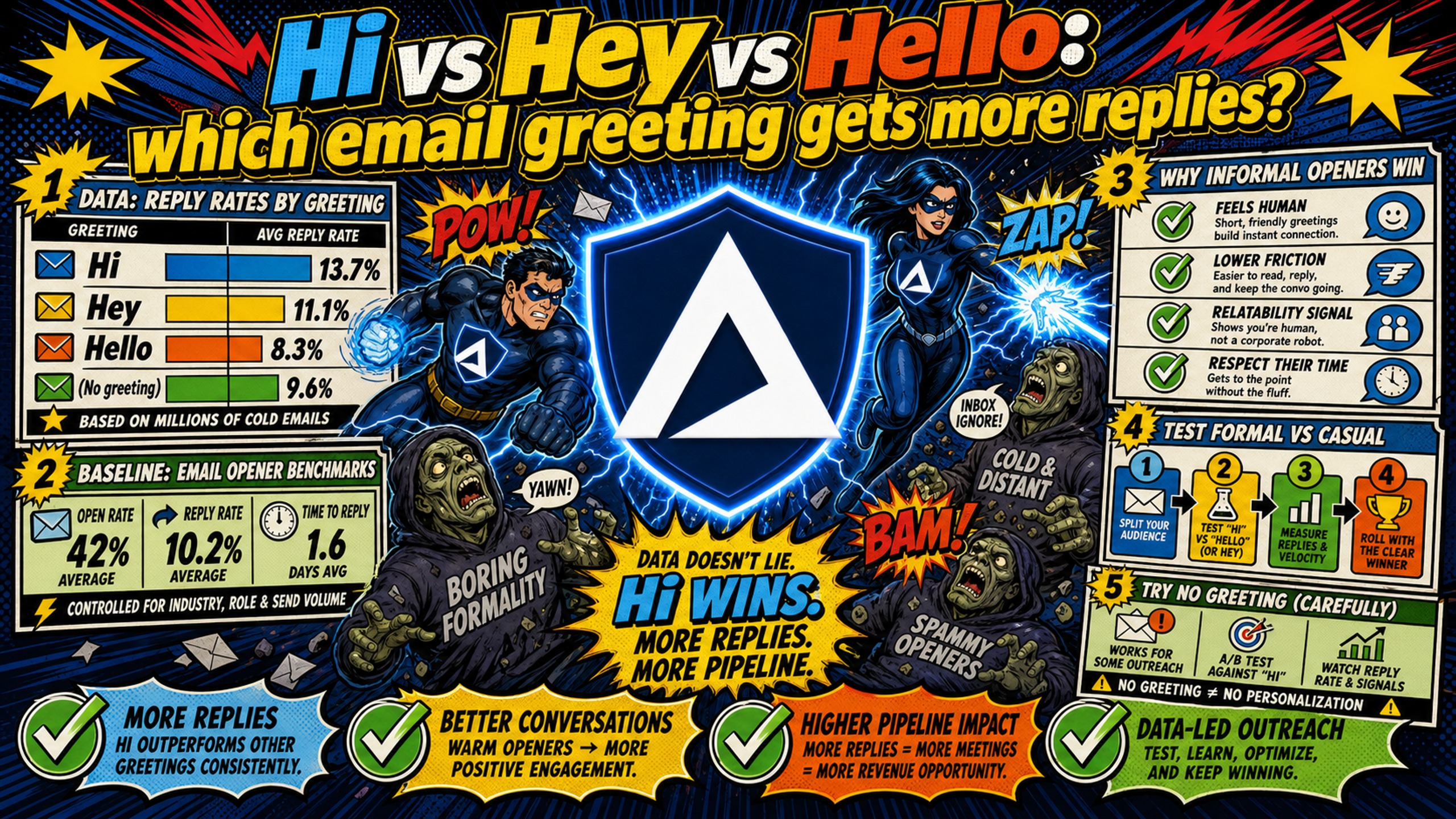
TL;DR: "Hi" is the safest default for B2B cold outreach, backed by Boomerang data from 300,000+ emails showing an ~11% relative reply-rate lift for "Hi" over "Dear". "Hey" wins in startup and peer-to-peer contexts where informality signals shared context. "Hello" sits in a neutral middle ground, professional but not optimized for reply rates. Skipping the greeting is a common test variant, but the best-documented data (Boomerang) found emails with any opening outperform emails with none. Treat greeting removal as unproven until you have tested it against your own list. The best email salutation depends on your audience, and split-testing across enough volume to reach statistical significance is the only way to know for sure.
Most cold email advice treats "Hi" and "Hey" as interchangeable, but Boomerang's reply-rate data shows they are not. "Hi" holds a meaningful reply-rate edge over "Dear" in Boomerang's data, a gap that compounds across thousands of sends. Your greeting is the first thing a prospect reads after your subject line, and the wrong choice creates friction before your pitch even starts. This article breaks down the published evidence on Hi, Hey, and Hello, maps each greeting to the scenarios where it wins, and gives you a concrete testing framework to generate your own data at scale.
Data-backed reply rates for common salutations
The published data on greeting performance is limited but consistent. The sources below represent the largest available analyses and provide a directional baseline for choosing between Hi, Hey, Hello, and no greeting.
Baseline data for email openers
Large-scale A/B data on greetings exists, though the number of published studies is limited. Directional evidence comes from several named sources, most notably Boomerang's 2017 analysis of over 300,000 email threads.
Boomerang analyzed over 300,000 email threads in 2017 and found that "Hi [First Name]" reached a 62.7% reply rate versus 56.5% for "Dear", a 6.2-point difference representing an ~11% relative lift. The same analysis of workplace email replies found that casual salutations performed better overall: "Hey" reached 64%, "Hello" 63.6%, and "Hi" 62.7%, while "Dear" trailed at 56.5%.
Several cold email platforms' published guidance confirms that casual greetings outperform formal alternatives in B2B tech outreach. For cold email specifically, "Hi [Name]" is widely recommended as the safest and most effective choice, with practitioners generally avoiding "Dear" (too formal) for most B2B contexts.
Why informal openers boost reply rates
Informal greetings reduce perceived distance between sender and recipient. When a prospect reads "Hi Sarah," the email feels like a message from a colleague. When they read "Dear Ms. Johnson," it reads like a form letter.
A precise universal number does not exist because greeting effects are small and confounded by subject line, sender domain, list quality, and send time, but the directional trend across multiple data sources is consistent: informal beats formal in most B2B contexts.
Testing formal vs casual email openers
Sample size matters more than most senders realize. For typical email metrics, HubSpot's guide on how to determine your A/B testing sample size recommends sending each test variant to at least 20,000 recipients for statistically significant results. A 2% reply rate gap with 500 recipients per variant falls within random variation, but the same gap with 10,000 per variant provides actionable signal.
Removing greetings to boost responses
The no-greeting cold email strategy skips the salutation entirely and opens with the first line of value. This approach places the value proposition immediately after the subject line. It works best in high-volume campaigns where every second of prospect attention counts, but it carries risk in contexts where skipping a greeting reads as abrupt.
Choosing the right salutation for cold outreach
Not every greeting fits every context. The breakdown below maps each common salutation to the audience type and scenario where the available evidence suggests it performs best.
Categorizing greeting tone by reply rate
| Greeting | Tone | Best Use Case | Reply-Rate Trend |
|---|---|---|---|
| Hi [Name] | Professional, approachable | General B2B, mid-level prospects, low spam risk | 62.7% reply rate (Boomerang, 300,000+ emails; see baseline section for full breakdown) |
| Hey [Name] | Casual, peer-to-peer | Startups, follow-ups, tech audiences, low spam risk in casual contexts | 64% reply rate in workplace data (Boomerang) |
| Hello [Name] | Neutral, professional | Enterprise, formal industries, low spam risk | 63.6% reply rate in workplace data (Boomerang) |
| No greeting | Direct, abrupt | Technical audiences, some follow-ups, test required | No independently measured figure in available published data; test required for your specific list |
This table combines Boomerang's workplace-email data with contextual guidance for cold outreach. Treat it as a starting framework, not a universal rule.
Evidence for using Hi in cold outreach
Of the three main greetings, "Hi" carries the broadest support in published cold email data. The sections below explain why and where that advantage holds.
Driving replies from mid-level prospects
Mid-level prospects (managers, directors, team leads) typically respond well to professional communication without stiffness. "Hi" often hits that balance, reading as competent without excessive formality, and it pairs naturally with a first name.
Instantly’s 2026 guide, based on patterns from 50,000+ cold emails, recommends “Hi [Name]” as a safe default greeting for mid-level B2B cold outreach. The same analysis advises against "Dear" as too formal and "Hey" as too casual for executive-level recipients.
For the Hi vs Hey email greeting debate at this seniority level, "Hi" wins on safety and consistency. However, the article does not provide greeting-specific performance data, so it should be treated as vendor guidance rather than a confirmed comparative benchmark.
Aligning email greetings with seniority
Greeting formality should map to prospect seniority. A VP of Engineering at a Fortune 500 company has different expectations than a startup founder. "Hi" works across a wide range of seniority levels because it reads as professional without being stiff, though formal industries may still prefer more traditional greetings.
In technology and startup contexts, first names from the first email are standard, and excessive formality signals an outsider. "Hi Sarah" is normal even to a founder, while "Dear Mr. Chen" reads as a cold-outreach template. But in regulated industries like healthcare or finance, formality expectations may differ, so segment-level testing is important.
Why Hi wins in cold outreach
"Hi" is the best email salutation for cold outreach because it carries the lowest risk across the widest audience range. It works with C-suite executives and mid-level managers. It works in tech and in traditional industries. And it has the strongest published data behind it.
The case for "Hi" as the default is not that it always wins. The case is that it performs consistently across diverse contexts. When you cannot split-test or when you are launching a campaign to a mixed audience, "Hi [First Name]" is a greeting with strong data behind it. The risk of "Hi" with most modern B2B contacts is low, though sources including Topo.io recommend erring toward formality for first contact with senior executives, meaning "Hi" is not a guaranteed safe choice at the VP level and above in traditional industries.
When Hey outperforms Hi and Hello
"Hey" is not universally stronger than "Hi," but it outperforms in specific scenarios. The sections below identify those contexts and explain why the tone shift drives higher replies.
Boosting replies in follow-up sequences
Follow-up emails operate in a different context than first touches. The prospect has already seen your name. The relationship (however thin) exists. "Hey" can signal familiarity, which is often appropriate for a follow-up.
After a few exchanges using "Hi", it is common to transition to "Hey" once you become more familiar with the recipient. In follow-up sequences, "Hey" often reads as natural rather than presumptuous because the prior email establishes context.
For a full breakdown of cadence and timing beyond the greeting itself, see Inframail's guide on how to follow up on a cold email without losing the reply.
Email greetings for startup outreach
Startup founders and technical audiences read formality as distance. "Hey" signals that you are part of the same world. In American corporate, Australian, and startup contexts, "Hey" is a valid greeting for business emails.
The key insight is that startup culture tends to penalize formality more than it penalizes informality. "Hey" to a startup founder often reads as normal, while "Dear" to the same person may read as a mass email.
Why Hey wins for peer prospecting
Peer prospecting (reaching out to people at your level, in your industry, or in your cohort) may benefit from "Hey" because it can establish immediate parity. You are not a vendor pitching upward. You are a peer sharing something relevant.
The published evidence does not include a controlled study showing "Hey" universally outperforming "Hi" in startup-only contexts. What the evidence shows is that "Hey" is culturally accepted and often preferred in these contexts, and that testing greetings per segment is the only reliable way to know which greeting lifts replies for your specific list.
When Hello works and when it doesn't
"Hello" occupies an unusual position in the greeting spectrum. The sections below cover where it fits, where it falls short, and when it remains the appropriate choice.
How Hello compares with Hi and Hey
In Boomerang's workplace email analysis, all three casual greetings clustered within 1.3 percentage points of each other, as shown in the baseline table above. The problem with "Hello" in cold email is positioning. "Hello" can sit in a middle ground: less warm than "Hi" or "Hey" for peer-to-peer communication, less formal than "Dear" for signaling respect in traditional hierarchies.
Compared with "Hello," "Hi" generally reads as warmer and more natural, while "Hello" can feel slightly stiff without the formality of "Dear." In the technology sector and startup world, more people use "Hello" for job applications and business introductions because it sounds professional and less stiff than "Dear." For cold outreach where reply rate is the metric, available data suggests "Hello" does not consistently outperform "Hi" or "Hey".
When Hello fits executive outreach
Some executive and enterprise audiences still expect "Hello" as a formality signal. In industries like banking, law, and government, "Hello" may read as appropriately professional without the obsolescence of "Dear."
Should you skip the greeting? What the evidence says
Skipping the greeting entirely is a legitimate test variant, not just an oversight. The sections below cover the rationale, the scenarios where it is most likely to work, and the evidence for why it still carries risk.
Why direct openers drive more replies
No-greeting cold email openers skip the salutation entirely and open with the first line of value. This approach aims to reduce the distance between the subject line and the value proposition. The prospect opens the email and immediately reads something relevant to their business. No social ritual, no filler.
This works because cold email attention spans are measured in seconds. Every line that does not deliver value is a line that gives the prospect a reason to close the email.
When to use zero-greeting openers
Zero-greeting openers may work in scenarios where directness is valued:
- High-volume campaigns: where you are sending thousands of emails and the audience is unlikely to know or expect your name.
- Technical audiences: developers, engineers, data scientists who tend to value directness over social convention.
- Follow-up sequences: where the greeting from the first email already established the relationship.
Why skipping greetings hurts reply rates
The counter-case is real. Boomerang's analysis of email opening lines recommends always using an opening in the beginning of an email chain, because emails with greetings performed better overall than emails without one. Reply.io's analysis of email salutations finds that emails with greetings are also read through to closing lines more often than emails that open directly with a subject.
Skipping the greeting can read as abrupt or low-effort, particularly in industries where relationship-building matters. The safest approach is to test both variants against your specific list and let the data decide.
Study design: tracking greeting performance
Directional data from published sources is a starting point. The only way to know which greeting lifts replies for your specific list is to generate your own data under controlled conditions. The sections below cover how to set that up correctly.
Setting email sample size parameters
HubSpot's A/B testing guide recommends at least 20,000 recipients per variant for typical email metrics. For click-rate differences in the range of 6.7% to 8.9%, a sample size of 5,000 per variant reaches 99% statistical significance, according to Zettasphere's A/B calculator (this is a click-rate example used to illustrate how significance scales with sample size, reply-rate thresholds will vary depending on your baseline rate).
Running a greeting test at this scale usually means picking from a wider set of email testing tools built for exactly this kind of split test. In practice, most campaign managers should aim for a minimum of 1,000 sends per variant for directional data and 5,000+ per variant for conclusions worth acting on.
Dataset demographics and mix
Your test dataset should reflect the diversity of your actual prospect list. Mix industries, seniority levels, and company sizes across variants to avoid bias. If your "Hi" variant goes mostly to startup founders and your "Hey" variant goes mostly to enterprise VPs, the results will tell you about audience differences, not greeting performance.
Variables controlled during testing
Hold these variables constant across all greeting variants:
- Subject line: identical across all variants.
- Body copy: every word after the greeting stays the same.
- Send time: same day, same time window.
- Sender identity: same sender name and similar sender domains.
- List source: same data provider and list quality tier.
- Offer and CTA: identical ask in every variant.
The only element that changes is the greeting. Everything else stays identical.
Testing greetings at scale without per-seat costs
Running a valid greeting test across 5,000+ sends per variant requires serious inbox volume. At 20-50 sends per inbox per day (to stay within safe deliverability limits), a 10,000-send test requires 200-500 inboxes.
On Google Workspace at $8.40 per user per month on the Flexible Plan, 200 inboxes cost $1,680/month, but Inframail's flat-rate model changes this math: the Unlimited Plan at $147/month includes unlimited inboxes, so the same test costs $1,533 less in platform fees. Domain costs ($5-16 per domain per year) and external warmup tools ($15-50 per inbox per month) apply on both sides.
Running a test at this volume also raises the question of IP strategy, and dedicated IPs typically scale better than shared pools once an agency is running tests across multiple client accounts.
The workflow is direct: provision inboxes in Inframail, export IMAP/SMTP credentials to CSV, import to Instantly or Smartlead, and set up your greeting variants. Inframail's automated DNS configuration handles SPF, DKIM, and DMARC records without manual panel work, so the infrastructure setup does not become the bottleneck.
For the exact field mapping and CSV formatting this export requires, see Inframail's guide on how to import Microsoft 365 credentials into Instantly or Smartlead.
For campaign managers running multiple greeting tests across client accounts, the cost difference compounds to $18,612 annually in platform savings alone, before counting domain and warmup costs which apply equally on both sides.
"Unlimited inboxes on a flat price? That alone saves me hundreds every month compared to Google Workspace or similar." - Verified user review of Inframail
Run your greeting tests on flat-rate infrastructure
Inframail is a flat-rate Microsoft email infrastructure provider built for agencies and operators running cold email at scale. The Unlimited Plan at $147/month includes unlimited inboxes, 1 dedicated US IP, and automated SPF, DKIM, and DMARC configuration with no manual DNS panel work. The Agency Pack at $387/month includes 3 dedicated IPs.
Domain costs ($5-$16 per domain per year) and external warmup tools apply on both sides of any platform comparison and are not included in platform pricing. Inframail reports 98%+ deliverability and a 68.3% blacklist delisting success rate within 48 hours.
Watch this case study video and see how Inframail helped this client close a $20,000 deal in its first month while generating 2.06x more positive replies per dollar than Outlook at scale.
Sign up to Inframail and get started today.
FAQs
Does the greeting really matter for reply rates?
Yes, but less than list quality and offer strength. Boomerang's 2017 analysis of 300,000+ email threads found "Hi [First Name]" carried an ~11% relative reply-rate lift over "Dear". Greeting choice is a marginal gain that compounds with other variables, not a silver bullet.
Should I use the same greeting for every campaign?
No. Different audiences respond to different tones. "Hi" is the safest default for mixed B2B lists, but "Hey" can perform better in startup and peer-to-peer contexts. Test greetings per segment, because what works in one industry may not work in another.
What about greetings with the recipient's name?
Always include the first name. "Hi Sarah" is generally more effective than a bare "Hi" because it signals the email was written for that specific person. Unpersonalized greetings like "Dear Sir/Madam" or "To whom it may concern" can trigger spam filters that recognize bulk-campaign patterns.
Can I test greetings without hurting deliverability?
Yes, within reasonable limits. Greeting text alone is unlikely to trigger spam filters. Google Postmaster Tools focuses on sender reputation, spam rate, and engagement patterns. What hurts deliverability is abrupt volume increases and low engagement, not whether you write "Hi" or "Hey." However, generic greetings combined with other spam signals may contribute to filtering.
How many inboxes do I need to run a valid greeting test?
For directional data, plan on 1,000 sends per variant, which requires roughly 20-35 inboxes at 30-50 sends per inbox per day. For statistical significance at 95% confidence, you need 5,000-20,000 sends per variant, which requires 100-670 inboxes depending on your daily send limits.
What greeting should I use for follow-up emails?
"Hey" works well in follow-ups because the first email already established context. Transitioning from "Hi" to "Hey" after initial exchanges is common practice. You can also skip the greeting entirely in follow-ups and reference the previous email directly.
Key terms glossary
Reply rate: The percentage of delivered emails that receive a response. Calculated as replies divided by emails delivered (sent minus hard bounces), then multiplied by 100. A 5-10% reply rate is strong for cold email.
Inbox placement rate: The percentage of successfully delivered emails that land in the recipient's primary inbox rather than spam or promotions folders. Calculated as emails reaching primary inbox divided by total emails delivered. Distinct from delivery rate, which only measures whether the email was accepted by the receiving server.
Split test (A/B test): A controlled experiment where two or more variants of an email are sent to randomly assigned segments of a list to measure which version performs better on a defined metric.
Sender reputation: A score assigned by email service providers based on your sending history, engagement rates, spam complaints, and bounce rates. High sender reputation improves inbox placement.
Sequence: A series of automated emails sent to a prospect over a defined time period, typically including an initial email and 2-5 follow-ups.
Dedicated IP: An IP address used exclusively by one sender or organization, isolating their sending reputation from other users. Contrast with shared IP pools where multiple senders' behavior affects deliverability.
SPF/DKIM/DMARC: Three email authentication protocols that verify sender identity. SPF specifies which servers can send email for your domain. DKIM adds a cryptographic signature. DMARC tells receiving servers how to handle emails that fail SPF or DKIM checks.
CSV export: A file format that contains structured data (like IMAP/SMTP credentials) in comma-separated values, used to transfer inbox credentials from an infrastructure provider to a sending platform like Instantly or Smartlead.