
Email tracking software pricing: what sales teams actually pay in 2026
Email tracking software is the visible line item, but the email seats underneath it drive the budget. As of September 2026, HubSpot Sales Professional runs $90/
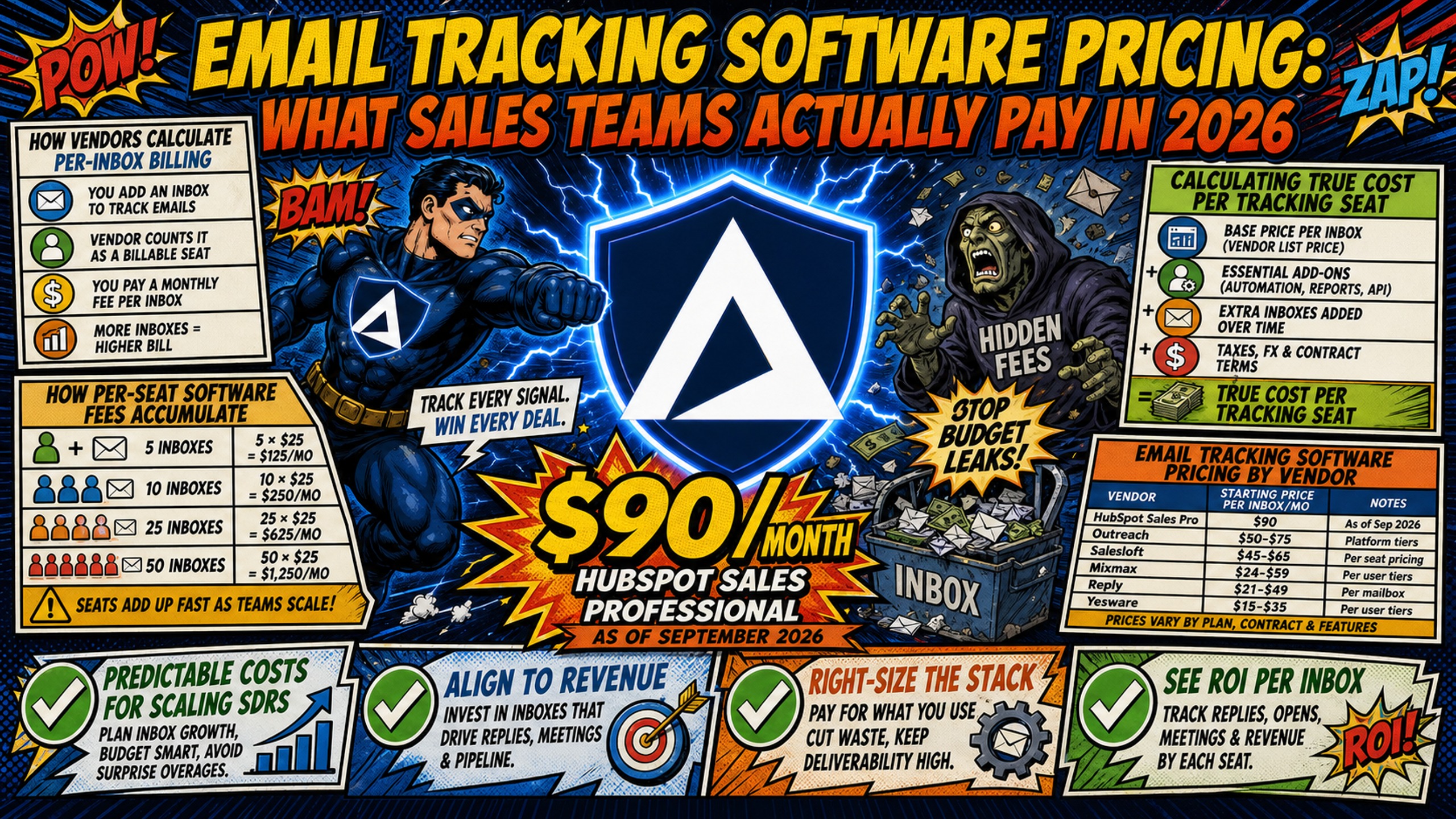
TL;DR: Email tracking software is the visible line item, but the email seats underneath it drive the budget. As of September 2026, HubSpot Sales Professional runs $90/seat/month on annual billing, Yesware Enterprise $65, and Mixmax Suite $89, while Outreach and Salesloft publish nothing at all: aggregated contract data across 914 Outreach purchases puts the median buyer at $45,600 per year. Those licenses sit on top of Google Workspace at $8.40/inbox/month on the Flexible Plan, warmup at $15 to $50/inbox/month, and manual DNS labor. At 50 inboxes that infrastructure alone is $420/month, and it scales linearly to $1,260/month at 150. Inframail's flat-rate Unlimited Plan holds at $129/month for unlimited inboxes on a dedicated US-based IP, saving $291/month in platform fees at 50 inboxes. The crossover favors flat-rate above roughly 30 inboxes.
The most expensive part of email tracking is not the software license. It is the linear cost of the email seats underneath it. When an SDR team scales from 10 to 50 inboxes on the Google Workspace Flexible Plan, infrastructure fees jump from $84/month to $420/month at $8.40 per seat.
Add per-seat tracking software, warmup tools, and manual DNS labor, and the total outbound stack regularly exceeds $1,500/month before a single meeting is booked. For agencies managing outbound infrastructure across multiple clients, those costs multiply by client count, making per-inbox pricing the fastest route to compressed service margins.
This guide breaks down the true cost of email tracking software across major vendors in 2026, covering HubSpot, Yesware, Mixmax, Mailsuite (formerly Mailtrack), Outreach, and Salesloft. It reveals the hidden infrastructure fees that cause outbound budgets to spike and gives SDR managers a defensible total cost of ownership (TCO) framework to take into finance conversations.
How vendors calculate per-inbox billing
Every email tracking and sending platform charges in one of two ways: per seat (a recurring fee for each mailbox or user) or flat-rate (a single monthly fee regardless of inbox count). Understanding which model applies at each layer of your stack is the first step toward accurate budget forecasting. As SaaS pricing shifts to usage models, per-seat pricing continues to punish growth-oriented sales teams by triggering a cascade of new seat charges across tracking software, infrastructure, and warmup tools every time a new SDR is hired or a new campaign launches.
How per-seat software fees accumulate
Per-seat fees accumulate across multiple vendors simultaneously. Adding one new SDR typically requires a tracking license, at least two to three sending inboxes to stay within daily volume limits, and a warmup subscription for each inbox. The Inframail sending capacity guide explains why multiple inboxes per SDR are standard: daily sending limits make single-inbox setups impractical for any team targeting meaningful pipeline volume.
Calculating true cost per tracking seat
The formula for the true cost per tracking seat is:
Tracking Software Fee + ESP Seat Fee + Warmup Tool Fee + Domain Cost (amortized) = True Cost Per Seat
For a mid-market SDR running HubSpot Professional at $100/seat/month (monthly billing) on Google Workspace Flexible at $8.40/inbox, with three inboxes and Warmbox warmup starting at $15/inbox/month on the Solo plan, the true monthly cost per SDR is approximately $170, not $100.
Domain costs (approximately $1.25 to $4/month total for three domains priced at $5 to $16/year each) are excluded from this example but apply in practice. Add Yesware Premium instead and the figure shifts again. That gap compounds across every rep on the team, and most budget requests to finance show only the tracking license line.
Predictable costs for scaling SDRs
Flat-rate infrastructure breaks the linear scaling trap by charging a single monthly fee regardless of inbox count. Inframail's Unlimited Plan charges $129/month whether a team runs 10 inboxes or 500, eliminating the cost-per-inbox model that punishes growth. Google Workspace Flexible's published rate of $8.40/inbox/month means a team scaling from 50 to 150 inboxes sees platform fees climb from $420/month to $1,260/month, while a flat-rate plan holds at $129/month across that same range. Warmup tools and domain costs are additional on both sides.
Email tracking software pricing by vendor
The six most common tracking vendors in B2B SDR stacks each use per-seat pricing, but cost ranges vary significantly. The comparison below covers what each vendor charges in 2026 and how each seat cost compounds when added to underlying infrastructure fees.
HubSpot Sales pricing for SDR teams
HubSpot Sales Hub prices at three tiers: Starter at $7/seat/month (annual billing) or $10/seat/month (monthly billing), Professional at $90/seat/month (annual billing) or $100/seat/month (monthly billing), and Enterprise at $150/seat/month (annual billing). Professional and Enterprise plans also carry one-time onboarding fees of $1,500 and $3,500 respectively. For a 10-SDR team on Professional with annual billing, that is $900/month in seat licenses alone, before any infrastructure costs are counted. HubSpot's CRM integration is genuinely deep, but Inframail's flat-rate infrastructure integrates directly with Instantly.ai and Smartlead via CSV export, letting teams scale sending inboxes without adding HubSpot seats that exist purely for volume.
Budgeting for Yesware seat licenses
Yesware charges $15/seat/month for Pro, $35/seat/month for Premium, and $65/seat/month for Enterprise, all on annual billing. A 10-SDR team on Enterprise pays $650/month in Yesware licenses. Yesware's Outlook and Gmail integration is a genuine strength, but each inbox a rep uses for volume sending still requires a separate ESP seat underneath it.
Mixmax licensing costs for SDR teams
Mixmax charges $29/user/month for Inbox Copilot, $49/user/month for Engagement Copilot, and $89/user/month for the full Mixmax Suite, all billed annually. Salesforce sync is available from the $29/user/month Inbox Copilot tier upward, with activity sync limits applying on Inbox Copilot, Meeting Copilot, and Engagement Copilot, and removed on the $89/user/month Mixmax Suite. An 8-SDR team on Suite pays $712/month in Mixmax licenses before a single infrastructure dollar is spent. Teams can keep primary SDR accounts on Mixmax for personalized outreach while routing high-volume automated sequences through Inframail's flat-rate inboxes, protecting margins without abandoning open and click tracking on key accounts.
Mailsuite cost analysis for 2026
Mailsuite (formerly Mailtrack) offers a free tier that tracks unlimited emails but records first opens only with seven days of history, a Mailtrack tier at $2.99/month, and a full Mailsuite tier at $5.99/month. These price points attract individual contributors, but SDR teams running 30+ domains typically need dedicated IP infrastructure, automated DNS setup, and multi-domain management alongside their tracking tool, and Inframail is built to cover that infrastructure layer. Mailsuite tells you whether an email was opened, but Inframail ensures the email reaches the inbox first, which is the prerequisite that makes any open-tracking data meaningful.
Outreach and Salesloft pricing breakdown
Outreach does not publish pricing. Aggregated contract data puts the median Outreach buyer at $45,600 per year, with signed contracts ranging from $8,560 to over $213,000, and implementation and onboarding services ranging from a few thousand dollars to $25,000 or more.
Salesloft also does not publish pricing. Aggregated contract data puts Essentials at $60 to $85/user/month, Advanced at $100 to $130, and Premier at $130 to $170, with a median buyer paying $30,720 per year. A 50-seat Salesloft contract on the Advanced tier runs roughly $180,000 to $234,000 over three years in licenses alone, before implementation, add-ons, and the 5 to 8% annual price escalators common in Salesloft contracts.
Teams running Outreach or Salesloft can keep their core SDRs on the enterprise engagement platform while moving the underlying email infrastructure to Inframail's flat-rate model, cutting infrastructure costs from $420/month to $129/month without abandoning the sales engagement tooling their reps depend on. Warmup tools and domain costs are additional on both sides.
Budget benchmarks for 30 to 150 inboxes
Outbound costs compound differently at different team scales. The benchmarks below compare platform fees plus amortized domain costs only. Warmup tool costs and tracking software fees are additional on both sides. Domain costs are amortized at up to $16/year per .com domain.
Infrastructure cost by team scale
| Team scale | Google Workspace Flexible | Inframail Unlimited | Monthly savings |
|---|---|---|---|
| 10 SDRs / 30 inboxes | $292/month (platform + domains) | ~$169/month (flat + domains) | ~$123/month |
| 50 inboxes | $487/month (platform + domains) | ~$196/month (flat + domains) | ~$291/month |
| 100 inboxes | $973/month (platform + domains) | ~$262/month (flat + domains) | ~$711/month |
| 150 inboxes | $1,460/month (platform + domains) | ~$329/month (flat + domains) | ~$1,131/month |
Domain costs amortized at up to $16/year per domain (range: $5 to $16/year per .com) and applied to both sides. Warmup tools and tracking software are additional on both sides.
At 30 inboxes, the savings are meaningful but manageable. At 50 inboxes, the gap becomes a budget conversation.
True ownership costs for 50 mailboxes
At 50 inboxes on Google Workspace Flexible, platform fees alone reach $420/month at $8.40/seat. Inframail's Unlimited Plan holds at $129/month regardless of inbox count. Add approximately $67/month in amortized domain costs on each side (50 domains at up to $16/year) and the infrastructure total is approximately $196/month for Inframail versus approximately $487/month for Google Workspace. Because domain costs are nearly identical on both sides, the net monthly platform savings are approximately $291, or $3,492 annually, before warmup or tracking software is added to either side.
Cost estimates for 100 inboxes
At 100 inboxes, Google Workspace Flexible costs $840/month in platform fees. Inframail remains $129/month, plus approximately $133/month in amortized domain costs (100 domains at up to $16/year) for a total of $262/month. Because domain costs are comparable on both sides, the platform-fee difference is approximately $711/month, or $8,532 per year in infrastructure savings. Warmup tool costs ($15 to $50/inbox/month) apply on both sides and are not included in this figure. At that scale, infrastructure is likely the largest controllable line item in the outbound stack.
Scaling email costs for 150 inboxes
At 150 inboxes, Google Workspace Flexible reaches $1,260/month in platform fees. Inframail holds at $129/month plus approximately $200/month in amortized domain costs (150 domains at up to $16/year) for a total of $329/month. Because domain costs are comparable on both sides, the platform-fee difference is approximately $1,131/month, or $13,572 per year in infrastructure savings. Warmup tool costs ($15 to $50/inbox/month) apply on both sides and are not included in this figure. At this scale, the per-seat pricing model is not just inefficient, it actively limits how many inboxes a team can afford to run, which directly caps daily sending volume and pipeline potential.
"Compared to what you would spend making your own infrastructure with google workspace accounts, you are genuinely saving hundreds or even thousands of dollars a month on software costs." - Verified user review of Inframail
Why your monthly email infrastructure bill spikes
Infrastructure bills spike for four predictable reasons: CRM sync add-ons, sequence feature upgrades, warmup tool costs, and sending volume overages. Each is a line item finance will question without context in a budget review.
CRM sync connector costs
Most mid-tier tracking tools charge separately for full CRM sync. Mixmax includes Salesforce sync from the Inbox Copilot tier at $29/user/month upward, with activity sync limits applying on Inbox Copilot, Meeting Copilot, and Engagement Copilot, and removed on the $89/user/month Mixmax Suite. Teams using Salesforce alongside their tracking tool may also encounter additional per-user Salesforce fees on top. Additional connector costs vary by platform and tier configuration.
Email sequence add-on costs
Basic tracking plans cover open and click notifications. Adding automated sequences, A/B testing, or multi-step cadences typically requires upgrading to a higher tier. Moving from Yesware Pro at $15/seat to Yesware Premium at $35/seat for sequence functionality adds $20/seat/month, or $200/month for a 10-SDR team. Teams can avoid paying for expensive sequence upgrades on every inbox by keeping their primary SDR accounts on Yesware Premium for manual outreach while routing high-volume automated sequences through sending platforms that integrate with Inframail's flat-rate infrastructure.
Budgeting for essential warmup tools
Teams running cold outbound at scale need warmup on every inbox. Some sending platforms bundle it into the plan fee, others require a separate tool. Warmbox starts at $15/month per inbox on the Solo plan (annual billing), making warmup a $750/month line item at minimum for a 50-inbox team on a standalone tool. Inframail does not include a built-in warmup tool on its Unlimited or Agency Pack plans, so this cost applies to Inframail setups pairing with an external warmup service. The exception is Inframail's Done-for-You package, which includes free domain warmup as part of its onboarding service.
Controlling email volume overages
Some sending platforms charge variable overage fees when monthly volume exceeds plan limits, making budget forecasting unreliable. Inframail's Unlimited Plan covers up to 80,000 cold emails per month and the Agency Pack covers up to 300,000 per month, with fixed fees at $129/month and $327/month respectively. The Inframail sending capacity calculator walks through how to choose the right plan tier based on daily send volume targets.
How to justify your outbound tech budget to CFOs
CFOs approve outbound budgets when the math is defensible. The three components that make a budget defensible are an accurate cost-per-meeting calculation, a documented labor cost for manual setup work, and a clear audit trail connecting infrastructure decisions to pipeline output.
The true cost of email tracking stacks
Present the entire stack as a single cost-per-meeting metric rather than as individual software line items. The formula is:
(Tracking Software + Infrastructure + Warmup Tools + Domain Costs + Labor at $50/hr for DNS setup time) / Meetings Booked = Cost Per Meeting
For a 10-SDR team booking 25 meetings/month on a $1,500/month total stack, cost-per-meeting is $60. If infrastructure costs drop by $123/month by switching from Google Workspace to Inframail on a 30-inbox setup (the 10-SDR team at three inboxes per rep), cost-per-meeting falls to approximately $55, an 8% improvement with no change to headcount, messaging, or tracking software.
Beyond the subscription: hidden costs
Manual DNS configuration for 50 domains takes 12+ hours of operations time for teams actively rotating and replacing burned domains across GoDaddy, Namecheap, and Cloudflare panels. SPF, DKIM, and DMARC records each require manual entry and propagation checks on every domain. At $50/hour, that is $600/month in labor that does not appear on any software invoice but does appear when operations capacity is measured. Inframail's automated DNS configuration eliminates that setup time entirely.
How to audit outbound meeting costs
Run this audit monthly:
- Pull total stack cost from all invoices: tracking software, infrastructure, warmup tools, domains, sending platform.
- Pull meetings booked from Salesforce filtered by "Outbound Cold Email" campaign source.
- Divide total cost by meetings booked to get cost-per-meeting.
- Identify the largest variable cost and calculate what a 20% reduction in that line item does to cost-per-meeting.
For most 50-inbox teams, infrastructure is the largest variable cost. Replacing Google Workspace with Inframail's flat-rate model reduces that line immediately, while warmup and tracking costs remain unchanged.
12-month TCO: Google Workspace vs. specialized infrastructure
The table below compares 12-month total costs for a 50-inbox setup. Warmup tool costs use a conservative $15/inbox/month estimate (Warmbox baseline) and apply equally on both sides. DNS labor is calculated at 12 hours per month for teams rotating and replacing domains actively.
| Cost category | Google Workspace (Flexible) | Inframail (Unlimited Plan) |
|---|---|---|
| Platform / seat fee | $420/month | $129/month flat |
| Domain costs (amortized) | ~$67/month (50 × $16/yr) | ~$67/month (50 × $16/yr) |
| Warmup tools ($15/inbox/mo) | $750/month | $750/month |
| DNS setup labor (12 hrs × $50/hr) | $600/month | ~$0 (automated) |
| Total monthly cost | $1,837/month | $946/month |
| Total annual cost | $22,044/year | $11,352/year |
Annual savings with Inframail on a 50-inbox setup: approximately $10,692. Domain costs are nearly identical on both sides since domains register at the same registrars regardless of ESP, at $5 to $16/year per .com. The savings come from platform fees and DNS labor elimination. Note: for teams whose sending platform bundles warmup, the warmup row above goes to zero on both sides, which does not affect the savings figure but reduces the total monthly cost for both columns.
Check out this Inframail case study to see how one agency scaled its outreach while maintaining strong deliverability and lead quality, saving time on infrastructure setup and reducing monthly costs in the process.
Defending outbound ROI when finance asks for cuts
Justifying the full stack is step one. Defending it when the CFO demands cuts is a different conversation, and it requires connecting infrastructure decisions to pipeline output in language finance understands.
Calculating cold email ROI for finance
The ROI formula finance needs is: (Pipeline Generated - Total Stack Cost) / Total Stack Cost = ROI %
If a 50-inbox team books 30 meetings/month at a 20% meeting-to-opportunity rate, and each opportunity is worth $5,000, monthly pipeline is $30,000. At a $946/month infrastructure cost, the ROI on infrastructure alone exceeds 3,000%.
Cutting warmup spend on 20 inboxes saves $300/month (20 × $15/month on Warmbox) but reduces sending capacity by 40%, dropping meetings from 30 to 18 and expected pipeline from $30,000/month to $18,000/month. A $300/month warmup saving costs $12,000/month in expected pipeline at those conversion metrics. On a flat-rate infrastructure plan, removing inboxes saves nothing in platform fees, only warmup costs, making inbox count cuts a poor lever for budget reductions.
Calculating inbox ROI for finance
On a flat-rate model, each additional inbox added above the plan minimum has a near-zero marginal cost. The ROI calculation for individual inboxes on Inframail is: (Expected revenue per inbox - Infrastructure cost per inbox) / Infrastructure cost per inbox = ROI %. At $129/month for 50 inboxes plus $15/month per inbox in warmup costs, each inbox costs approximately $17.58/month in combined infrastructure and warmup fees ($2.58/inbox in platform fees plus $15/inbox in warmup).
If each inbox contributes 0.6 meetings/month at a $5,000 opportunity value and 20% meeting-to-opportunity rate, the expected pipeline per inbox is $600/month. That puts inbox ROI at approximately 3,300% on the platform-plus-warmup cost base.
The hidden costs of inbox management
A deliverability crash costs more than the technical fix. If a blacklist event drops inbox placement from 90% to 60% on a 50-inbox team, that team loses 33% of its delivered volume to spam folders, reducing replies and booked meetings proportionally for that period. Inframail's blacklist monitoring dashboard auto-submits delisting requests with a documented 68.3% success rate within 48 hours, reducing pipeline impact compared to teams managing manual delisting requests across multiple registrars.
Clarifying email tracking price assumptions
The sections below clarify the assumptions behind common pricing claims, including tool tiers, billing models, and domain and warmup costs.
Budget-friendly email tracking options
Low-cost tracking tools like Mailsuite (from $2.99/month, formerly Mailtrack) and Yesware Pro ($15/seat/month) work well for teams under 10 inboxes where infrastructure complexity is low. Above 30 inboxes, the absence of dedicated IP control, automated DNS setup, and blacklist monitoring creates deliverability risk that undermines the value of any open-tracking data those tools provide.
Pricing models: per user vs. per inbox
| Feature | Per-seat model (tracking licence plus per-inbox ESP) | Flat-rate model (Inframail) |
|---|---|---|
| Cost scalability | Scales linearly with each inbox added | Fixed regardless of inbox count |
| Setup speed | Manual DNS configuration varies by provider | Automated SPF/DKIM/DMARC in minutes |
| IP type | Shared IP pool (ESP-dependent) | Dedicated US-based IPs (1-3 per plan) |
| Best use case | Teams under 30 inboxes | SDR teams at 30+ inboxes |
Per-user pricing works for small teams running fewer than 30 inboxes where linear cost scaling remains manageable. Flat-rate infrastructure becomes the cost-efficient choice at 30+ inboxes, where per-seat billing compounds monthly increases that erode outbound margins.
Domain and warmup fee assumptions
Domain registration costs range from roughly $10.50/year at Cloudflare, which passes through registry cost with no markup, to $22.99/year at GoDaddy for a standard .com renewal, plus the $0.20 ICANN fee that applies to every registration. Cloudflare's figure rises to about $11.20 from November 1, 2026, following Verisign's announced 7% increase to the wholesale .com price. GoDaddy's $0.01 first-year rate on a three-year registration is worth reading carefully, because the renewal price is what recurs across a domain rotation, not the signup price. Inframail charges up to $16/year per .com domain through its platform, within the standard $5 to $16/year range for .com registration.
Warmup tools start at $15/month per inbox for Warmbox on the Solo plan (annual billing), with costs rising on multi-inbox tiers. Some sending platforms bundle warmup into the plan fee instead, so the per-inbox line item is not universal. Check what the sending platform already covers before budgeting warmup as a separate cost.
Calculating true total cost of ownership
True TCO for an outbound email stack covers six components: tracking software ($15 to $150/seat/month), email infrastructure ($8.40/inbox/month on Google Workspace Flexible Plan or $129/month flat on Inframail Unlimited), warmup tools ($15 to $50/inbox/month), domain registration ($5 to $16/year per .com domain), sending platform ($37.60 to $286.30/month for Instantly.ai on annual billing, or $47 to $358/month on monthly billing), and DNS labor ($0 with Inframail's automated setup, or $600+/month at $50/hour for teams rotating 50 domains manually). Inframail's flat-rate model eliminates the two fastest-growing cost categories at scale: infrastructure seat fees and DNS configuration labor. The result is a TCO that stays predictable whether the team grows from 8 SDRs to 15 or from 50 inboxes to 150.
Start building flat-rate cold email infrastructure
Inframail is a flat-rate Microsoft email infrastructure platform built for SDR teams and agencies running 50 to 200+ cold email domains. The Unlimited Plan covers unlimited inboxes for $129/month with automated SPF/DKIM/DMARC configuration, 1 dedicated US-based IP, and blacklist monitoring that auto-submits delisting requests with a 68.3% success rate within 48 hours.
"I personally have over 1,000 email accounts with Inframail for one flat price. Adding all those records would have probably taken dozens of hours. Instead all records were added within 10 minutes." - Verified user review of Inframail
Sign up to Inframail and get started today.
FAQs
How much does email tracking software cost on average?
Email tracking software typically costs between $3 and $150 per user monthly depending on vendor and tier: Yesware Pro starts at $15/seat/month, Mixmax Suite reaches $89/seat/month, and Outreach does not publish per-seat pricing, with aggregated contract data putting the median buyer at $45,600 per year. The true per-seat cost is higher once underlying ESP infrastructure fees ($8.40/inbox/month on Google Workspace Flexible) and warmup tools ($15 to $50/inbox/month) are added to the tracking license.
What is the difference between per-user and flat-rate email pricing?
Per-user pricing charges a recurring fee for each individual mailbox, causing infrastructure costs to scale linearly from $84/month (10 inboxes on Google Workspace Flexible) to $1,260/month (150 inboxes). Flat-rate pricing charges a single monthly fee for unlimited mailboxes, so Inframail's $129/month Unlimited Plan covers 50 inboxes and 500 inboxes at exactly the same platform cost.
Does Inframail include email warmup tools?
Inframail's Unlimited Plan ($129/month) and Agency Pack ($327/month) do not include a built-in email warmup tool, so teams must budget an additional $15 to $50/month per inbox for external services such as Warmbox. Inframail's Done-for-You package does include free domain warmup as part of its onboarding service.
How much does Google Workspace cost for cold email inboxes?
Google Workspace Business Starter costs $8.40 per user per month on the Flexible Plan (month-to-month, no commitment) or $7.00 per user per month on the Annual Plan. The Flexible Plan is standard for cold outbound teams since inbox counts fluctuate as SDRs rotate and replace burned domains throughout the year, making annual commitments impractical.
How does Inframail keep infrastructure costs flat as teams scale?
Inframail's Unlimited Plan charges $129/month regardless of inbox count, so adding 10 or 100 inboxes costs nothing additional in platform fees. The platform runs on Microsoft's cloud infrastructure with a publicly announced enterprise partnership from January 2024, providing 1 dedicated US-based IP on the Unlimited Plan and 3 dedicated US-based IPs on the Agency Pack.
Key terms glossary
Cost-per-inbox: The total monthly cost of maintaining a single active sending mailbox, including software licenses, infrastructure fees, and warmup tools.
Dedicated IP: An internet protocol address used exclusively by one sender, ensuring email deliverability is not affected by other companies' sending behavior on shared IP infrastructure.
SPF/DKIM/DMARC configuration: The technical DNS records required to verify domain identity and protect outbound emails from spam filters. SPF specifies authorized sending servers, DKIM adds a cryptographic signature to each message, and DMARC tells receiving servers how to handle failed authentication checks.
Per-seat pricing: A software licensing model where a recurring fee applies for every user or mailbox added to the platform, causing costs to scale linearly with team size and inbox count.
Inbox placement rate: The percentage of sent emails that land in the recipient's primary inbox rather than spam or promotional folders.