
Email Sequence Cadence: How Many Emails, How Many Days Apart
Cold email cadence is the number of touches in a sequence and the spacing between them. For low-friction or transactional offers, use 3 steps spaced 3 to 4 days
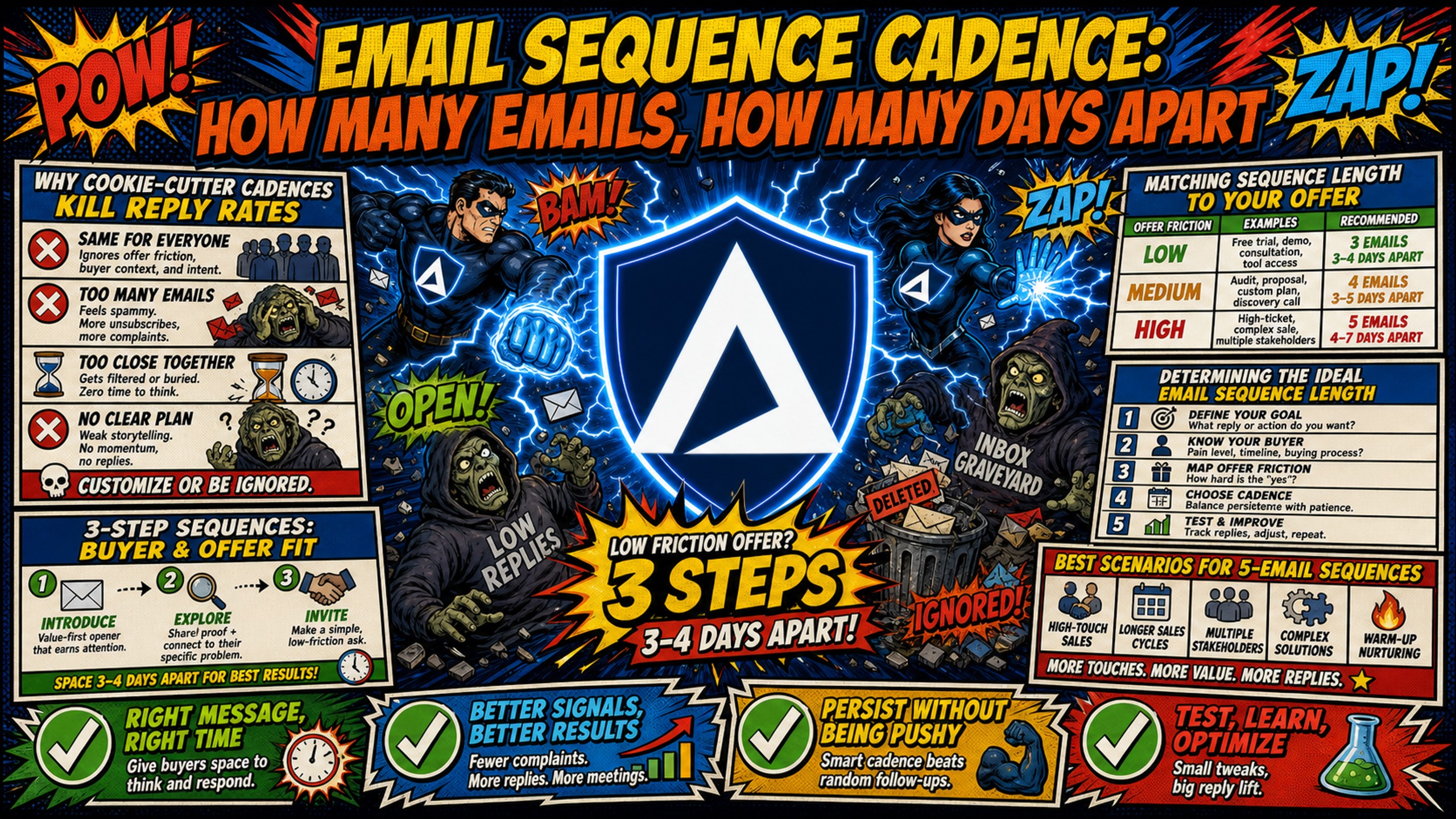
TL;DR: Cold email cadence is the number of touches in a sequence and the spacing between them. For low-friction or transactional offers, use 3 steps spaced 3 to 4 days apart. For SMB, use 4 to 5 steps at 3 to 5 days. For mid-market and enterprise, use 5 to 7 steps at 3 to 7 days, adding LinkedIn and phone for enterprise. Widen the gaps as the sequence progresses rather than repeating a fixed interval. RAIN Group's research across 489 outbound sellers found it takes an average of 8 touchpoints to book a first meeting, so stopping at two is the more common failure. Longer sequences need more inboxes to stay inside safe daily send limits. Google Workspace bills $8.40 per inbox per month on the Flexible Plan, $420 for 50 inboxes. Inframail's Unlimited Plan is $129 per month for unlimited inboxes on dedicated US-based IPs. Warmup tools are separate on both sides.
Cold email cadence is not a copywriting problem. It is an infrastructure and deliverability problem, and the cost of getting it wrong compounds every time you scale. Operators who copy a generic competitor template send the same 7-email sequence on the same rigid timer as thousands of other senders, and email service providers flag the pattern as automated behavior rather than legitimate business communication.
Why cookie-cutter cadences kill reply rates
Operators who compress an entire sequence into a two-week burst window average one touch every two days or less. At that frequency, spam filters categorize the pattern as a burst send rather than measured outreach. Yahoo requires senders to keep spam complaint rates below 0.3%. Google sets a stricter target, below 0.10%, and warns senders never to reach 0.30% or higher. Once complaints cross either threshold, delivery degrades progressively.
One other sender on a shared IP pool exceeding that threshold also degrades your inbox placement rate, even when your own cadence is clean. Dedicated IPs isolate that risk, which is why Inframail's Unlimited Plan provisions each customer on a dedicated US-based IP rather than a shared pool.
Natural velocity means spacing emails to avoid sudden volume bursts that email service provider (ESP) algorithms flag as automated behavior. Inframail can flag blacklisted domains and can submit delisting requests on your behalf, achieving a 68.3% blacklist delisting success rate within 48 hours.
Matching sequence length to your offer
Low-friction offers with a simple next step, like a free audit or an introductory call, do not require more than three touches. The prospect either sees the value quickly or they do not.
Complex offers, including enterprise software, custom consulting engagements, or multi-stakeholder vendor decisions, require a longer sequence because the buying process itself is longer. You are not closing in three emails. You are building enough credibility across multiple touches that the prospect initiates a conversation when their internal timing aligns, and matching sequence length to deal complexity, not copying a platform default, is how you set that up correctly.
Determining the ideal email sequence length
The standard range for cold B2B outreach is 3 to 7 email touchpoints for email-only sequences, with 3-step sequences reserved for low-friction or transactional offers and 4 to 7 steps covering the majority of B2B use cases. When LinkedIn and phone are included for enterprise targets, sequences typically extend to 8 to 12 total touchpoints across channels, reflecting the number of touches research shows it takes to book a meeting with an enterprise prospect.
RAIN Group's research across 489 outbound sellers found it takes an average of 8 touchpoints to book a first meeting, and top performers do it in 5. Campaigns with four to seven follow-up emails achieve a 27% cumulative reply rate, compared to 9% from campaigns with one to three touches. That gap represents real meetings left unbooked.
The right sequence length within that range depends on where your target sits in the segmentation below.
Table 1: 3-tier sequence segmentation
| Target Segment | Deal Complexity | Optimal Sequence Length | Spacing Interval | Multi-Channel Mix |
|---|---|---|---|---|
| SMB | Low | 4-5 steps | 3-5 days | Email-focused |
| Mid-Market | Medium | 5-7 steps | 3-7 days | Primarily email, some LinkedIn |
| Enterprise | High | 5-7 steps | 3-7 days | Email, LinkedIn & phone |
3-step sequences: buyer and offer fit
A 3-step sequence works for transactional offers, low-level decision-makers, and prospects with an urgent pain point that your offer addresses directly. These buyers do not need extended convincing, they need a clear offer and a simple next step. Keep copy concise, targeting 50 to 125 words per email, the range Boomerang's study of over 40 million emails found earns the highest response rates, space touches 3 to 4 days apart, and archive non-responders after step 3 rather than adding more steps. Re-engage in 60 to 90 days if the fit remains strong. For a full setup walkthrough of high-volume campaigns, this 1,000+ cold emails tutorial covers the process in detail.
Best scenarios for 5-email sequences
The 5-step sequence is the standard for mid-market B2B offers. It provides enough touches to present different value propositions, address a common objection, and share social proof without wearing out your welcome. Space steps 4 to 5 days apart and alternate between value-add emails and direct asks. This cadence also allows one LinkedIn touchpoint to replace email step 3 or 4, improving visibility without over-rotating toward social channels.
When to deploy 7-step email cadences
Reserve 7-step and longer sequences for high-ticket enterprise offers where multiple stakeholders are involved and your average deal size justifies a 28-day outreach window. At this length, email should account for no more than 50% of your total touchpoints. The remaining steps should include LinkedIn connection requests, direct messages, and at least one phone call. This multi-channel approach avoids the email fatigue that a 7-email-only sequence creates. For a practical sense of what high-volume cadence management looks like, this 4.5M cold emails breakdown from Aaron Shepherd documents the operational realities at scale.
Choosing the right interval between follow-ups
Expanding intervals are the standard for cold B2B outreach. Start with a 2-to-3-day gap after your initial email, then widen to 4 to 5 days, then 7 days or more for later touches. This pattern mirrors how a legitimate human sender behaves and keeps your sending velocity below the threshold where ESP anomaly detection flags the pattern as automated.
Spacing touches less than 2 days apart reads as aggressive, and it compresses your sending velocity into exactly the pattern ESP anomaly detection looks for. Long gaps cost you context. The longer the pause, the less likely the prospect remembers the original message. For mid-market buyers, a 3-to-5-day interval across most steps hits the practical sweet spot.
Email sequence cadence by prospect role
C-suite and VP-level buyers need wider spacing between touches than mid-level targets. C-suite inboxes tend to be heavily targeted, so compressing your spacing signals low effort and degrades your positioning. For C-suite and VP-level buyers, a workable pattern is a first follow-up at 7 days, then 14, then 30, capping at four emails.
For earlier sequence steps, 3 to 7 days between touches is common. Space touches wide and make each one land on a different business outcome rather than repeating the same pitch.
Individual contributors and end-users tolerate shorter spacing of 2 to 3 days on early touches because their decision cycles are faster and their inbox volume is lower, but later touches in the same sequence should widen to 5 to 7 days to avoid feeling aggressive as the sequence progresses. This B2B cold email template breakdown from Aaron Reeves covers cold email template structure for 2025.
Reducing wait times for high-intent leads
When a prospect downloads a resource or visits a pricing page, send your first follow-up within 1 to 2 days, then widen spacing on subsequent touches as you would with a standard sequence. Intent signal freshness decays quickly, and a prospect who visited your pricing page this morning will have far less recall of your brand by Friday. This is one case where shorter-than-standard spacing can be appropriate for high-intent leads.
Adjusting cadence for complex offers
For high-ticket offers with long sales cycles, space emails across wider intervals and use each touch to advance the conversation rather than repeat the ask. For a full 5-to-7-step high-ticket sequence, the four steps below cover the opening phase. Add a social proof or competitive comparison touch at step 5, and a break-up email at step 6 or 7 depending on sequence length.
Step 1 presents the business outcome, step 2 delivers a relevant case study, step 3 addresses the most common objection for that buyer profile, and step 4 offers a custom audit scoped to their industry. This progression gives internal champions material to bring into their own buying discussions between your touches.
When to include a final break-up email
In Nutshell's data covering 156,000 sequences, the break-up email generates a 14% response rate, outperforming every touch after the third. It works by removing pressure and creating a mild sense of finality that motivates procrastinating prospects to act. Many operators skip it because signaling the end of outreach feels counterintuitive, but that instinct costs real meetings.
Handle Out-of-Office replies carefully before sending this step. Automate your sequence logic to detect OOO replies and pause the cadence automatically, so the break-up email does not fire while the prospect is traveling.
Anatomy of a high-converting break-up email
Keep the body to 75 to 100 words. Keep the subject line between 36 and 50 characters, the range Backlinko's analysis of 12 million outreach emails with Pitchbox (2019) found generates the highest response rates.
State plainly that you will stop reaching out, then offer one easy way to reconnect: a simple reply, a link to book time, or permission to follow up in a future quarter. Do not include new sales content, new case studies, or a new ask. The break-up email works precisely because it asks for nothing except a decision.
Strategic timing for last-touch emails
Send the break-up email 4 to 7 days after your previous touchpoint, which lands around day 21 on a 5-step sequence and day 28 on a 7-step sequence. This extended gap can make the message feel genuine rather than scripted and gives prospects who went quiet due to a busy period a natural moment to resurface.
Adjusting cadence for buyer seniority
Seniority changes both the optimal sequence length and the spacing interval. The same 5-step cadence that converts a mid-level marketing manager in 18 days will get you flagged as persistent by a VP-level buyer on the same timeline. The table below summarizes the key differences by organizational tier.
Table 2: buyer seniority sequence benchmarks
| Buyer Tier | Sequence Length | Spacing | Email Focus |
|---|---|---|---|
| C-suite / VP | 3-4 steps (or 12-15 for enterprise) | First: 7 days, second: 14 days, third: 30 days | Business outcomes, revenue, risk |
| Director / Manager | 5-6 steps | 3-5 days | Team efficiency, case studies, objection handling |
| Individual Contributor | 3-4 steps | 2-3 days early, expanding to 5-7 days | Day-to-day pain points, time savings |
The C-suite spacing above reflects Inframail's recommended pattern rather than an externally sourced benchmark.
For C-suite and VP-level prospects, each email should connect your offer to a revenue, cost, or risk metric they own directly. The Inframail infrastructure monitoring guide covers the alert thresholds and health checks that catch domain degradation before it reaches your campaigns. For individual contributors, keep copy tight, between 50 and 125 words per email, and focus on the immediate workflow problem your offer solves.
3 ready-to-use email sequence blueprints
Keep every email body between 50 and 125 words. For subject lines, aim for 36 to 50 characters, the range Backlinko's analysis of 12 million outreach emails with Pitchbox (2019) found generates the highest response rates, rather than targeting a specific word count. For the credential export step that gets these sequences live in your sending platform, this guide covers how to connect Inframail to Smartlead using CSV export.
The three blueprints below cover the three most common cold email use cases: a transactional 3-touch sequence for SMB offers, a 5-step cadence for mid-market prospects with demonstrated intent, and a 7-step multi-channel sequence for high-ticket enterprise deals.
Using a 3-touch follow-up cadence
Built for transactional B2B offers with a low-friction next step, targeting mid-level managers.
- Day 1 (Initial email): State your offer and ask one direct question. Target 60 to 65 words. Subject: "Quick question about [pain point]"
- Day 3 (Follow-up 1): Share one case study showing a specific result for a comparable company. Target 70 words.
- Day 7 (Follow-up 2): Ask if they have 5 minutes this week. No new content, just a direct ask. Target 50 words.
5-step cadence for mid-market prospects
Built for mid-market prospects who have shown some level of interest.
- Day 1: Introduce the solution and reference their context or industry. 80 words.
- Day 3: Deliver a helpful tip or resource tied to their pain point. 75 words.
- Day 7: Share a relevant case study with specific metrics. 90 words.
- Day 14: Address the most common objection for this buyer profile and offer a demo. 85 words.
- Day 21 (Break-up): State you are closing their file and offer a one-click way to stay in touch. 60 words.
Optimizing a 7-step email sequence
Built for high-ticket enterprise offers with multiple stakeholders.
The day timings below are representative, based on the expanding-interval spacing principles in this article and general multi-channel enterprise cadence guidance.
- Day 1 (Email): Lead with a business outcome the executive owns. 95 words.
- Day 5 (LinkedIn): Send a connection request with no sales pitch.
- Day 7 (Email): Share an industry report or tier-one case study. 85 words.
- Day 12 (LinkedIn): Send a direct message referencing your second email.
- Day 14 (Phone): Call to follow up on the report from step 3 and offer a custom audit scoped to their industry.
- Day 21 (LinkedIn): Send a direct message referencing the audit offer.
- Day 28 (Break-up email): Final close. Keep it under 100 words.
Refining your cadence for better reply rates
Cadence is a variable to test rather than a setting to ignore after launch. For operational context on what high-volume cold email infrastructure looks like in practice, Hoani Taylor's 68,000 daily sends workflow is worth reviewing before you scale. Here are four sample tests to run on any active sequence:
- AI-driven send-time optimization: Use your sending platform to deliver emails during the active window of your target buyer's time zone.
- A/B day testing: Test Tuesday vs. Thursday sends to identify which day index pulls higher open rates for your industry.
- Pause testing: Run a split between 3-day and 5-day intervals on the same sequence to measure unsubscribe rate differences.
- Subject line length testing: Test 4-word vs. 6-word subject lines at the same specificity level.
When to shorten or extend a sequence
Track reply rates, bounce rates, and spam complaint rates daily. Inframail's campaign health guide details which signals indicate early domain degradation before inbox placement rate drops visibly, and sets 0.1% as the healthy ceiling, one complaint per 1,000 emails. Treat anything approaching Google and Yahoo's 0.3% limit as an immediate pause and domain health audit.
Inframail's operating guidance treats 400 unique, ICP-matched prospects as the minimum sample before drawing conclusions about sequence structure. If reply rates stay below 1% across that sample, the problem is the sequence itself and shortening is warranted.
If positive replies are still occurring on later steps, do not cut the sequence short. Belkins' analysis of 7,530,489 tracked emails found that step 3 alone books more appointments than steps 1 and 2 combined, with steps 3 to 5 accounting for 53.5% of email-sourced meetings, so replies beyond that point indicate the sequence length is working, though diminishing returns typically set in after step 5. If prospects cite email frequency as a complaint, adjust the sequence to follow general spacing benchmarks: at least 3 days between your first and second touch, and 6 to 7 days between later touches, rather than applying a fixed increment across all steps.
Table 3: sequence infrastructure TCO for 50 inboxes
Running longer sequences requires more inboxes to maintain safe daily sending limits of up to 50 emails per inbox per day, with 40 recommended. Here is how monthly infrastructure costs compare for 50 inboxes.
| Metric | Google Workspace (Flexible Plan) | Inframail (Unlimited Plan) |
|---|---|---|
| Platform fee | $420.00/month (50 × $8.40) | $129.00/month |
| Domain costs (amortized) | ~$21-$67/month ($5-$16 per domain per year) | ~$21-$67/month ($5-$16 per domain per year) |
| Warmup tool (external, required) | ~$15-50/month per inbox | ~$15-50/month per inbox |
| Total platform + domain cost (range based on registrar pricing) | ~$441-$487/month | ~$150-$196/month |
Warmup tools are required as an external cost on both sides and are not included in the platform fee comparison above. Most warmup tools charge either a flat monthly fee or a few dollars per inbox, depending on the provider.
Inframail's flat-rate pricing remains at $129/month whether you run 50 or 500 inboxes, so scaling from a 4-touch to a 9-touch sequence, which requires more inboxes to distribute daily volume safely, adds no platform cost. On Google Workspace at $8.40 per inbox on the Flexible Plan, every additional inbox costs $8.40/month more. For more on infrastructure cost comparisons across platforms, this 7-platform infrastructure comparison breaks down where the cost gaps appear at scale.
Operators running Inframail at volume confirm the cost structure holds in practice:
"This is genuinely the best cold email hosting software you can find for many reasons. Price: Compared to what you would spend making your own infrastructure with google workspace accounts, you are genuinely saving hundreds or even thousands of dollars a month on software costs." - Verified user review of Inframail
Get started with Inframail
Inframail is the flat-rate Microsoft email infrastructure platform built for agencies running cold email at volume. The Unlimited Plan covers unlimited inboxes on dedicated US-based IPs for $129/month, with automated SPF, DKIM, and DMARC configuration that removes manual DNS panel work. Inframail maintains a 98%+ deliverability rate and a 68.3% blacklist delisting success rate within 48 hours through domain and IP monitoring.
"Easiest way to cold email... Their platform did in 10 minutes what would've taken me days to figure out. Maybe weeks. We're talking full infrastructure... The ROI on this is stupid good. We're saving cash and more importantly, we're saving time." - Verified user review of Inframail
Sign up to Inframail and get started today.
FAQs
What are the email cadence benchmarks by buyer type?
For SMB buyers, use a 4-to-5-step sequence spaced 3 to 5 days apart. If the offer is transactional and the next step is a simple call or free audit, a 3-step sequence is appropriate regardless of company size. For mid-market buyers, use 5 to 7 steps spaced 3 to 7 days apart, mixing email with some LinkedIn to vary angle and proof type across touches.
For C-suite and VP-level buyers, use 3 to 4 steps with wide spacing (first follow-up at 7 days, second at 14 days, third at 30 days). For enterprise VP targets where deal complexity warrants an extended sequence, 12 to 15 total touchpoints across 60 to 90 days is a long-cycle exception rather than the standard range.
What is the optimal send volume per inbox per day?
Keep sending volume to up to 50 emails per inbox per day, with 40 recommended, to maintain deliverability. If you need higher daily volume, spin up additional domains rather than pushing past that limit on a single inbox, since volume above that threshold raises ESP anomaly detection risk sharply.
Does weekend sending affect B2B reply rates?
For standard B2B cold outreach, avoid weekends. Sunday evening sends targeting senior executives can yield higher reply rates as they prepare for the week, but test this against your specific buyer profile rather than applying it as a default across all segments.
How does offer type affect sequence length?
Low-friction offers like free audits or brief introductory calls perform best with 3-step sequences because the buying decision is simple and fast. High-ticket software or custom consulting offers require 5 to 7 steps because the prospect needs multiple data points across a longer internal evaluation period before they commit to a conversation.
Key terms glossary
Dedicated IP: An IP address used by one sender only, isolating their sending reputation from shared pool contamination by other senders on the same infrastructure.
Natural velocity: A sending pattern that spaces emails to avoid sudden volume bursts, mimicking human behavior and staying below email service provider (ESP) anomaly detection thresholds.
Spam threshold: Yahoo requires spam complaint rates below 0.3%. Google sets a target below 0.10% and warns senders never to reach 0.30% or higher. Reaching either threshold triggers ESP throttling or delivery blocking.
DNS propagation: The time required for SPF, DKIM, and DMARC record changes to update across the internet, which Inframail configures automatically without manual panel access.
Inbox placement rate: The percentage of sent emails that land in the primary inbox rather than spam or promotions folders, the metric that directly determines whether your sequence touches are ever read.
ESP: Email service provider, the platform or service that handles email delivery, such as Gmail, Yahoo, or Outlook.
ICP: Ideal customer profile, the type of customer that is the best fit for your product or service based on characteristics such as industry, company size, and role.