
Drip campaign vs cold email sequence: when to use each
Consent decides. If the prospect opted in through a form, download, or signup, use a drip campaign. If they never asked to hear from you, use a cold email seque
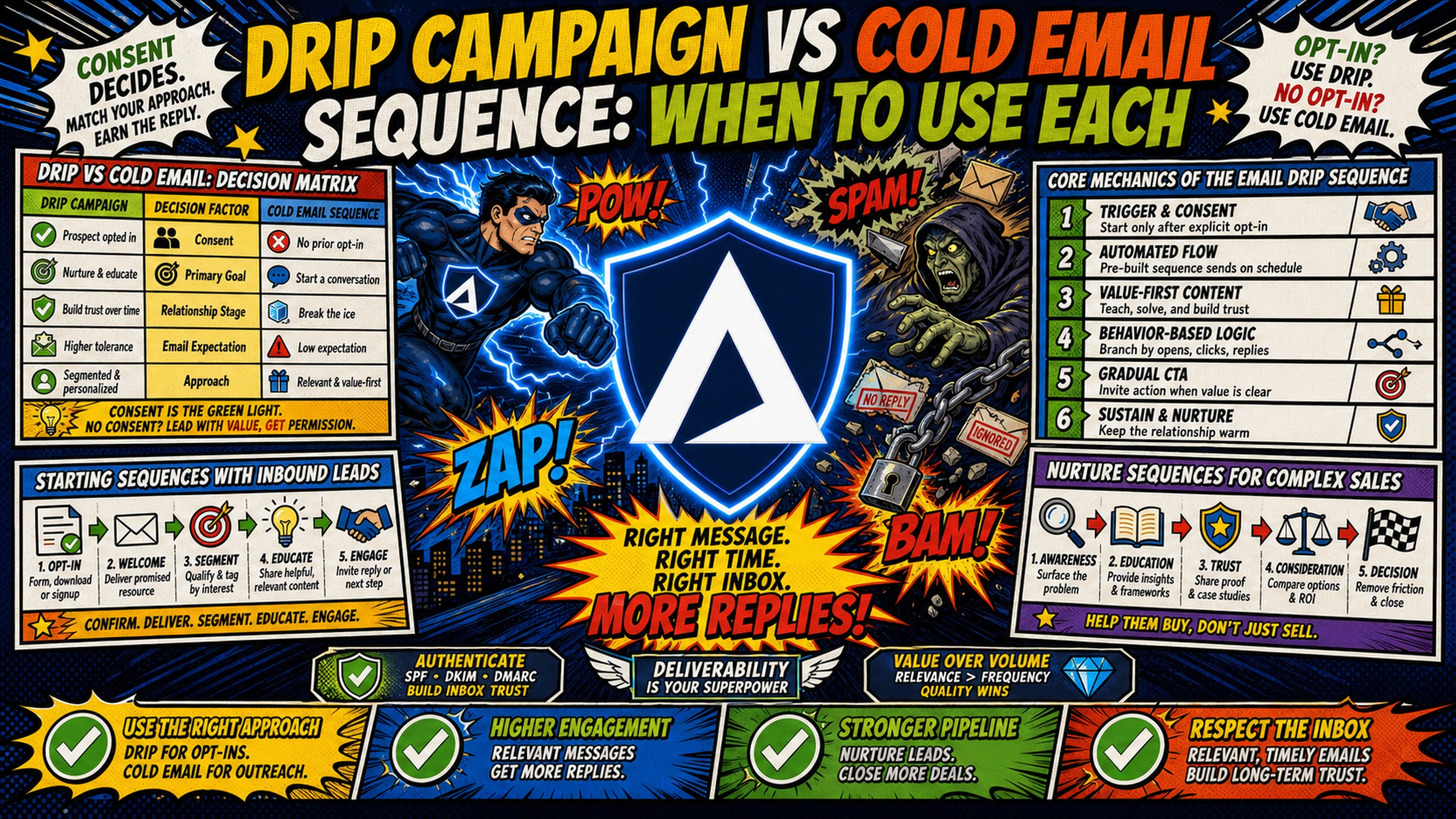
TL;DR: Consent decides. If the prospect opted in through a form, download, or signup, use a drip campaign. If they never asked to hear from you, use a cold email sequence. Drip campaigns run behavioral-trigger nurture on marketing automation platforms using platform-managed infrastructure. Cold sequences run time-bounded outbound on isolated domains with dedicated IPs, provisioned separately from the sending platform that runs them, such as Instantly or Smartlead. Both need SPF, DKIM, and DMARC configured, and mixing the two on shared infrastructure risks contaminating your primary domain. Google's Postmaster Tools documents the spam complaint and delivery error signals that feed domain reputation. At 50 inboxes, Inframail's platform fee is $129/month flat against $420/month on Google Workspace, a $291 monthly saving before domains and warmup, which apply on both.
Many campaign managers treat drip campaigns and cold email sequences as interchangeable. The confusion surfaces in client briefs, where a stakeholder asks for "a nurture sequence" but wants outbound prospecting. The mistake carries a direct cost: a blacklisted outbound domain requires spinning up replacement domains ($5-16 per domain) and restarting warmup (4-8 weeks per domain), during which those inboxes generate zero replies.
Mixing cold outreach with opted-in marketing lists on shared infrastructure can put your domain reputation at risk, potentially affecting all emails from that domain including login confirmations and support replies.
The technical divide matters more than the copywriting divide. Drip campaigns and cold email sequences are different technical architectures with different DNS requirements, IP strategies, and cost models.
Drip vs cold email: decision matrix
The five filters below cut the choice to a single answer. Match your campaign against each row, and the infrastructure decision follows. Consent status is the first filter because it determines every other row: a prospect who opted in belongs on drip infrastructure, and a prospect who never asked to hear from you belongs on cold.
| Filter | Use drip campaign | Use cold email sequence |
|---|---|---|
| Consent | Opted-in prospects | No prior consent |
| Trigger | User-initiated actions | Sender-initiated, no prior contact |
| Goal | Education and nurture | Direct reply and meetings |
| Domain | Often platform-managed | Multiple isolated domains |
| IP | Platform-managed infrastructure | Dedicated IP recommended |
Core mechanics of the email drip sequence
A drip campaign is an automated communication sequence triggered by specific user actions. The user may opt in through actions like form fills, content downloads, trial signups, or event registrations, and that action starts a pre-planned series of emails delivered on a schedule. These sequences often run through marketing automation platforms.
The defining characteristic is consent. Every recipient explicitly requested communication, which drives high open rates and low spam complaints. The Ehrenberg-Bass 95:5 rule finds that roughly 95% of B2B buyers are not in the market at any given time. This means the majority may need consistent touchpoints before taking the next step.
Starting sequences with inbound leads
Inbound actions trigger the first email. A prospect downloads a pricing guide, and the system sends a welcome email shortly after. They sign up for a free trial, and the onboarding sequence begins. These leads expect the email because they just requested it.
The trigger is always user-initiated. You configure the automation once, and it runs indefinitely for every new lead who matches the entry criteria.
Nurture sequences for complex sales
Nurture sequences capture prospects who are interested but not yet ready to buy. These prospects need education, social proof, and consistent touchpoints over weeks or months. The goal is trust building, not immediate conversion. Drip campaigns respect the buyer's timeline, keeping your brand present without pushing for a meeting before the prospect is ready.
Optimizing sequence timing for leads
Drip campaigns send on a fixed schedule, where everyone who enters gets the same emails in the same order at the same intervals. A lead who downloads an ebook might receive the first follow-up three days later, while a trial signup triggers an immediate welcome email. Higher-intent actions often trigger faster follow-up than lower-intent actions.
Drip timing is generous because you have consent. You can space emails days or weeks apart while maintaining engagement. Cold sequences compress timing because the prospect never asked to hear from you.
Anatomy of an effective cold email sequence
A cold email sequence is a time-bounded, highly targeted outbound campaign sent to prospects through direct outreach. The primary goal is a direct reply that starts a conversation leading to a booked meeting.
The infrastructure requirements are fundamentally different. Cold sequences run on separate domains with dedicated IPs, isolated from your primary brand domain. This isolation helps protect your main domain's reputation when complaint rates rise on outbound campaigns. According to Inframail's infrastructure cost guide, sending cold outreach from your primary domain puts your core brand reputation at risk if complaint rates spike, whereas a dedicated outbound domain isolates that risk.
Structuring your outbound prospect list
Cold sequences start with a highly targeted list built from your ideal customer profile. Data providers supply the contacts, but list hygiene determines deliverability. Every address must be verified before import.
The list is finite and campaign-specific, built for one offer and retired when the campaign ends. Sequence length is where published guidance diverges most, with recommended durations running anywhere from two weeks to a month depending on segment and strategy. The more consistent finding is persistence. RAIN Group's Top Performance in Sales Prospecting study, based on 489 sellers who outbound prospect, found it takes an average of 8 prospecting touchpoints to get an initial meeting with a new prospect, and 5 for top performers.
Focusing sequences on high reply rates
Cold sequences avoid marketing imagery, HTML templates, and tracking links to improve inbox placement. Plain-text emails mimic one-on-one personal communication, which can improve deliverability and response rates. This walkthrough video on cold email setup demonstrates why plain-text formatting is recommended for cold outreach.
The copy reads like a personal note from one professional to another. No branded headers, no pixel tracking. Every element that makes a marketing email look like marketing reduces the chance a prospect replies.
Cold email sequences: 3-7 day cadence
Cold outreach uses a compressed cadence of multiple touchpoints spaced 3-7 days apart. The sequence typically runs two to four weeks total before the prospect goes cold and the campaign ends.
This aggressive timing exists because cold prospects forget you quickly. Each day of delay reduces the chance they remember the previous email. Safe sending volume requires multiple mailboxes, each with its own domain and warmup schedule.
Comparing drip campaigns and outbound sequences
The tooling stack for each campaign type is different. Marketing automation platforms handle drip campaigns on managed infrastructure they control. Cold sequences run on two layers instead: an infrastructure layer that provisions domains, DNS records, and dedicated IPs, and a sending platform layer that runs the sequences on top of it. Choosing the infrastructure layer is a separate decision from choosing the sending platform, and it is the decision that determines cost per inbox and domain reputation. Cold outreach into the EU carries GDPR and ePrivacy obligations that vary by member state. Inframail provisions US-based Microsoft infrastructure and does not address EU compliance requirements.
| Feature | Marketing automation (Mailchimp, HubSpot) | Cold email stack (Inframail infrastructure + Instantly or Smartlead sending) |
|---|---|---|
| Primary use case | Opted-in subscriber campaigns | Cold email sequences, outbound prospecting |
| Consent model | Requires prior opt-in | No prior opt-in required (US CAN-SPAM) |
| IP type | Platform-managed IPs | Dedicated IPs (1-3 per plan) |
| Domain strategy | Platform-managed infrastructure | Multiple isolated domains |
| Email format | Often HTML templates, branded | Typically plain text, personal |
| Cost model | Per-seat or per-contact | Flat-rate for unlimited inboxes |
When to use each audience trigger
Drip campaigns use user-initiated triggers. The prospect fills a form, downloads a resource, or signs up for a trial, and that action starts the sequence. Cold sequences are outbound-initiated. You decide who to contact, build the list, and launch the campaign without any prior interaction.
This trigger difference affects the technical setup. User-initiated triggers mean the prospect expects your email, so platform-managed infrastructure often works well. Outbound-initiated campaigns mean the prospect does not expect your email, so dedicated IPs and isolated domains help absorb spam complaints without damaging your main domain.
Scheduling drip vs cold email flows
Drip campaigns are often evergreen and ongoing. You build the sequence once, and it can run for every new lead who enters. Cold sequences are finite and campaign-specific. You build a list for a specific offer, run the sequence over a set time period, and the campaign ends.
Defining goals for your email sequence
Drip campaigns aim for brand education, content consumption, and conversion over time. Cold sequences aim for one thing: a direct reply that leads to a booked meeting. The goal difference shapes the copy. Drip emails can be educational and brand-focused because the prospect already knows you. Cold emails must be direct and value-focused because the prospect has no reason to read past the first sentence unless you give them one.
DNS and IP requirements by campaign type
The technical infrastructure comparison below shows the DNS and IP requirements for each campaign type.
| Technical element | Drip campaign | Cold email sequence |
|---|---|---|
| SPF record | Configured on sending domain | Configured on sending domains |
| DKIM record | Configured on sending domain | Configured on sending domains |
| DMARC record | Configured on sending domain | Configured on sending domains |
| IP type | Platform-managed IP | Dedicated IP (1-3 per plan) |
| Domain count | Platform-managed | Multiple isolated domains |
| Setup method | Platform-managed | Automated via Inframail |
Drip campaigns typically use platform-managed infrastructure. Cold sequences commonly involve spinning up multiple isolated domains on dedicated IPs, each with its own SPF, DKIM, and DMARC records. Manual DNS configuration for 50 domains takes 12+ hours, which is why Inframail automates the entire process, configuring all three record types without DNS panel access.
Cost comparison at 50 inboxes
The cost comparison at 50 inboxes shows the margin impact of choosing the right infrastructure.
| Cost element | Inframail | Google Workspace |
|---|---|---|
| Platform fee (50 inboxes) | $129/month flat | $420/month ($8.40 x 50) |
| Domains (50 domains) | ~$21-67/month | ~$21-67/month |
| Total platform + domains | ~$150-196/month | ~$441-487/month |
| Monthly platform savings | $291 | - |
Domain cost assumes 50 domains at $5-16/year each ($250-800/year ÷ 12 months = ~$21-67/month). Warmup tools ($15-50/inbox/month) apply to both platforms and are not included in this comparison.
For deeper guidance on maintaining deliverability across these domains, see Inframail's email infrastructure monitoring guide. When you provision new domains for cold sequences, you also need a domain warmup process before sending at full volume.
When to prioritize drip campaigns over outbound
Drip campaigns are highly effective when the prospect has already raised their hand. Sending cold outreach to someone who downloaded your ebook or signed up for your webinar wastes the consent they gave you and confuses the relationship.
The scenarios where drip campaigns win are clear: inbound lead follow-up, post-trial onboarding, webinar attendee sequences, and any situation where the prospect took an action that requested communication.
Best practices for lead follow-up
Leads who have already raised their hand need immediate, automated follow-up. A prospect who fills a contact form expects a response within minutes, not days. The drip sequence starts with an instant acknowledgment email, then follows up with relevant content based on the specific action they took.
Automating post-trial nurture flows
Agencies managing SaaS clients use drip campaigns to guide trial users through product features. The client's sequence triggers on trial signup and sends targeted emails based on in-app behavior. The goal is activation before conversion, and the agency's job is to configure the automation and segment lists correctly. Critically, these opted-in trial users must never land on the same infrastructure the agency uses for cold outreach.
Automating webinar attendee sequences
Agencies running event marketing for clients use drip campaigns to nurture webinar registrants before and after the event. The pre-event sequence builds anticipation and reminds registrants to attend. The post-event sequence delivers the recording, key takeaways, and a next step for those who attended. Because registrants opted in at signup, this use case belongs on drip infrastructure on the client's primary domain, completely separate from the agency's cold email domains.
How to choose between drip and cold outreach
The decision framework is simple: if they asked to hear from you, use drip. If they do not know you, use cold. The consent status determines the infrastructure, the cadence, the copy, and the cost model. Most agencies and B2B companies need both, and best practice recommends separating the infrastructure to protect sender reputation, although some platforms do support both campaign types on unified infrastructure with proper list segmentation.
- Identify consent status: Did the prospect opt in through a form, download, or signup? If yes, use drip. If no, use cold.
- Choose infrastructure: Drip runs on your primary domain with shared IPs. Cold runs on secondary domains with dedicated IPs.
- Provision domains: For cold sequences, spin up secondary domains with automated SPF, DKIM, and DMARC configuration.
- Build the list: Drip lists grow through inbound actions. Cold lists are built from data providers and verified before import.
- Set the cadence: Drip sequences space emails days or weeks apart. Cold sequences compress to 3-7 day intervals.
- Write the copy: Drip emails can be branded and educational. Cold emails must be plain-text and direct.
- Monitor deliverability: Drip campaigns track engagement metrics. Cold sequences track bounce rates, spam complaints, and blacklist status.
Cold email sequences for prospecting
Cold sequences deploy when you are launching a new service, targeting a specific list of high-value accounts, or entering a new market. The campaign is time-bounded and list-specific.
The infrastructure must be ready before the list is built. Inframail's setup process provisions domains, configures DNS records, and exports credentials to CSV for import into Instantly or Smartlead. Customer testimonials report spinning up 10 inboxes in 2 minutes, which means the infrastructure never becomes the bottleneck.
"The setup is ridiculously fast. SPF, DKIM, DMARC, forwarding - all handled in literally seconds... Unlimited inboxes on a flat price? That alone saves me hundreds every month compared to Google Workspace or similar." - Verified user review of Inframail
3 illustrative scenarios: choosing your email strategy
Three illustrative scenarios show how the decision framework applies in practice. Each maps directly to a consent status, an infrastructure choice, and a cost model.
Scenario 1: SaaS trial nurture sequences
An agency managing email infrastructure for a SaaS client configures a drip campaign to guide trial users through activation. The trial signup is an opt-in action, so the sequence runs on the client's primary domain with a shared marketing IP on a marketing automation platform. The agency's cold email domains stay completely separate. The infrastructure decision is the agency's call: one primary domain for drip, isolated secondary domains for any outbound prospecting on behalf of the same client.
Scenario 2: Agency prospecting Fortune 500
A lead generation agency targets enterprise buyers at Fortune 500 companies. These prospects never opted in, so the agency uses cold email sequences across multiple secondary domains on dedicated IPs. The campaign runs for three weeks, with four to five touchpoints per prospect, and the sole goal is a direct reply that leads to a booked meeting.
The infrastructure is complex: multiple isolated domains, each with SPF, DKIM, and DMARC records, typically on dedicated IPs to isolate sending reputation. Inframail's flat-rate pricing keeps the platform cost at $129/month regardless of whether the agency creates 50 or 500 inboxes (before domains and warmup). This flat fee protects margins as the campaign scales.
Scenario 3: Automated nurture for event leads
An agency managing post-event follow-up for a client collects trade show attendee contacts and needs to nurture them. The attendees have baseline awareness but require opt-in confirmation before receiving marketing emails. The agency sends a confirmation email asking attendees to opt in, then routes those who confirm into a drip campaign on the client's primary domain. The sequence runs on platform-managed infrastructure, and the agency keeps this confirmed list entirely separate from any cold email domains used for outbound prospecting.
5 fatal errors that tank campaign ROI
Five mistakes destroy deliverability and waste budget, all stemming from confusing drip and cold architectures:
- Using drip cadence on cold lists: Sending daily branded emails to prospects who never opted in spikes complaint rates and can blacklist your domain.
- Mixing cold outreach on marketing IPs: Shared IP contamination from cold email puts your primary domain at risk of blacklisting.
- Mismatching sequence logic to lead status: Generic nurture content to a hot lead wastes the reply. Aggressive pitches to cold inbound leads burn trust.
- Running both campaign types without proper segmentation: Specialized cold email platforms exist for safe outreach, while marketing automation platforms excel at opted-in nurture. Proper list separation is critical regardless of tool choice.
- Poor transition management from cold to opted-in status: Leaving opted-in leads running in the cold sequence contaminates your marketing list and wastes the consent they just gave you. For the full handoff process, see the "When to layer drip and cold sequences" section below.
The cost of mixing infrastructures
Sending cold outreach through shared infrastructure puts your primary domain at risk. Poor list hygiene from other senders can trigger blacklisting that affects every sender on that IP immediately, and this "noisy neighbor" effect is a primary risk of shared infrastructure for cold email, according to Inframail's blacklist guide.
For an agency running 50 cold domains, that downtime means weeks of zero outbound reply volume while replacement domains warm, plus $250-800 in new domain registration and setup costs. A blacklisted primary domain means your login confirmations, support replies, and transactional notifications all land in spam. The domain reputation loss takes weeks or months to recover. Dedicated IPs isolate this risk by ensuring your sending behavior alone determines reputation, as shown in this dedicated IP comparison video.
When to layer drip and cold sequences
The transition from cold to nurture is a deliberate handoff, not an automatic one. The safe transition from cold to drip happens when a prospect explicitly opts in, not simply when they reply. A cold reply opens a sales conversation, but it does not constitute consent to receive marketing emails. Only when the prospect takes an explicit opt-in action, such as requesting a resource, filling a form, or confirming they want to receive content, should they be moved to drip infrastructure. At that point, export the lead from the cold email platform and import them into the marketing automation platform. The cold sequence ends, and the drip sequence begins. Maintain clear segmentation between cold and opted-in lists to protect deliverability.
Build cold email infrastructure without per-seat pricing
Inframail is a flat-rate Microsoft email infrastructure platform for agencies and SDR teams running cold email sequences at scale. For $129/month, Inframail provisions unlimited inboxes with automated SPF, DKIM, and DMARC configuration, 1 dedicated US IP, and CSV export to Instantly or Smartlead. Domain costs ($5-16/domain/year) and warmup tools ($15-50/inbox/month) apply separately. See this case study video on how an Inframail customer used its affordable cold email infrastructure and support to close deals and scale their outreach.
Sign up to Inframail and get started today.
FAQs
Can I manage both drip and cold email in one tool?
Some platforms support both, but the cold side still needs its own infrastructure layer. Sending platforms like Instantly and Smartlead handle the outbound layer: sequences, inbox rotation, and reply handling. Underneath that sits the infrastructure layer, where domains are registered, SPF, DKIM, and DMARC records are configured, and dedicated IPs are assigned. Even where one tool spans both campaign types, keep the lists and the sending domains separate. Inframail provisions the infrastructure layer and exports IMAP and SMTP credentials to CSV for import into Instantly or Smartlead.
What is the deliverability difference between drip and cold sequences?
Drip campaigns typically use platform-managed sending infrastructure where opted-in engagement helps maintain strong deliverability. Cold sequences benefit from dedicated IPs and multiple isolated domains to protect your primary domain from deliverability issues.
How do I define warm versus cold prospect lists?
Warm lists consist of opted-in contacts who explicitly requested communication from your brand. Cold lists consist of targeted prospects who fit your ideal customer profile but have no prior contact with your business.
How do I change a cold sequence into a drip campaign safely?
Never run the transition within the same sending tool. Export the opted-in lead and import them into your marketing automation platform on your primary domain. The "When to layer drip and cold sequences" section above covers the full process.
What does Inframail cost for cold email infrastructure?
Platform fee is $129/month (Unlimited Plan, 1 dedicated IP) or $327/month (Agency Pack, 3 dedicated IPs) with unlimited inboxes on either plan. Add domain costs ($5-16/domain/year) and warmup tools ($15-50/inbox/month), which apply on both Inframail and Google Workspace.