
Cold email opener frameworks: which to use and when
Match the opener framework to the list and the sequence step. Insight-Led openers fit SaaS, financial services, and VP lists. Question-Based openers fit healthc
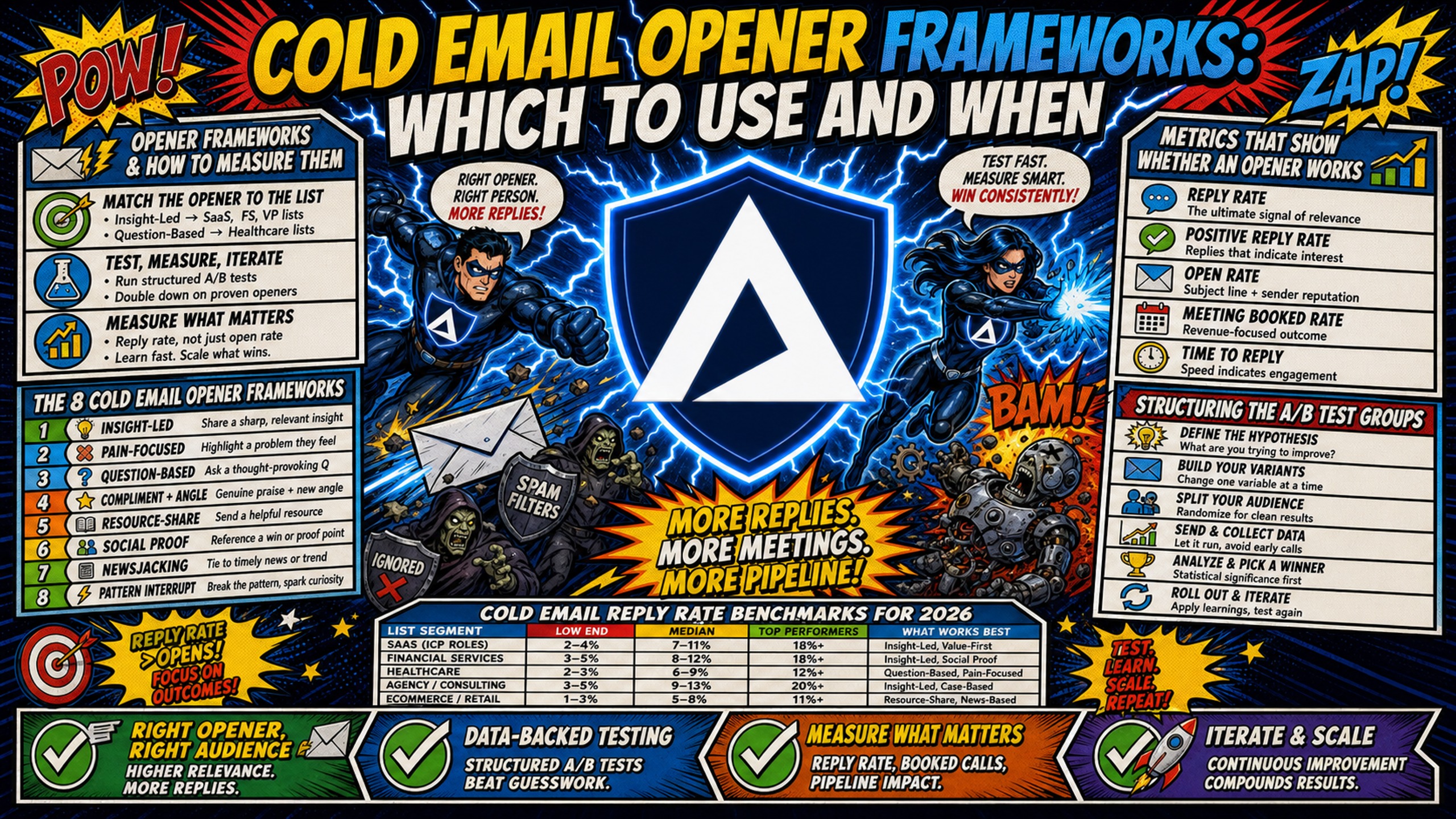
TL;DR: Match the opener framework to the list and the sequence step. Insight-Led openers fit SaaS, financial services, and VP lists. Question-Based openers fit healthcare, directors, and individual contributors, and Pain-Point openers fit consulting teams and managers. Direct Ask works best from follow-up 2 onward. Judge each test on reply rate, positive reply rate, and meeting-booked rate rather than opens, because Apple Mail Privacy Protection downloads tracking pixels whether or not anyone reads the email. Hunter puts the average sequence reply rate at 4.5% across 31 million emails sent in 2025, and Cleverly says a rate above 5% beats most B2B senders. Openers only work when emails reach the inbox, and The Digital Bloom found fully authenticated domains are 2.7x more likely to get there. Inframail automates SPF, DKIM, and DMARC records on dedicated US-based IPs for a flat $147/month, with warmup handled by an external tool.
Cold email opener performance often depends on structure as much as word choice. A Pain-Point opener and a Compliment-Based opener can carry the same offer and still get very different responses, because each one asks the reader to do different work in the first two lines.
This guide covers 8 opener frameworks, the metrics that show whether an opener is working, and when to use each framework by industry, seniority, and sequence position. It also covers why DNS authentication decides whether any opener gets seen at all.
Opener frameworks and how to measure them
This section defines the 8 opener frameworks, the metrics that show whether an opener works, and the setup needed for a reliable test.
The 8 cold email opener frameworks
- PAS (Problem-Agitate-Solve): Identifies a problem the prospect faces, agitates the frustration by amplifying consequences, then presents the solution.
- AIDA (Attention-Interest-Desire-Action): Captures attention fast, builds interest through specificity, creates desire with proof, and drives action with a clear CTA. Usually credited to advertising pioneer E. St. Elmo Lewis, AIDA is a four-step progression from hook to ask.
- Insight-Led: Opens with a data point, free audit, or quick analysis before making any ask. This framework offers value first to demonstrate worth.
- Question-Based: Asks a highly relevant question about something the prospect wants to achieve.
- Compliment-Based: Opens with genuine acknowledgment of recent work or achievement before transitioning to relevance.
- Pain-Point: Names a real problem, puts a number on what it costs, then offers resolution in one line. The Digital Bloom found plain problem hooks earned a 4.39% reply rate against 8.57% for numbers hooks.
- Social Proof: Uses storytelling or case studies to build credibility. This approach works well when you have real examples to share.
- Direct Ask: States the reason for reaching out and makes one specific, low-friction request in the first two lines, such as 'Open to a one-page breakdown?' Avoid leading with a meeting request. Hunter's State of Email Outreach 2026 found that 'Can I send more info?' and 'Open to learning more?' are preferred by decision makers over scheduling a meeting upfront.
The 5 frameworks with the clearest best-fit profiles:
| Framework | Effort to write | Best-fit industry | Best-fit seniority |
|---|---|---|---|
| Insight-Led | Medium (requires data/audit) | SaaS, financial services | VP |
| Question-Based | Low (single question) | Healthcare | Director, IC |
| Pain-Point | Low (problem + cost) | Consulting, supply chain | Manager |
| PAS | Medium (3-step sequence) | General B2B | Not seniority-specific |
| Direct Ask | Low (clear CTA) | All industries (late sequence) | VP |
For greeting and first-line examples beyond these frameworks, see Inframail's complete guide to email greetings and openers.
Metrics that show whether an opener works
Three metrics show whether an opener is working:
- Reply rate: Replies divided by delivered emails, excluding auto-replies and out-of-office messages. It is a more reliable signal than open rate because it requires a human response.
- Positive reply rate: Qualified or interested replies as a percentage of total replies, filtering out 'not interested' and 'remove me' responses.
- Meeting-booked rate: Meetings booked as a percentage of emails sent. Cleverly calls it the benchmark most revenue teams care about and the one almost no published study focuses on.
Open rates are left out because Apple Mail Privacy Protection downloads remote content in the background when a message arrives, not when someone reads it. Litmus's July 2026 email client report, calculated from over 1 billion opens, puts Apple, including Mail Privacy Protection, at 62.26% of tracked opens.
Structuring the A/B test groups
Effective A/B tests segment lists by industry (SaaS, consulting, healthcare, financial services, supply chain) and seniority (VP, Director, Manager, IC). Only the opener should change between variants, while subject line, body copy, CTA, and sender name stay constant. Each segment needs its own sample, so split lists only as far as send volume allows.
Cold email reply rate benchmarks for 2026
Published benchmarks show what a good reply rate looks like before any opener test starts. Use them as the bar for judging test results.
What counts as a good cold email reply rate
Hunter's State of Email Outreach 2026, based on 31 million emails sent in 2025, puts the average cold email sequence reply rate at 4.5%. Empra's 2026 analysis of three large datasets, totaling more than 70 million emails, puts the average at 3.4% (per Instantly) to 5.8% (per Belkins), with roughly 4% as the realistic median. Cleverly notes that a reply rate above 5% puts senders ahead of most B2B senders, and 10%+ is considered excellent. For reply rates broken down by industry, see Inframail's cold email reply rate benchmarks for 2026.
| Benchmark | Reply rate |
|---|---|
| Average sequence reply rate | 4.5% |
| Average range across three datasets | 3.4%-5.8% |
| Ahead of most B2B senders | Above 5% |
| Excellent | 10%+ |
The Digital Bloom's 2025 B2B benchmark is one of the few published datasets that compares opener types directly. It covers four hook types:
- Timeline hooks: 10.01% reply rate, 65.36% positive reply rate, 2.34% meeting rate
- Numbers hooks: 8.57% reply rate, 61.76% positive reply rate, 1.86% meeting rate
- Social proof hooks: 6.53% reply rate, 53.44% positive reply rate, 1.25% meeting rate
- Problem hooks: 4.39% reply rate, 48.30% positive reply rate, 0.69% meeting rate
Numbers hooks lead with a metric, the same opening move as an Insight-Led opener. The Digital Bloom does not publish its sample size, so treat these figures as directional rather than a controlled test.
Meeting-booked rates by hook type
Opener differences grow at the meeting stage. In The Digital Bloom's data, timeline hooks booked meetings at 2.34% against 0.69% for problem hooks, a 3.4x gap, compared with 2.3x on reply rate.
Which opener framework to use by industry
Buyers in different industries respond to different opener structures. The Digital Bloom's 2025 benchmark puts average reply rates at 7.88% for consulting, 7.49% for healthcare, 7.42% for SaaS, and 6.72% for financial services. The guidance below matches each framework to the industries where it fits best.
Opener frameworks for SaaS
Start SaaS lists with Insight-Led openers, with Question-Based openers as the backup. SaaS buyers expect data and specificity, so an opener that leads with a metric or a quick audit earns attention faster than a relationship-based approach. Skip Compliment-Based openers here, since technical buyers tend to discount flattery that comes without substance.
Opener frameworks for consulting firms
Start consulting lists with Pain-Point openers, with Direct Ask as the backup. Consulting buyers value clarity and efficiency, so naming the problem and its cost in the first line respects their time. Social Proof openers are a weaker fit here without a named peer or recognized customer to anchor the story.
Opener frameworks for healthcare
Start healthcare lists with Question-Based openers, with PAS as the backup. Healthcare buyers work under compliance constraints, so an opener that frames the problem as a question, without making claims, is easier to say yes to. Avoid Compliment-Based openers, which read as filler to compliance-minded buyers.
Opener frameworks for financial services
Start financial services lists with Insight-Led openers, with Pain-Point openers as the backup. Financial buyers expect proof and risk control, so leading with data or naming a specific cost works better than relationship-building. Compliment-Based openers are the weakest fit for this audience.
Opener frameworks for supply chain
Start supply chain and logistics lists with Pain-Point openers, with Direct Ask as the backup. Operations buyers value efficiency, so naming a bottleneck and its cost in one line beats storytelling. Skip PAS on a first touch here, since its three-step build delays the point.
| Industry | First choice | Backup |
|---|---|---|
| SaaS | Insight-Led | Question-Based |
| Consulting | Pain-Point | Direct Ask |
| Healthcare | Question-Based | PAS |
| Financial services | Insight-Led | Pain-Point |
| Supply chain | Pain-Point | Direct Ask |
Which opener framework to use by seniority
Seniority changes which opener structure earns a reply. VPs, directors, managers, and individual contributors each read cold email with different time and priorities.
Opener frameworks for VPs
Start VP lists with Insight-Led openers, with Direct Ask as the backup. VPs have limited time, so an opener that leads with value or a clear ask works better than a multi-step framework. AIDA's four steps tend to feel slow for senior buyers.
Opener frameworks for directors and managers
Start director lists with Question-Based openers, with Pain-Point openers as the backup. Directors balance strategy and execution, so a relevant question or a specific pain point lands better than a broad framework.
Start manager lists with Pain-Point openers, with Question-Based openers as the backup. Managers own specific problems, so naming the pain and its cost directly works better than an abstract approach.
Opener frameworks for individual contributors
Start IC lists with Question-Based openers, with Insight-Led openers as the backup. ICs value specificity and practicality, so a tactical question or a concrete resource works better than a high-level framework. They are also among the most responsive readers. In Lavender's benchmark of emails to marketing teams, ICs replied at 5.3%, ahead of managers (4.3%), VPs (3.4%), and directors (3.4%).
| Seniority | First choice | Backup |
|---|---|---|
| VP | Insight-Led | Direct Ask |
| Director | Question-Based | Pain-Point |
| Manager | Pain-Point | Question-Based |
| IC | Question-Based | Insight-Led |
Which opener framework to use at each sequence step
Industry and seniority decide which framework to pick. Sequence position decides when to use it. Hunter's State of Email Outreach 2026 found three-email sequences earned a 6.8% reply rate against 3.3% for a single email, so every touch needs an opener that earns its place.
First touch
Open first touches with Insight-Led or Question-Based openers. The first email has to establish credibility fast, so leading with value or a relevant question works better than a relationship-based approach. Compliment-Based openers are hard to make credible from an unknown sender.
Follow-ups 1 and 2
Use Question-Based openers for follow-up 1, with Direct Ask as the backup. A follow-up should reference the prior email without repeating it, so a new question or a clear ask works better than restating the problem.
Use Direct Ask for follow-up 2, with Pain-Point openers as the backup. By the second follow-up, the reader needs a clear reason to reply now, so naming the cost of inaction works better than a softer approach.
Optional fourth email
If the list is still replying after three emails, use Direct Ask for a fourth, with PAS as the backup. Late touches need to justify the persistence, so a final clear ask or a reminder of what inaction costs works better than repeating the value pitch.
| Sequence step | First choice | Backup |
|---|---|---|
| First touch | Insight-Led | Question-Based |
| Follow-up 1 | Question-Based | Direct Ask |
| Follow-up 2 | Direct Ask | Pain-Point |
| Optional fourth email | Direct Ask | PAS |
DNS authentication as the foundation for opener performance
Even the best opener fails when emails land in spam. The Digital Bloom's 2025 B2B deliverability benchmark found that fully authenticated domains are 2.7x more likely to reach the inbox than unauthenticated ones. Full authentication means SPF, DKIM, and DMARC are all in place, the DNS records that prove a sender is authorized to send for a domain. Domains missing DKIM saw 71.89% inbox placement against 83.75% for fully authenticated domains.
Before testing opener frameworks, verify this technical foundation checklist:
- SPF configured: Sending domain includes all authorized mail servers in SPF record.
- DKIM signed: All outbound emails carry a valid DKIM signature from your domain.
- DMARC enforced: Policy set to quarantine or reject, not just monitor.
- Warmup complete: Domains fully warmed with a gradual send volume ramp.
- Dedicated IP: Sender reputation isolated from shared pool contamination.
Inframail automates SPF, DKIM, and DMARC record setup on dedicated US-based IPs, which covers items 1, 2, and 5 before the first send. Set the DMARC policy to quarantine or reject for item 3. Inframail does not include built-in warmup, so pair it with an external warmup tool for item 4.
Selecting high-converting cold email openers
The guidance above shows which frameworks fit where. Applying it means matching frameworks to the campaign profile and sequence position.
Aligning openers to your campaign profile
Select frameworks based on industry, seniority, and offer type. Use this checklist:
- Industry: SaaS and financial services favor Insight-Led. Consulting and supply chain favor Pain-Point. Healthcare favors Question-Based.
- Seniority: VPs favor Insight-Led. Directors and ICs favor Question-Based. Managers favor Pain-Point.
- Offer type: Free audits and data favor Insight-Led. Clear ROI asks favor Direct Ask. Permission-based asks favor Question-Based.
Optimizing opener placement for reply rates
Sequence frameworks across a 3-email campaign, and add a fourth touch only if the list is still replying. Hunter's State of Email Outreach found three emails is the best balance between persistence and fatigue.
Steps for custom opener testing
Run your own A/B test with this 5-step protocol plus prep:
- Prep the list and domains: Verify lists before import and send from authenticated, fully warmed domains at conservative daily volumes, so bounces and spam placement don't skew the comparison.
- Define the metric: Choose reply rate, positive reply rate, or meeting-booked rate as the primary metric.
- Set sample size: At Hunter's 4.5% average reply rate, about 1,000 recipients per variant is enough to detect a lift to roughly 7.2% at 95% significance and 80% power. Detecting a smaller lift, to 6.5%, takes about 1,800 per variant. Check your own numbers in Evan Miller's sample size calculator.
- Isolate the variable: Change only the opener. Keep subject line, body copy, CTA, and sender name constant.
- Run the test: Run each test for at least two full weeks. CXL recommends covering one to two full business cycles, which is 2 to 4 weeks for most businesses.
- Validate the winner: Run a control group that receives a proven baseline email during the test window. If the new opener beats the control at 95% significance, with both versions sent to a randomly split list over the same window, the difference is unlikely to come from timing, list quality, or chance, per CXL.
Get started with Inframail
Inframail provides unlimited Microsoft inboxes on dedicated US-based IPs for a flat $147/month. The platform reports 98%+ deliverability, with automated blacklist monitoring and 68.3% delisting success within 48 hours, so opener tests measure the copy rather than the infrastructure.
Watch this case study video and see how Inframail helped a client run reliable cold email infrastructure across multiple domains for well over a year with no problems, build periods of fast response volume as campaigns became more dialed in, and support $42,000 in new sales over the last four weeks.
Sign up to Inframail and get started today.
FAQs
What sample size do I need to A/B test opener frameworks reliably?
At a 4.5% baseline reply rate, about 1,000 recipients per variant detects a lift to roughly 7.2%, and about 1,800 detects a lift to 6.5%. Enter your own baseline and target lift into Evan Miller's sample size calculator.
How long should I wait before declaring a winner?
Run each test for at least two full weeks, even if you reach the sample size sooner, and declare a winner only at 95% significance.
Should I test openers or entire sequences first?
Test openers first in isolation, then test full sequences once the opener is validated. Changing multiple variables at once makes it impossible to know which element drove the result.
Does this guidance apply to warm outreach?
No. Warm outreach has different reply dynamics because recipients already know the sender. The frameworks and benchmarks in this article apply to cold email only.
Key terms glossary
Reply rate: Replies divided by delivered emails, excluding auto-replies and out-of-office messages.
Positive reply rate: Qualified or interested replies as a percentage of total replies.
Meeting-booked rate: Meetings booked as a percentage of emails sent. It is the metric most revenue teams care about.
Opener framework: A structured formula for the first sentence or two of a cold email, such as PAS or AIDA. Frameworks provide repeatable structures for different list types.
Sequence position: The placement of an email within a multi-touch outreach sequence, such as first touch or follow-up 1. Sequence position changes which framework performs best.
Statistical significance: The significance level that a test result is not due to random chance, typically 95% or higher. Statistical significance requires sufficient sample size and test duration.