
Cold Email Infrastructure Security and Compliance Checklist
Audit your cold email infrastructure for CAN-SPAM compliance, data residency, and access controls. Learn how to protect client campaigns from security risks.
Updated July 10, 2026
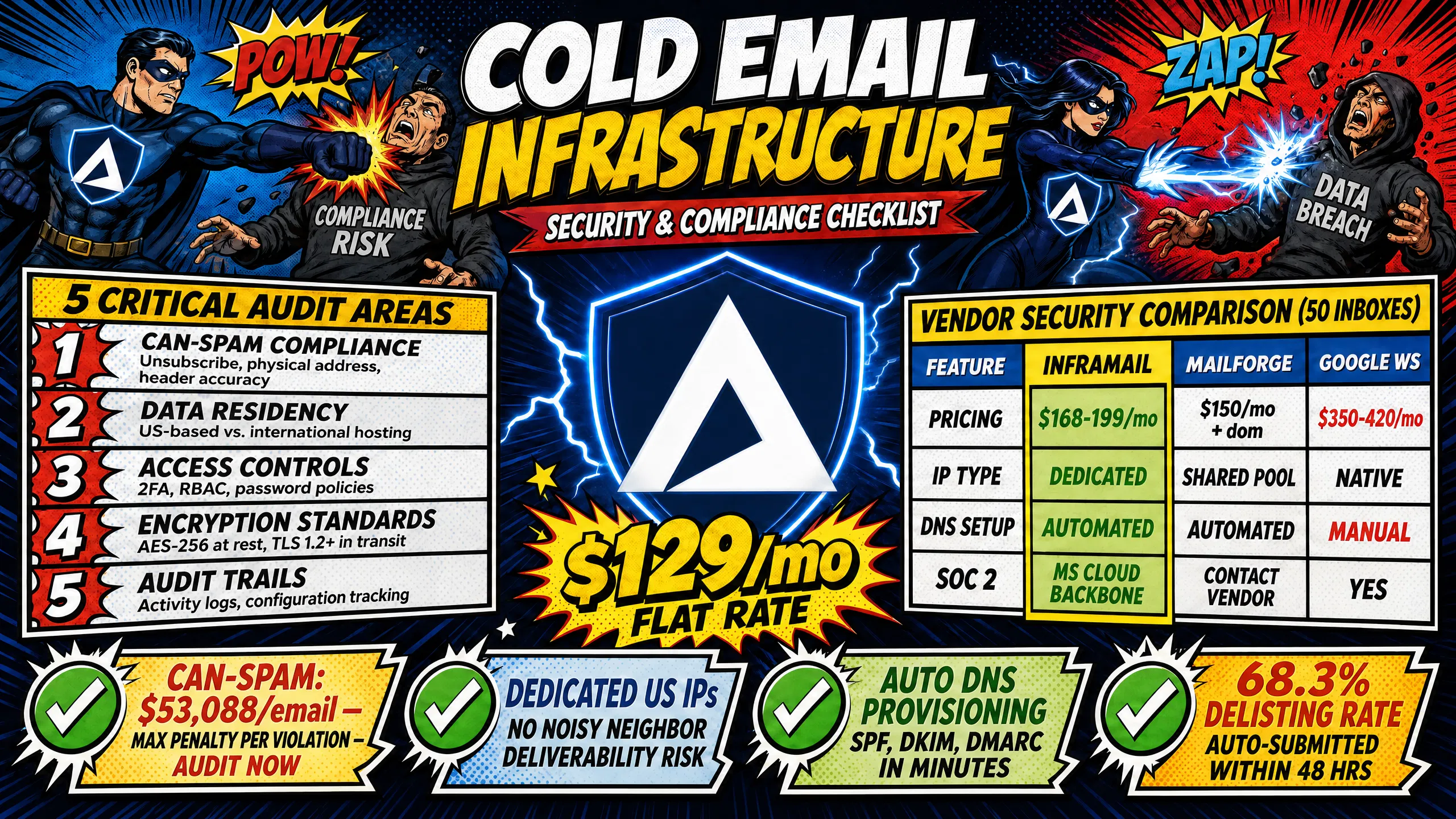
TL;DR: Operations managers vetting cold email infrastructure vendors must audit five areas: CAN-SPAM compliance (unsubscribe handling, physical address, header accuracy), data residency (US-based vs. international hosting), access controls (2FA, RBAC, password policies), encryption (AES-256 at rest, TLS 1.2+ in transit), and audit trails (activity logs, configuration tracking). Shared IP pools like Mailforge expose agencies to "noisy neighbor" deliverability risk. Inframail's flat-rate Microsoft infrastructure at $129/month provides unlimited inboxes on dedicated US-based IPs, saving agencies $2,244-$3,084 annually versus Google Workspace at 50 inboxes, running on Microsoft's SOC 2 Type II-certified cloud platform.
Cold email infrastructure is the combination of domains, mailboxes, DNS records (SPF, DKIM, and DMARC), and IP addresses configured to send outbound campaigns. Deliverability, the percentage of emails reaching the primary inbox rather than spam, depends on multiple factors including authentication, content, and list quality, and upstream security misconfiguration is one of the largest correctable causes of inbox placement failure. A shared IP pool, an unverified vendor, or a missed CAN-SPAM requirement can each create significant compliance and deliverability risks.
This checklist covers every layer operations managers must audit before committing infrastructure spend, from CAN-SPAM regulatory requirements to vendor compliance certifications, so your platform passes both internal security reviews and enterprise client audits.
Poor security practices degrade deliverability directly. When a sending domain lacks properly configured SPF (Sender Policy Framework, the DNS record that authorizes which mail servers can send on your domain's behalf), DKIM (DomainKeys Identified Mail, a cryptographic signature that verifies the email was not tampered with), or DMARC (Domain-based Message Authentication, Reporting and Conformance, the policy that tells receivers what to do with unauthenticated messages), receiving servers may reject, quarantine, or reduce inbox placement for those messages, depending on the mailbox provider and the DMARC policy configured on the sending domain. Cold email infrastructure monitoring is not optional at agency scale, since deliverability drops typically surface through client complaints rather than monitoring dashboards.
Ensuring data residency and audit trails
Enterprise clients require strict audit trails to confirm that campaign data is handled securely. Activity logs must capture configuration changes, credential exports, and access events at minimum. Without them, reconstructing a security incident or satisfying a client vendor questionnaire is nearly impossible. Inframail provisions infrastructure exclusively on US-based Microsoft cloud, providing a clear and verifiable data residency answer for US-market agencies.
When to audit your email security
The following circumstances commonly indicate that an infrastructure audit is warranted:
New enterprise client onboarding: Enterprise procurement teams routinely request vendor security packages before signing contracts.
Sudden deliverability drop: A noticeable drop in inbox placement within a short period can signal a DNS misconfiguration or blacklisting event.
Scaling domain infrastructure: As domain count increases, the cold email infrastructure costs comparison across seven platforms shows why infrastructure decisions become material to margin.
Avoiding costly compliance failures
Non-compliance carries direct financial consequences. The CAN-SPAM Act imposes penalties of up to $53,088 per email violation, and the FTC imposed a $2.95 million fine on Verkada for CAN-SPAM violations in August 2024, the largest penalty in the Act's enforcement history. Domain blacklisting compounds these costs: a blacklisted domain disrupts all active client campaigns simultaneously, triggering contract termination clauses that put recurring revenue at immediate risk.
The CAN-SPAM Act governs commercial email sent to US recipients and applies to agencies running outbound campaigns on behalf of clients. Non-compliance liability extends to the agency when campaign content or list management is within its control. The Act has seven core requirements that operations managers must verify: accurate sender and header information, honest subject lines, identification of messages as advertisements, physical postal address, functional opt-out mechanism, honoring opt-out requests within 10 business days, and monitoring third-party compliance.
Streamlining one-click opt-outs
CAN-SPAM requires an opt-out mechanism that is "easy for an ordinary person to recognize, read, and understand," and recipients cannot be required to complete lengthy forms or click through multiple pages to unsubscribe. A simple link or reply option is typically used to meet this requirement. Automated list-unsubscribe mechanisms can streamline removal from active sequences. The cold email legal framework covers how agencies share liability for list-unsubscribe implementation across client campaigns.
Physical address requirements for CAN-SPAM
Every outbound email must include the sender's valid physical mailing address or registered PO box. For agencies running campaigns across multiple client brands, the method for managing client-specific address footers varies by platform (some handle it through account or template settings, others support infrastructure-level automation), so confirm how your sending platform implements address footers and verify that the correct client address appears in every outbound message before campaign launch.
Header accuracy for legal compliance
Misleading "From," "To," or routing information violates federal law. The sender identification in the email header must match the actual sending domain, and subject lines cannot be deceptive. Infrastructure vendors that allow sending from domains not owned by the account introduce immediate compliance risk.
Who owns compliance liabilities
Agencies share compliance liability when they control campaign content and list selection. Contracts should define which party is responsible for unsubscribe processing, list sourcing, and header accuracy. Infrastructure that includes compliance safeguards can help manage risk, though agencies remain legally responsible for campaign compliance regardless of platform features.
DNS configuration (the process of setting up domain records including MX, SPF, DKIM, and DMARC to verify domain ownership and authorize mail servers) determines where authentication happens. Physical data residency encompasses the controls, configurations, and operational practices that enforce where credentials, metadata, and campaign data are physically stored and processed. This distinction carries direct legal, contractual, and policy obligations across jurisdictions including the EU, India, and Brazil, each of which enforces its own rules on permissible storage locations. These are different questions with different compliance implications.
Where your email data resides
Inframail hosts infrastructure exclusively in US-based data centers on Microsoft's cloud platform, formalized through an enterprise partnership announced in January 2024. This provides a clear answer for US-market agencies when enterprise clients ask where their data lives. Platforms routing data through unverified international servers introduce GDPR exposure for campaigns touching EU citizens, even when the agency is US-based. The Maildoso to Inframail migration guide covers how to preserve data integrity during a platform switch.
Cross-border data transfer rules
GDPR restricts transferring EU personal data to countries the European Commission has not approved. Standard Contractual Clauses (SCCs) are pre-approved legal terms that allow transfers when no approval exists. Any agency sending cold email to EU business contacts must use a vendor that provides a GDPR Data Processing Agreement with SCC language, or face direct regulatory exposure.
Client data residency requirements
Clients in regulated industries, including healthcare, finance, and legal services, frequently mandate US-only data residency in vendor contracts. Verify data center locations with every infrastructure vendor before onboarding these clients. US-based infrastructure on a named cloud provider such as Microsoft Azure provides regional data residency options, though organizations transferring personal data across borders should review applicable legal requirements for such transfers.
Weak access controls create the fastest path to compromised mailboxes and domain hijacking. An administrative account controlling 200 domains across 10 client campaigns represents a single point of failure for your entire operation. Build access policies that isolate this risk through role-based permissions and mandatory 2FA.
Mandatory password complexity rules
Current NIST SP 800-63B Rev. 4 guidance prioritizes password length over complexity requirements. Enforce a minimum of 15 characters for password-only accounts, or 8 characters when combined with 2FA. For generated mailbox credentials exported to CSV and imported into sending platforms like Instantly.ai or Smartlead, verify that credentials are unique per inbox and are not reused across clients.
Preventing unauthorized access with 2FA
Two-factor authentication (2FA) for administrative platform access prevents credential-stuffing attacks from granting full access even when a password is leaked. Enforce 2FA on all accounts that can modify DNS records, create inboxes, or export credentials. The Inframail to Smartlead integration guide covers how to manage credential handoffs securely between platforms.
Automating secure API key rotation
Static API keys that connect infrastructure platforms to sending tools create a long window of vulnerability if exposed. Rotate API keys quarterly at minimum, and immediately after any team member with credential access departs. Document the rotation process as a standard operating procedure, not an incident response. Inframail supports credential export as CSV with IMAP/SMTP details per inbox. Confirm with Inframail directly whether download events are logged by user and timestamp before relying on this capability to satisfy enterprise audit trail requirements.
Managing team access and permissions
Role-based access control (RBAC) limits each team member to only the domains they manage. Campaign managers do not need access to billing, DNS configuration, or credential export functions. Restricting permissions by role limits the blast radius of a compromised account and satisfies the "least privilege" principle required by most enterprise security frameworks.
Encryption standards for saved data
AES-256 encryption is NIST-approved and aligns with current NSA guidance for protecting information at the highest classification levels. Acceptable AES key lengths vary by classification tier. Acceptable encryption standards may also vary depending on data classification and applicable regulatory frameworks. Require vendors to document their specific encryption standards in writing during procurement. Inframail provisions infrastructure on Microsoft's cloud platform. Verify the specific encryption standards applied to stored credentials and email metadata with Inframail directly before procurement.
Encryption protocols for email transit
TLS (Transport Layer Security) encrypts emails in transit between servers, preventing interception. Verify your vendor enforces TLS 1.2 or higher. Note that cryptographic strength in transit depends on the specific cipher suite negotiated, so require vendors to confirm in writing that weak cipher suites are disabled and that strong AES-based cipher suites are supported.
Essential TLS/SSL compliance checks
Verify these SSL/TLS configurations for every sending domain:
Valid SSL certificate installed and current (not expired)
Server rejects TLS 1.0 and TLS 1.1 connections (deprecated protocols with known vulnerabilities)
Legacy protocols such as plain-text authentication disabled where not required for business operations
![Inframail activity audit log tracking user access and DNS configuration changes][image_inframail_audit_log]
Required security audit log events
Require your email infrastructure vendor to log these events for security audits:
User login and logout timestamps with IP address
Password changes and resets
API key generation and revocation
DNS record creation, modification, and deletion
Mailbox and domain creation or removal
Credential export actions
Role and permission changes
Managing log storage and compliance
Store logs for 90 days minimum to satisfy most enterprise audits, or one year for regulated industries. Logs stored within the platform should be write-protected to prevent tampering. For vendors without built-in log retention, export logs monthly to a secure, append-only storage location.
How to audit user activity logs
Run monthly log audits:
Flag login events from unfamiliar IP addresses or geographic locations
Cross-reference credential exports against authorized user activity
Compare DNS modifications to your change management log and escalate anomalies within one business day
Verifying vendor compliance certifications
Request the vendor's current SOC 2 Type II report and verify the report date. SOC 2 Type II reports are typically issued on a 12-month cycle, so a report older than 12 months signals the vendor may not have current certification. Cross-reference the report's scope against the specific services you use, since some vendors hold certification for only a subset of their infrastructure.
Using an uncertified vendor introduces contractual liability when enterprise clients audit your vendor list. The certifications most commonly requested during enterprise client audits are SOC 2 Type II and ISO 27001. GDPR is a legal regulation rather than a certification, and compliance is demonstrated through documentation such as a Data Processing Agreement rather than a certificate. Agency client requirements vary, so confirm the specific frameworks required by each client before vendor selection.
SOC 2 Type II compliance essentials
SOC 2 Type II assesses not only the design but also the operating effectiveness of security controls over a sustained period (typically three to twelve months), making it a stronger signal than SOC 2 Type I, which only verifies that controls exist at a point in time. Inframail provisions infrastructure on Microsoft's SOC 2 Type II-compliant cloud platform, providing third-party-audited security controls that satisfy most enterprise procurement requirements. Organizations requiring SOC 2 certification directly from Inframail as a separate vendor should request current certification status during the procurement process.
GDPR compliance for email outreach
Any campaign targeting EU business contacts requires a Data Processing Agreement (DPA) between the agency and its infrastructure vendor. GDPR Article 28 requirements govern controller-to-processor relationships and require DPAs to include SCC language covering security obligations, data use limits, and data subject rights. Request the vendor's DPA template before signing an infrastructure contract.
ISO 27001 certification requirements
Financial services and healthcare clients frequently require vendors to hold ISO 27001 certification. ISO 27001 provides a systematic, risk-based framework for managing information security, making it the international benchmark for ISMS (Information Security Management System) governance. Confirm whether your vendor holds current ISO 27001 certification or operates on a cloud provider that does.
Verifying critical security standards
Use this checklist during procurement:
SOC 2 Type II report dated within 12 months
ISO 27001 certificate (or cloud provider ISO 27001 confirmation)
GDPR DPA with SCC language available on request
Penetration test executive summary dated within 12 months
Business continuity plan with stated recovery time objectives
The comparison below evaluates the following vendor features relevant to agency operations and security procurement: transparent pricing, IP reputation isolation, automated DNS configuration, third-party-audited security controls, and support responsiveness.
Cold email infrastructure vendor comparison
Feature | Inframail | Mailforge | Maildoso | Google Workspace |
|---|---|---|---|---|
Pricing (50 inboxes) | $129/mo + ~$21-67 domains | $150/mo ($3/mailbox) | $95-125/mo total | $350-420/mo |
IP type | Dedicated (1-3 IPs) | Shared pool | Shared pool | Native platform |
DNS setup | Automated (SPF/DKIM/DMARC) | Automated | Automated | Manual |
SOC 2 compliance | Microsoft cloud backbone is SOC 2 Type II certified | Contact vendor | Contact vendor | Yes |
Support | 16 hrs/day, 7 days, real people | Contact vendor | Contact vendor | Varies by plan |
Total cost of ownership model (50 inboxes, monthly)
Cost variable | Inframail | Google Workspace |
|---|---|---|
Platform fee | $129 | $350-420 |
Domain costs (amortized) | ~$21-67 | Separate |
Warmup tools (external) | $15-50/inbox | $15-50/inbox recommended |
Total monthly (before warmup) | ~$150-196 | $350-420 |
Total monthly (with warmup at $30/inbox average) | ~$1,650-1,696 | ~$1,850-1,920 |
For agencies scaling past 50 inboxes, Mailforge's shared IP pool model introduces the noisy neighbor effect, where one sender on the shared pool engages in poor practices, causing the entire IP range to be flagged and dropping inbox placement for every sender on that pool. Inframail's dedicated US-based IPs mean your sending reputation reflects only your own behavior. Mailforge holds a 4.7/5 on G2 across 81 reviews with users citing ease of use, but the shared IP architecture is a structural limitation that certification alone cannot resolve. For a direct cost breakdown across seven platforms, the cold email infrastructure costs comparison provides line-item figures by volume tier.
Audit-ready security configuration steps
Setting up an audit-ready cold email environment on Inframail follows four steps:
Purchase or transfer domains through the platform at $5-16 per year for purchases or $5 per transfer (free on quarterly or annual plans) with instant turnaround.
Auto-configure DNS by letting the platform provision SPF, DKIM, and DMARC records automatically, with no manual DNS panel access required.
Configure access controls by enabling 2FA and setting role-based permissions for team members.
Generate IMAP/SMTP credentials per inbox, export to CSV, and import to your sending platform with credentials isolated per client.
Verifying vendor regulatory standards
Cross-reference vendor compliance claims against public databases before committing to a contract. SOC 2 reports are issued by licensed CPA firms and can be verified by requesting the audit firm's name and confirming its licensing. ISO 27001 certificates are issued by accredited certification bodies and include an expiry date. Do not accept a vendor's self-attestation as equivalent to a third-party-audited report.
Handling infrastructure security breaches
When you detect a breach or compromise:
Isolate affected domains by restricting or disabling access to compromised systems.
Rotate credentials for all inboxes associated with affected domains.
Pull audit logs covering the period before detection to identify the scope of the breach.
Notify clients within the contractual timeline (typically 72 hours for GDPR incidents).
Submit delisting requests if domains or IPs were blacklisted. Inframail's platform auto-submits delisting requests and achieves a 68.3% delisting success rate within 48 hours.
Verifying provider security configurations
Check for these secure defaults with every vendor evaluation:
TLS 1.2 or higher enforced on all connections
Legacy protocols (POP3, SMTP AUTH with plain passwords) disabled by default
DMARC policy set to "quarantine" or "reject" (not "none") on all sending domains
Warning signs for vendor escalation
Exit or escalate the vendor relationship when you observe:
Frequent unannounced downtime with no post-incident report
Inability to provide an updated SOC 2 report or DPA on request
No response to a deliverability issue within one business day
Absence of dedicated IP options for accounts sending at scale
Setting vendor risk limits
Distributing campaigns across multiple dedicated IPs limits the impact of a single IP blacklisting event. Inframail's Agency Pack ($327/month) provides 3 dedicated US-based IPs, allowing agencies to segment client campaigns by IP and contain reputation damage without disrupting others. The Mailreef vs. Inframail comparison covers how dedicated server providers compare on this risk isolation capability.
Evaluating non-SOC 2 vendors
For newer vendors lacking formal SOC 2 certification, use a detailed security questionnaire to assess controls. Require written answers on encryption standards at rest and in transit, physical data center locations, access control policies, incident response timelines, and audit log availability. A vendor that cannot answer these questions in writing is not ready for enterprise-client campaigns.
How often to verify vendor security
Review all critical infrastructure vendors annually, and trigger an out-of-cycle review after any major platform update, a vendor data breach disclosure, or a significant ownership change. Track review dates in a vendor register and tie renewal decisions to review completion.
Defining vendor compliance responsibilities
The vendor secures the physical infrastructure, the cloud platform, and the credential storage layer. The agency remains responsible for campaign content accuracy, list hygiene, unsubscribe processing, and CAN-SPAM header compliance. This division of responsibility should be explicit in the service agreement to prevent liability gaps during a client audit.
Required vendor security artifacts
Request and maintain these documents for every infrastructure vendor:
SOC 2 Type II report (dated within 12 months)
GDPR Data Processing Agreement with SCC language
Penetration test executive summary (dated within 12 months)
Business continuity and disaster recovery plan
Data residency confirmation in writing
For a step-by-step guide on how Inframail compares against other shared-pool providers on pricing and deliverability, the Maildoso alternatives guide provides a current benchmark across the category.
Sign up to Inframail and provision audit-ready infrastructure today with flat-rate pricing at $129/month, automated DNS configuration, and dedicated US-based IPs on Microsoft's SOC 2 Type II-certified cloud platform.
What are the main alternatives to Mailforge?
Inframail, Maildoso, Mailscale, and Infraforge are the main alternatives. Inframail provides flat-rate pricing at $129/month for unlimited inboxes on dedicated US-based IPs, eliminating the per-mailbox cost scaling and shared-IP reputation risk of Mailforge's model.
What is the difference between SOC 2 Type II and ISO 27001 for cold email vendors?
SOC 2 Type II is a third-party audit confirming that a vendor's security controls were not only designed correctly but operated effectively over a sustained period, typically 3 to 12 months. ISO 27001 provides a systematic, risk-based framework for managing information security and is the international benchmark for ISMS governance. Enterprise clients in financial services and healthcare frequently require ISO 27001, while SOC 2 Type II is the most commonly requested certification across general enterprise procurement. Request both from vendors and verify that SOC 2 reports are dated within 12 months.
What must a GDPR Data Processing Agreement include for cold email infrastructure?
Any campaign targeting EU business contacts requires a Data Processing Agreement (DPA) between the agency and its infrastructure vendor. Under GDPR Article 28, DPAs must include Standard Contractual Clause (SCC) language covering security obligations, data use limits, and data subject rights. Request the vendor's DPA template before signing an infrastructure contract and verify it includes SCC language permitting cross-border data transfers where applicable.
How long should audit logs be retained for cold email infrastructure?
Store logs for a minimum of 90 days to satisfy most enterprise audits, or one year for regulated industries, including healthcare and financial services. Logs should be write-protected to prevent tampering. For vendors without built-in log retention, export logs monthly to a secure, append-only storage location. At minimum, logs must capture user login and logout timestamps, password changes, API key generation and revocation, DNS record modifications, credential export actions, and role and permission changes.
What is the compliance risk of shared IP pools versus dedicated IPs for cold email?
Shared IP pools expose agencies to the noisy neighbor effect, where poor sending behavior by one user on the pool degrades inbox placement for all senders on the same IP range. For enterprise clients requiring reputation isolation or operating in regulated industries, shared IP infrastructure introduces a structural deliverability and compliance risk that certification alone cannot resolve. Dedicated IPs ensure that your sending reputation reflects only your own campaign behavior, making them the appropriate choice for agencies managing enterprise client accounts with contractual deliverability commitments.
How does Inframail handle enterprise security reviews?
Inframail provisions infrastructure on Microsoft's SOC 2 Type II-certified cloud platform, providing third-party-audited security controls that satisfy most enterprise procurement requirements. Organizations that require SOC 2 certification issued directly by Inframail as a standalone vendor entity should request current certification status during their procurement process.
Cold email infrastructure: The combination of domains, mailboxes, DNS records (SPF, DKIM, DMARC), and IP addresses configured specifically to send outbound campaigns.
TCO (Total Cost of Ownership): The complete cost of running email infrastructure, including platform fees, domain purchases, warmup tools, and sending platforms.
Deliverability: The percentage of sent emails that successfully land in the recipient's primary inbox rather than the spam folder.
DNS configuration: The process of setting up domain records (including MX, SPF, DKIM, and DMARC) to verify domain ownership and authorize mail servers.
Dedicated IP: An IP address assigned exclusively to one account, isolating sending reputation from other users. Shared IP pools distribute reputation risk across all users on the pool, creating noisy neighbor exposure.
Warmup: The process of gradually increasing email sending volume to build a positive sender reputation with email service providers before running full-scale campaigns.
SOC 2 Type II: A third-party audit confirming that a vendor's security controls were not only designed correctly but operated effectively over a sustained period (typically 3 to 12 months).
SCC (Standard Contractual Clauses): Legally recognized contractual terms that permit organizations to transfer personal data from the EU to countries without an adequacy decision from the European Commission.