
Casual email openers: when 'Hey' beats 'Hi'
Match the opener to the prospect, not personal preference: use "Hi" as the default for most B2B tech and startup outreach, "Hey" only after rapport is establish
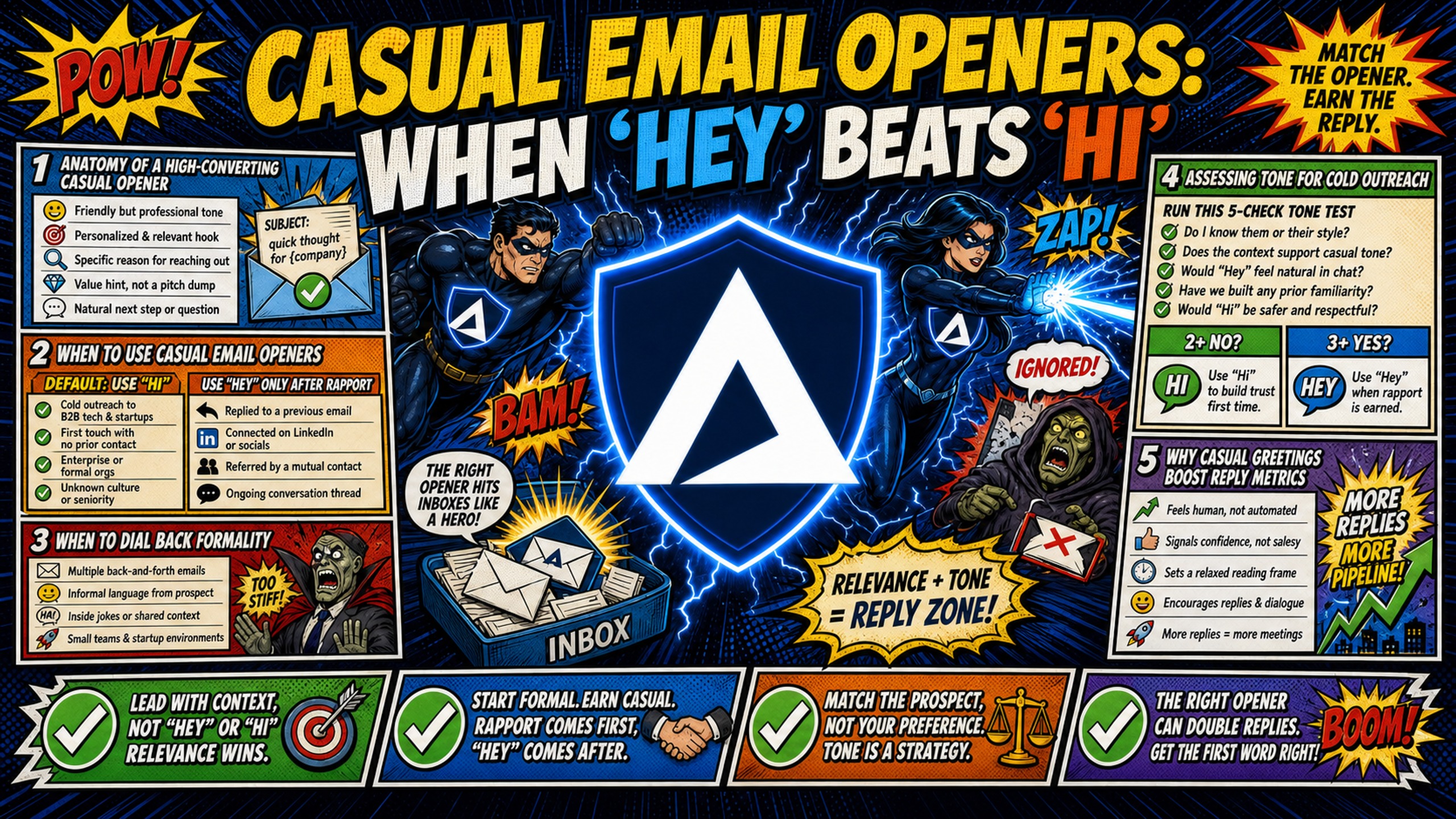
TL;DR: Match the opener to the prospect, not personal preference: use "Hi" as the default for most B2B tech and startup outreach, "Hey" only after rapport is established or in informal cultures, and "Dear" with titles for C-level executives in finance, legal, or healthcare. None of it matters if the email never reaches the inbox: authentication and dedicated IP infrastructure determine deliverability before the opener does. Test opener changes with statistically significant sample sizes and track reply rate, not open rate.
Most cold email advice tells you to obsess over your greeting. The data says your greeting matters less than your SPF record. Cleverly's cold email statistics put the average reply rate at 3.43%, but opener choice only moves that number after infrastructure determines whether the email lands in the inbox at all.
Your team is likely split on whether to use "Hey" or "Hi," and the answer depends on three variables: industry, seniority, and sequence position. This article gives you the data to choose the right opener, then shows you the infrastructure that ensures it gets seen.
Anatomy of a high-converting casual opener
The opener is one variable in a longer decision chain. These are the conditions that determine whether casual or formal serves your reply rate.
When to use casual email openers
Casual email openers work best in specific, measurable scenarios. Use them when:
- The prospect works in tech, SaaS, or a startup environment with informal company culture (commonly favors casual openers)
- The prospect has already replied in the thread and their reply tone was casual
- Industry research suggests the prospect's sector favors directness over ceremony
When to dial back formality
Watch for these signals that formality is hurting your reply rates. Low reply rates on formal openers in tech industries suggest you're reading as too stiff. Prospects who reply casually to your formal opener are signaling they prefer direct communication.
An overly casual opener signals low effort to executives in formal industries, while an overly formal opener reads as a template blast to managers in tech environments. The mismatch happens at the first word, before your value proposition gets evaluated. Matching opener to seniority and industry is the reliable starting point.
Assessing tone for cold outreach
Ask three questions before choosing an opener. What industry is the prospect in? What's their seniority level? Is this a cold email or a follow-up in an active thread? For tech and startup prospects at manager level or below in follow-ups, use "Hey." For C-level executives in finance, legal, or healthcare on first touch, use "Hi" or "Dear." The decision rule: match the opener to the prospect's communication style, not your own preference.
Why casual greetings boost reply metrics
Opener style influences reply behavior, but the effect only shows up clearly when matched to the right context. Here is what the available research shows across industries and seniority levels.
Performance stats for opener styles
Casual openers ("Hey," "Hello," "Hi") got replies 63 to 64% of the time, versus 56 to 57% for formal options like "Dear," roughly a 7-point gap, in a Boomerang analysis of 300,000+ email threads. That data comes from general online communities in 2017, not cold B2B outreach, so treat the gap as directional rather than a cold-email benchmark. Boomerang also cautioned that results may differ in more formal settings, so the best opener may depend on the audience and context.
Comparing reply rates by business type
Reply rates vary significantly by industry, and opener effectiveness follows those patterns:
| Industry | Opener Recommendation |
|---|---|
| Legal services | Dear (formal) |
| Financial services | Dear or Hi (formal) |
| SaaS/Technology | Hi or Hey (casual) |
| Healthcare | Dear (formal) |
How seniority impacts opener success
C-suite executives are often considered more sensitive to tone mismatches than other seniority levels, making opener choice higher-stakes on first touch. For C-level executives in conservative industries, formal greetings ("Dear" with titles) remain the safer choice on first touch.
Reading the prospect's communication style
The key lever is matching the opener to the prospect's communication style, not your own preference. Read their LinkedIn posts, company blog tone, and previous email replies. If they write casually, match it. If they write formally, stay formal.
When the opener matches industry norms, the prospect moves directly to evaluating your value proposition rather than questioning whether the email is relevant to them.
Proven casual openers to boost reply rates
Not all casual openers carry equal weight. Context, seniority, and sequence position each shape which greeting fits a given send.
When to use Hey vs Hi
The "Hey vs Hi email" decision depends on context, not personal preference:
| Opener | Best Context | Reply Rate Impact | Reply Rate Risk |
|---|---|---|---|
| Hey | Informal company cultures, after rapport established | High in casual contexts | Low (tech), High (formal sectors) |
| Hi | B2B tech, SaaS, startups, most professional contexts | Baseline | Low (all sectors) |
| Dear | C-level executives, legal, finance, healthcare, academia | Baseline in formal contexts | Low (formal), High (tech) |
| Quick question | Follow-ups, busy executives | High for short emails | Low (all contexts) |
Impact of casual openers on replies
Casual openers signal peer-to-peer communication, which reduces the "sales email" reflex. When a prospect sees "Hey" instead of "Dear Sir/Madam," the email reads as coming from a colleague rather than a vendor. This psychological shift matters more in industries where prospects receive high volumes of formal sales outreach. The mechanism: casual openers lower the barrier to reply by making the interaction feel less transactional.
Choosing the right informal greeting
Map greeting types against industry sectors using this decision matrix:
| Greeting | Tech/Startup | Legal/Finance | Healthcare | E-commerce |
|---|---|---|---|---|
| Hey | ✓ After rapport | ✗ Avoid | ✗ Avoid | Context-dependent |
| Hi | ✓ Good | ✓ Good | ✓ Good | ✓ Good |
| Dear | Context-dependent | ✓ Best | ✓ Best | Context-dependent |
This matrix reflects industry norms, not prescriptive rules. Test within your specific prospect segments to validate.
Best practices for cold email salutations
Follow these five practices when using casual cold email openers:
- Match prospect tone: Check if they use emojis, short sentences, or casual sign-offs in LinkedIn posts. If yes, "Hey" may work after initial contact. If they write in long paragraphs with formal language, use "Hi."
- Avoid excessive casualness: "Heyyy" and "Yo" can read as unprofessional in B2B contexts
- Use first names: "Hey Sarah" outperforms "Hey" alone in reply rate
- Test before scaling: Run A/B tests with statistically significant sample sizes before rolling out to your full list
- Keep it consistent: Don't switch from "Dear" to "Hey" across a sequence unless the prospect replies casually first.
Optimizing openers for cold outbound
The opener sets the tone, but the first line of value determines whether they keep reading. Most reps overthink the greeting. What matters is the 10 to 15 words that follow. Use "Hi [Name]" for B2B, avoid "Dear" (too formal for cold outreach) and "Hey" (too casual for executives).
Research suggests you have roughly 8 seconds to capture a prospect's attention, according to Campaign Monitor's analysis of email attention spans. The value proposition in the next sentence determines whether you get a reply.
When should you use casual email openers?
Casual openers perform well in specific conditions. These are the scenarios where the data supports using them.
Adapting openers for tech startups
Tech startup founders and operators expect direct, casual communication. "Hey" or "Quick question" works because it matches the communication style they use internally. Example: "Hey Marcus, noticed you're scaling outbound at [Company]. Quick question about your current infrastructure." This reads as peer-to-peer, not vendor-to-prospect.
Follow-up emails in active threads
Once a thread is active, formality drops naturally. "Hey" or no greeting at all works in follow-ups because the context is already established. Drop the headers and formatting, and write like you're responding to a thread.
Adapting opener tone for individual leads
Read a prospect's communication style using this two-step process. First, check their LinkedIn activity for tone signals (casual vs. formal language, emoji use, post length). Second, review their company blog or About page for brand voice. If they write casually, match it. If they write formally, stay formal. The goal is to read as someone who did their research, not someone using a template.
When industry norms favor casual openers
Prospects in tech, SaaS, and startup environments respond better to casual openers because industry norms favor directness over formality. "Hey" or "Quick question" reads as natural in these contexts, while "Dear" reads as stiff.
Using casual openers in warm introductions
Warm intros allow for the most casual openers because trust is already established. "Hey" works when a mutual connection made the intro because the prospect already has context for who you are. The casual opener signals that you're continuing a conversation, not starting a cold pitch.
When casual openers damage your sender reputation
Casual language carries risk in certain contexts. These are the conditions where informal openers hurt performance or compound deliverability problems.
Before testing openers, verify your infrastructure handles the delivery layer. Confirm SPF/DKIM/DMARC records authenticate correctly, check your domain and IP are not blacklisted, keep bounce rates low, and monitor complaint rates closely. The opener only matters if the email reaches the inbox first.
Risks of informal salutations in cold email
The opener itself rarely triggers spam filters. "Hi" and "Hey" are generally not treated as spam trigger words by modern filters. Having a spam word or phrase here and there doesn't immediately mean a visit to the spam folder, because spam filters have evolved beyond automatic blacklisting. However, casual language combined with other spam signals (poor list quality, high bounce rates, shared IP contamination) can compound deliverability problems.
Why 'Heyyy' hurts your sender reputation
Excessive casualness ("Heyyy," "Yo," "Sup") reads as unprofessional and can increase spam complaints, which directly damages sender reputation. Google recommends keeping spam complaint rates under 0.1%, and rates above 0.3% make a domain ineligible for delivery mitigation, per Google's own sender guidelines. Research on email pet peeves ranks no greeting at all as the single most annoying opener (53%), followed by "To whom it may concern."
"Hey" also appears on that list at 28%, which looks like a contradiction until you check the population: Perkbox surveyed general email recipients, not B2B tech buyers replying to outbound sequences. That gap is exactly why this article segments by industry and seniority instead of picking one universal opener. "Hey" is annoying to an inbox full of newsletters and customer service threads. It reads as normal to a founder who lives in Slack all day.
Inframail's guide to the 7 most common deliverability mistakes covers the specific infrastructure and sending behavior errors that route emails to spam.
Avoid these unprofessional email openers
Skip these openers in cold outreach:
- "Heyyy": Excessive casualness increases spam complaints.
- "Yo" and "Sup": Too informal for B2B contexts.
- "To whom it may concern": Shows you didn't research the prospect.
- "Dear Sir/Madam": Outdated and impersonal.
- "I hope this finds you well": Overused and invisible to prospects.
When nicknames damage sender trust
Using a nickname when the prospect uses their full name signals that you didn't do your research. If their email signature says "Michael" and you write "Hey Mike," you're telling them you didn't pay attention. Match the name format they use in their signature, LinkedIn profile, or company bio. This detail matters more than the opener itself because it demonstrates whether you treated them as an individual or a list entry.
Testing openers: which greeting drives replies?
Measuring opener performance requires the right benchmarks and the right metrics. Here is how reply rate data breaks down by opener type.
Reply rate trends by opener type
The average cold email sequence reply rate is 3.43%, meaning for every 1,000 recipients that received a cold email in 2026, only 34 replied. Top-quartile campaigns achieve 5.5% reply rates, while elite performers exceed 10%, consistent with Cleverly's benchmark definitions. Your opener carries significant weight in determining whether you hit these benchmarks.
Analyzing tone in cold email openers
Analyze prospect tone using this rubric. Read their website copy: is it casual or formal? Check their LinkedIn posts: do they use emojis and short sentences, or long paragraphs and formal language? Review their email replies if you have them: do they sign off with "Best" or "Thanks" or "Cheers"? Match your opener to their demonstrated style, not your assumption about their industry.
When to choose Hey over Hi
Choose "Hey" when the prospect is in tech or in an active thread. Choose "Hi" when the prospect is a C-level executive in a conservative industry or this is a first-touch cold email. The decision rule: when in doubt, start with "Hi" and adjust based on their reply tone. If they reply with "Hey," mirror it in your next email. If they reply with "Dear," stay formal.
A/B testing your email intro variations
Reliable opener testing depends on test configuration as much as sample size. These are the steps to run a valid split test and read the results accurately.
How to configure A/B split testing
Configure A/B tests in Instantly or Smartlead using these settings. Set a 50/50 split between variants. Change one variable only (the opener). Use the same list quality for both variants to avoid contamination. Run the test for 7-10 business days to capture replies across different days of the week. Track reply rate as your primary metric, not open rate.
Required sample sizes for reliable data
Run valid tests by sending statistically significant sample sizes per variant, changing one variable at a time, and tracking reply rate as your primary metric. For positive reply rate tests, use sufficient samples to reach statistical significance, run for 7-10 business days, and look for a meaningful difference of 1.5+ percentage points. Reply rate tests on cold email can reach significance with smaller samples than open rate tests because reply rates are lower and differences are larger.
Essential metrics for opener tests
Track these metrics in order of importance. Reply rate is the primary metric because it directly measures engagement. Positive reply rate (replies that express interest) matters more than total reply rate because it filters out "not interested" responses. Meeting booked rate is the ultimate outcome metric. Open rate is unreliable because Apple Mail Privacy Protection masks opens at scale, making engagement signals invisible, according to Cleverly's benchmark analysis.
Matching tone to your prospect type
Match tone using the three-question framework: industry, seniority, sequence position. For tech startups at manager level in follow-ups, use "Hey." For C-level executives in finance on first touch, use "Hi." The framework gives you a starting point, but testing validates whether the match works for your specific prospect segment.
Testing openers is wasted effort if emails land in spam. You can A/B test "Hey" vs "Hi" across 10,000 sends, but if your SPF/DKIM/DMARC records are misconfigured or you're sending from a contaminated shared IP, neither opener reaches the inbox.
Google escalated enforcement to permanent rejections for non-compliant bulk senders starting in November 2025, according to Google's Email sender guidelines. Authentication is necessary, but it does not guarantee inbox placement. Your domain reputation, complaint rate, bounce rate, recipient engagement and sending behavior still affect delivery.
Inframail automates SPF/DKIM/DMARC configuration, eliminating the manual DNS work that delays campaign launches. The platform provisions unlimited email inboxes on dedicated IPs, which isolates your sending reputation from other users. Dedicated IP pools deliver 85 to 95% inbox placement with proper warm-up, compared to 65 to 80% on shared pools, according to EmailBison's dedicated vs. shared IP pool analysis.
The infrastructure cost difference matters when scaling opener tests across hundreds of inboxes. For 50 inboxes, Google Workspace Business Starter costs $420/month at $8.40 per seat on the Flexible Plan. Inframail's platform fee is $147/month flat. That's $273/month in platform savings, or $3,276 annually.
Domain costs (typically $5 to $16 per domain per year) and warmup tools (typically $15 to $50 per inbox per month) apply on both sides and are not included in this comparison.
"I've been running cold email campaigns for my agency for a while now, and email infrastructure used to be one of the most frustrating parts. Then I found Inframail, and honestly, it's been a massive relief. The setup is ridiculously fast. SPF, DKIM, DMARC, forwarding - all handled in literally seconds without me having to dig through docs or guess what records to add." - Verified user review of Inframail
Inframail: email infrastructure for cold outbound agencies
Inframail is a flat-rate Microsoft email infrastructure platform for agencies running 50 to 200 cold email domains. It automates SPF/DKIM/DMARC setup, provisions dedicated IPs, and delivers 98%+ deliverability with 68.3% blacklist delisting success within 48 hours. The Unlimited plan is $147/month flat. The Agency Pack is $387/month. Domain costs and warmup tools are additional on both sides.
See how Inframail helped a client close four clients in his first month by automating his cold email setup and supporting him when deliverability issues came up in this case study video.
Sign up to Inframail and get started today.
FAQs
Is it unprofessional to start an email with Hey?
No, in tech and startup contexts "Hey" is standard and often outperforms "Hi" in reply rate. In finance, legal, and healthcare, "Hi" or "Dear" remains safer for first-touch cold emails.
Do casual email openers hurt deliverability?
The opener itself rarely triggers spam filters. Casual language combined with poor list quality, high bounce rates, or shared IP contamination can compound deliverability problems.
Should I use casual openers with C-level executives?
For C-level executives in conservative industries, use "Hi" or "Dear" on first touch. For C-level executives in tech startups, "Hey" matches the communication style they use internally and reduces the sales-email signal.
Can I mix casual and formal language in the same email?
A casual opener with a professional body can work well depending on your audience. The opener sets the tone, but the value proposition determines whether they keep reading.
How do I know if my prospect prefers casual communication?
Read their LinkedIn posts, company blog tone, and previous email replies. If they write casually, match it. If they write formally, stay formal.
Key terms glossary
Reply rate: The percentage of delivered emails that receive a reply. The primary metric for measuring opener effectiveness.
Inbox placement rate: The percentage of sent emails that land in the primary inbox rather than spam or promotions.
Sender reputation: A score assigned by email service providers based on sending behavior, complaint rates, and infrastructure quality.
SPF/DKIM/DMARC: Email authentication protocols that verify the sender's identity and prevent spoofing. Misconfigured records cause emails to land in spam.
Dedicated IP: An IP address used exclusively by one sender, isolating their reputation from other users on shared IP pools.
A/B split test: A controlled experiment where two variants are sent to randomly selected segments of the same list to measure which performs better.
Statistical significance: The confidence level that a test result is not due to random chance. Cold email opener tests require larger sample sizes than open rate tests because reply rates are lower.