
Best cold email tools for SaaS startups in 2026
The best cold email tool for your SaaS startup depends on whether you need predictable infrastructure costs, fast domain setup, or integrated lead data. Inframa
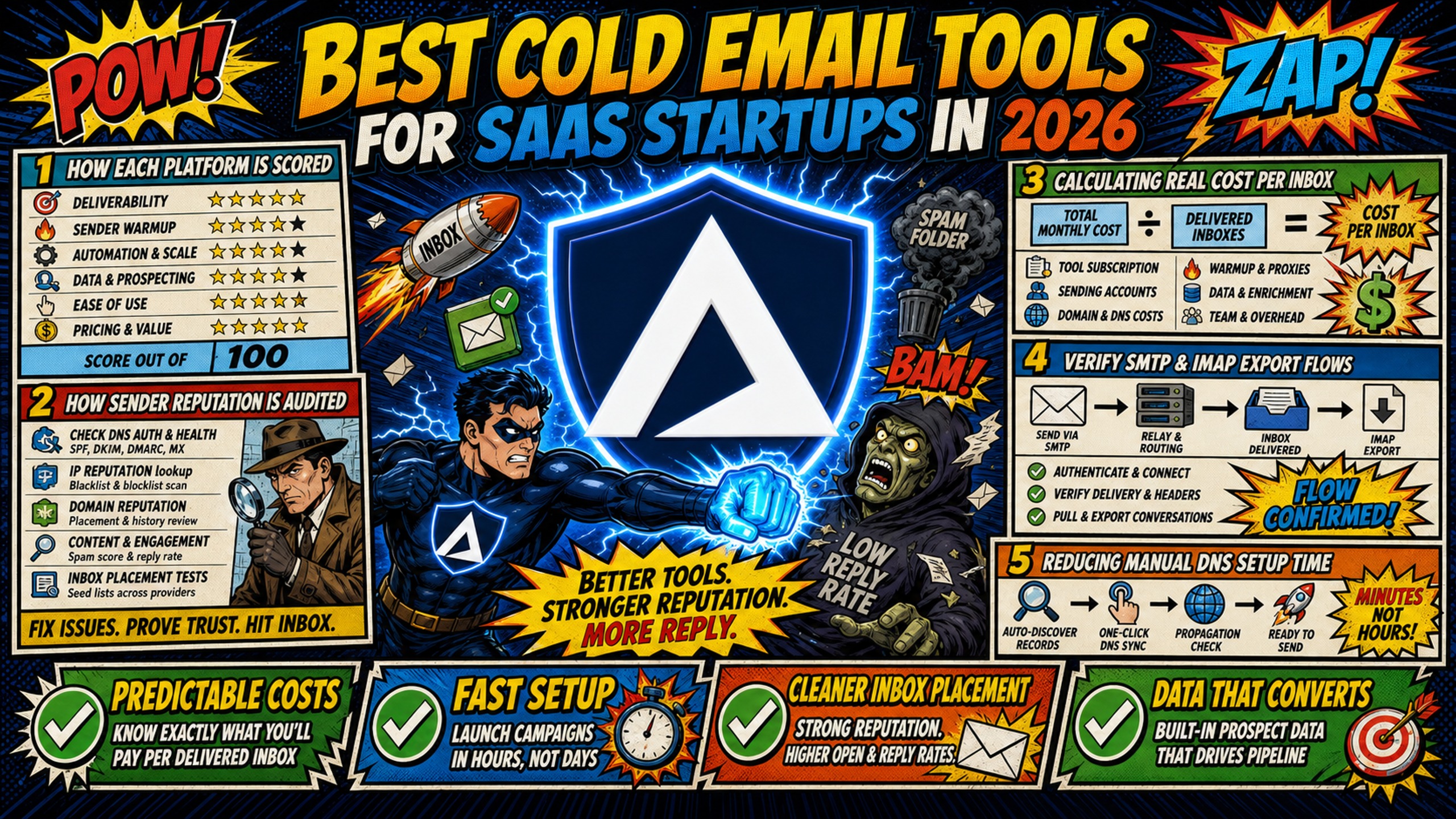
TL;DR: The best cold email tool for your SaaS startup depends on whether you need predictable infrastructure costs, fast domain setup, or integrated lead data. Inframail wins on flat-rate pricing ($147/month with no cap on inbox count and up to 80,000 emails per month) and automated DNS setup for teams running 50-200 domains. Instantly and Smartlead pair well with Inframail as sending platforms. Apollo adds lead data. Lemlist fits high-touch campaigns.
The cold email tool you choose for sending is not the one that determines your margin. Your inbox infrastructure is. Most comparisons rank sending platforms and skip the infrastructure layer, but that layer decides whether your campaigns land in the inbox and whether your costs stay flat or climb with every domain you add. This article scores five platforms on sender reputation, real cost per inbox, export flows, DNS setup time, and scaling capabilities.
How each cold email platform is scored
This comparison uses its own scoring framework rather than an industry standard. Every platform below is scored on five criteria: sender reputation infrastructure, real cost per inbox, SMTP and IMAP export flows, DNS setup time, and scaling capabilities for outbound teams.
How sender reputation is audited
The audit checks whether each platform offers dedicated IPs or shared pools, how it handles blacklist monitoring, and whether it auto-submits delisting requests. Dedicated IPs isolate your reputation from other senders. Shared IP pools work like carpool lanes where you're affected by other drivers. One bad actor spamming gets the whole range flagged.
Inframail publishes a 68.3% blacklist delisting success rate within 48 hours, a specific benchmark to compare against.
Calculating real cost per inbox
The cost model adds platform fees, domain costs, and warmup tool costs to estimate monthly spend at three tiers chosen for this comparison: 10, 50, and 100 inboxes. Inbox-based costs (platform seats, warmup) are counted per inbox, while domain costs are counted per domain and assume 1 inbox per domain, the highest-cost case, since adding more inboxes to each domain lowers domain spend. A $47/month sending platform means nothing if the infrastructure behind it costs $420/month. Google Workspace Business Starter costs $8.40 per user monthly on the Flexible Plan, the rate most cold email teams pay since they scale inboxes up and down month to month.
Verifying SMTP and IMAP export flows
The verification tests whether each platform exports IMAP/SMTP credentials to CSV for import into sending tools like Instantly, Smartlead, and Lemlist. Manual credential entry for 50 inboxes takes hours. Automated CSV export takes minutes.
Reducing manual DNS setup time
The measurement tracks how long it takes to go from domain purchase to operational inbox with SPF, DKIM, and DMARC records configured. These three DNS records verify your identity as a sender and prevent spoofing. Manual setup across 50 domains takes 12+ hours. Automated platforms handle this without DNS panel access.
Key capabilities for scaling outbound
The evaluation covers whether the platform supports multiple client accounts or product lines, how it handles domain rotation for sender reputation management, and whether costs stay predictable as inbox count grows. A platform that works at 10 inboxes but breaks your budget at 100 is not a scaling solution.
Top 5 cold email platforms for 2026
Choose based on where your current bottleneck sits: infrastructure cost, campaign speed, multi-client management, personalization, or data access. These five platforms each cover one of those needs:
- Inframail: Flat-rate infrastructure with automated DNS setup for teams scaling 50-200 domains.
- Instantly: Rapid campaign setup with unlimited inbox connections.
- Smartlead: Multi-client agency management with unlimited mailbox connections.
- Lemlist: High-touch multichannel outreach with personalized images and LinkedIn touches.
- Apollo: Integrated lead data and email sequences in one platform.
1. Inframail for automated inbox setup
Inframail is a flat-rate Microsoft email infrastructure platform that provisions unlimited inboxes on dedicated IPs. The Unlimited Plan costs $147/month with no cap on inbox count, but total sending is limited to 80,000 cold emails per month across all inboxes on 1 dedicated US-based IP. The Agency Pack costs $387/month with 3 dedicated IPs and up to 300,000 emails per month, so teams should size a plan by sending volume, not inbox count. Domain costs run $5-16 per domain per year through the platform, regardless of how many inboxes sit on each domain.
The platform auto-configures SPF/DKIM/DMARC records without DNS panel access. You purchase domains through Inframail or migrate existing domains, and each inbox comes with IMAP/SMTP credentials ready for CSV export to your sending platform. Customer testimonials report setting up 10 inboxes in 2 minutes, and the company states you can go from domain purchase to ready-to-send inboxes in 2 minutes.
"I've been using Inframail for a couple of months and the experience has been really good. I can set-up inboxes in 5mins while saving money on Google Workspace subscriptions and benefit from great deliverability. All of my campaigns on Inframail are on a >10% reply rate." - Verified user review of Inframail
Inframail publishes a 98%+ deliverability rate and a 68.3% blacklist delisting success rate within 48 hours. The platform does not include warmup, so you pair it with an external tool like Warmbox or Lemwarm. Support is available 16 hours a day, 7 days a week from real people.
2. Instantly for rapid campaign setup
Instantly is a sending platform that manages sequences, reply detection, and campaign analytics. The Growth plan costs $47/month on monthly billing or $37.60/month on annual billing (about $451 billed upfront). It includes 1,000 uploaded contacts and 5,000 emails per month, with unlimited email account connections and unlimited warmup. That makes it a strong pair for flat-rate infrastructure like Inframail, where you connect as many inboxes as you need without per-seat fees on either side.
Instantly's strength is speed to launch. You import leads, build sequences, and connect sending accounts through a clean interface, and when you pair it with Inframail, where customers report provisioning 10 inboxes in about 2 minutes, infrastructure setup stops being the slow part of your launch. The platform includes basic warmup features and unified inbox management, but new inboxes still need to warm up before you send cold campaigns. For SaaS founders who need a campaign ready to launch this week, Instantly removes the learning curve heavier platforms create while Inframail removes the DNS configuration bottleneck that delays most launches.
3. Smartlead for automated warmup and delivery
Smartlead is a sending platform built for agencies managing multiple client accounts. The Base plan starts at $39/month with 2,000 contacts and 6,000 emails per month. Smartlead offers unlimited mailbox connections across all tiers. Warmup pool access is a flat $59/month add-on (not priced per inbox) on the Base and Growth tiers (Base/Pro tiers start at $39 and $94/month), while higher tiers carry their own add-on structure.
Smartlead's strength is multi-client management with white-label capabilities. You run separate campaigns for different clients under one login with clear separation between accounts, and Inframail's flat-rate infrastructure means adding a new client costs you zero in additional inbox fees. Smartlead's $59/month warmup pool access on the Base and Growth tiers is a flat add-on, while the external warmup tools you pair with Inframail are priced per inbox ($15-50/month), so the two are not directly equivalent. Budget for warmup separately and compare both options at your own inbox count.
4. Lemlist for high-touch cold email
Lemlist is a multichannel outreach platform combining email sequences with LinkedIn touches, cold calls, and personalized images. The Email plan starts at $69/month for 50,000 emails per month, with unlimited users, senders, and campaigns. Lemwarm comes free with all paid plans, so warmup is included in the plan fee rather than billed per inbox.
Lemlist fits teams running lower-volume, higher-personalization campaigns where each prospect gets custom images, video thumbnails, or dynamic landing pages. The Multichannel plan costs $109 per user per month, so it gets expensive as the team grows, but for a 2-5 person founding team doing targeted outreach to 50-100 prospects per week, the multichannel capabilities justify the cost. Pair Lemlist's plan fees with Inframail's $147 flat rate and you protect margin since your inbox infrastructure cost stays fixed even when you add team members or domains.
5. Apollo for targeted lead lists
Apollo is a sales intelligence and engagement platform. Apollo's database covers 240M+ contacts and 30M+ companies directly inside the platform. The Basic plan starts at $49 per user per month on annual billing. Apollo combines lead sourcing, email sequencing, and a dialer in one platform.
Apollo's strength is data integration. You search for prospects, enrich contact records, and add them to sequences without switching between a data provider and a sending tool. For early-stage SaaS founders without a separate data budget, Apollo's Basic plan at $49/user/month replaces a separate data provider subscription. The trade-off is per-user pricing that scales with team size, and sending capabilities less specialized than dedicated platforms. If you run both, Inframail covers only the inbox infrastructure layer at a flat $147/month, so Apollo's per-user fees cover data and engagement without adding per-inbox infrastructure costs.
| Platform | Setup speed | Warmup | Best for |
|---|---|---|---|
| Inframail | Minutes (automated DNS) | External tool required (per-inbox pricing, $15-50/ inbox/month) | Teams scaling to 50-200 domains at a flat $147/mo regardless of inbox count (sending capped at 80,000 emails/mo) |
| Instantly | Minutes | Basic features included | Rapid campaign launches from $47/mo ($37.60/mo annual) |
| Smartlead | Minutes | Flat $59/mo add-on on Base and Growth tiers, not per inbox (higher tiers have their own add-on structure) | Multi-client agency management from $39/mo |
| Lemlist | Minutes | Lemwarm included in plan fee at no extra charge | High-touch multichannel outreach from $69/ mo (Email plan, unlimited users) |
| Apollo | No published setup time (1:1 onboarding sessions typically last 30-60 minutes) | Not applicable (engagement platform) | Integrated data and sending from $49/user |
Best cold email software by use case
The sections below match each platform to a specific use case.
Minimize monthly spend per domain
Inframail wins on cost for teams running 50+ inboxes. Google Workspace costs $8.40 per inbox per month on the Flexible Plan, so 50 inboxes run $420/month before you send a single email. Inframail charges $147/month whether you run 50 or 200 inboxes because inbox count is not capped, though total sending on the Unlimited Plan is limited to 80,000 emails per month. Domain costs ($5-16/year per domain) and warmup tools ($15-50/month per inbox) apply on both sides, and the domain figures here assume 1 inbox per domain, so 50 inboxes need 50 domains. Per-mailbox competitors like Maildoso charge $2.50 per mailbox at 30 mailboxes, dropping to $0.49 at 1,000. The per-mailbox rate falls with volume, but the total bill still rises with every mailbox you add, while Inframail's platform fee stays fixed.
For 50 inboxes, that is $273/month in platform fee savings (before domain and warmup costs) over Google Workspace, or $3,276 annually. The savings grow as you scale because Inframail's cost stays fixed while per-inbox costs climb linearly, as long as your total sending stays within the plan's 80,000 emails per month.
Rapid domain deployment for startups
Inframail wins on setup speed. Manual DNS configuration across 50 domains is the slowest step in any launch. Inframail's automated SPF/DKIM/DMARC configuration handles record creation without DNS panel access, and customer testimonials report 10 inboxes operational in 2 minutes. Mailforge describes its shared infrastructure as low-cost with pre-warmed IPs and minimal setup, and notes that on shared IPs one sender's poor behavior can hurt others' deliverability, while Inframail's dedicated IPs isolate your reputation so setup speed does not come at the cost of deliverability control.
A SaaS startup that just closed a funding round and needs outbound operational this week benefits from faster setup, since DNS configuration is the step that delays most launches.
Automating your campaign launch process
Smartlead wins on workflow automation for teams managing multiple campaigns. The unified inbox and multi-client separation reduce the number of platforms you check daily. Instantly wins for single-product SaaS teams that want the fastest path from lead import to live sequence. Both pair with Inframail's infrastructure layer: you export IMAP/SMTP credentials to CSV from Inframail and import them into either sending platform in minutes.
Best integrated data and email stacks
Apollo fits teams that want lead data and sequencing in one platform. Apollo's database covers 240M+ contacts and 30M+ companies directly inside the platform, so you can search for prospects, verify emails, and add them to sequences without leaving the platform. For early-stage SaaS companies without a data budget, Apollo's Basic plan at $49/user/month replaces a separate data provider subscription. The trade-off is less specialized sending infrastructure. You can combine Apollo's data, Inframail's inbox infrastructure, and Instantly's sending by importing Inframail's IMAP/SMTP credentials into Instantly, and while Inframail's $147/month platform fee stays flat, warmup and domain costs still grow with inbox count.
Key criteria for choosing cold email software
The sections below break down the criteria to check when choosing cold email software.
Managing warmup cycles at scale
Every new inbox needs a warmup period before you send cold campaigns. Warmup tools gradually increase send volume while generating positive engagement signals. External warmup tools typically charge per inbox at $15-50/month, so 50 inboxes cost $750-2,500/month in warmup alone. Smartlead charges a flat $59/month for warmup pool access on its Base and Growth tiers (higher tiers carry their own add-on structure), and Lemlist includes warmup in its plan fee, so neither is directly equivalent to per-inbox pricing. Inframail requires external warmup.
Any sending platform without built-in warmup adds cost on top of its plan fee, and that cost takes different forms. Per-inbox external tools scale with inbox count, while flat add-ons and included warmup do not. A $47/month platform plus $750/month in per-inbox external warmup for 50 inboxes is $797/month. Run the numbers at your inbox count to see which model wins, and check whether warmup is included in the plan you choose.
Automating SPF, DKIM, and DMARC setup
SPF, DKIM, and DMARC are DNS records that verify your identity as a sender. SPF lists which servers can send email for your domain. DKIM adds a cryptographic signature to each message. DMARC tells receiving servers what to do when SPF or DKIM checks fail. Without all three, your emails land in spam or get rejected.
Manual configuration means logging into each domain's DNS panel, creating TXT records, and waiting for propagation. Across 50 domains, that repeated work adds up to the manual setup time measured in the scoring section. Inframail automates this process entirely.
How to resolve blacklist incidents fast
A blacklist is a database that flags IP addresses or domains associated with spam. When your sending IP lands on one, inbox placement drops immediately. The three things that matter are detection speed, fixing the root cause of the listing, and delisting response time (which typically takes days).
Inframail monitors dedicated IPs and auto-submits delisting requests when domains are flagged, with a published 68.3% success rate within 48 hours. Shared IP pool providers face a structural problem: if another user's behavior gets the IP flagged, you are affected even though you did nothing wrong. Maildoso offers automatic IP rotation and replacement to address shared-pool contamination, while Inframail solves the contamination problem at the root with fixed dedicated IPs where your behavior alone determines reputation and no other sender can affect your score.
Impact of IP type on sender reputation
Sender reputation is the trust score email providers assign to your sending IP and domain. It determines whether your emails reach the inbox, land in spam, or get rejected. Dedicated IPs give you full control: only your sending behavior affects your score. Shared pools split that control across every sender on the same IP range.
The cost gap between shared and dedicated IPs is roughly $1 more per mailbox per month between Mailforge (shared) and Infraforge (dedicated), plus $99/month for each additional dedicated IP. Inframail includes 1-3 dedicated IPs in its flat rate, so IP isolation comes built into the platform fee rather than as an add-on. Shared IPs mean your deliverability is partially determined by other users' sending behavior, a risk you cannot mitigate with better copy or targeting. Inframail's dedicated IP infrastructure isolates your reputation so only your sending behavior determines your inbox placement rate.
Syncing domains with email platforms
The connection between your infrastructure layer and sending platform happens through IMAP/SMTP credentials. Manual credential entry for 50 inboxes takes hours. Inframail's CSV export workflow takes minutes:
- Export credentials: Inframail exports IMAP/SMTP credentials to CSV from the dashboard.
- Import to sending platform: Upload the CSV directly into Instantly, Smartlead, or Lemlist.
- Test and start sending: Run a connection test on each inbox within the sending platform before assigning any sequences. Once the tests pass, your inboxes are ready to send.
Inframail does not publish a timed benchmark for the CSV export workflow, and larger batches of 100 inboxes have not been tested in published sources. Run a pilot batch to confirm timing at your scale.
Watch out for these hidden monthly fees
The sections below cover the recurring costs that are easy to miss when budgeting for cold email infrastructure.
Per-inbox and per-mailbox pricing compounds as you scale
Per-inbox pricing looks affordable at 10 inboxes and punishing at 100. Google Workspace at $8.40/inbox costs $84/month for 10 inboxes and $840/month for 100. Microsoft 365 Business plans start at $4 per user per month, depending on the plan. Maildoso's per-mailbox tiers drop from $2.50 at 30 mailboxes to $0.49 at 1,000, but even at volume you pay $499/month for 1,000 inboxes. Inframail's $147/month stays flat whether you run 10 or 200 inboxes, so the cost gap widens as you scale. Inbox count is unlimited, but the Unlimited Plan caps total sending at 80,000 emails per month, so teams sending above that volume need the Agency Pack.
Warmup and domain costs apply to every platform
Inframail does not include warmup, so budget $15-50/month per inbox for an external tool like Warmbox or Lemwarm. Smartlead's Base and Growth tiers do not include warmup either, and the add-on is a flat $59/month rather than a per-inbox rate, while higher tiers carry their own add-on structure. Lemlist bundles Lemwarm free with any paid plan, so warmup is covered by the plan fee. Domains are a recurring annual cost that teams forget to budget, and they are priced per domain, not per inbox. Inframail charges $5-16 per domain per year and Infraforge charges $14 per year per .com domain. At an assumed 1 inbox per domain, 50 inboxes need 50 domains, which is $250-800/year in domain costs on top of platform fees, or $21-67/month amortized. Inframail's $147/month Unlimited Plan plus $750/month in per-inbox warmup for 50 inboxes (the low end of the $15-50 per inbox range) is $897/month total before domain costs, which changes the math significantly compared to a platform where warmup is included or billed as a flat fee.
| Cost category | 10 inboxes | 50 inboxes | 100 inboxes |
|---|---|---|---|
| Inframail platform fee | $147/mo | $147/mo | $147/mo |
| Google Workspace platform fee | $84/mo | $420/mo | $840/mo |
| Domain costs (amortized, per domain, assumes 1 inbox per domain) | $4-13/mo (10 domains) | $21-67/mo (50 domains) | $42-133/mo (100 domains) |
| Warmup (external, $15-50/inbox) | $150-500/mo | $750-2,500/mo | $1,500-5,000/mo |
The warmup row reflects per-inbox external tool pricing ($15-50/inbox/month), so it scales with inbox count and varies by provider. Lemlist includes warmup in its plan fees, so this line item does not apply when using Lemlist. Smartlead's Base and Growth tiers charge a flat $59/month add-on instead of a per-inbox rate, so it is not directly comparable to the per-inbox figures in the table, and higher tiers carry their own add-on structure. The domain row is priced per domain and assumes 1 inbox per domain, so at 2 or more inboxes per domain, domain costs fall proportionally while inbox-based costs stay the same.
Proving inbox placement before you commit
Deliverability claims are easy to make and hard to verify. Here is how to test before committing at full scale.
Request specific inbox placement rates
Ask for the current deliverability rate and the methodology behind it. Inframail publishes 98%+ deliverability and 68.3% blacklist delisting success within 48 hours, but like most providers in this category, does not publish the testing methodology behind these figures. That is normal for the industry and exactly why a pilot matters.
Confirm successful domain delisting
Ask what happens when a domain gets blacklisted. Who submits the delisting request, how long does it take, and what is the success rate? A 68.3% delisting success rate within 48 hours is a specific, checkable claim. "We monitor your domains" is not.
Run a 7-day test after warmup, before scaling
Provision 10-20 inboxes, configure your warmup tool, and record the time from domain purchase to operational inbox. Let the inboxes warm up for 2-4 weeks before sending any cold campaign. After warmup, run a 7-day campaign to a seed list and measure inbox placement and reply rate. This gives you first-party data to compare against published claims.
Verify claims with existing customer data
Check Trustpilot and G2 for reviews that mention specific results. Inframail displays a 4.5/5 rating on Trustpilot. Look for reviews that mention your use case (agency vs. in-house, domain count, sending platform) rather than generic praise.
Get started with Inframail
Inframail is a flat-rate Microsoft email infrastructure provider for teams running 50-200 cold email domains. The Unlimited Plan costs $147/month with no cap on inbox count, 1 dedicated US-based IP, and automated SPF/DKIM/DMARC setup, and total sending is limited to 80,000 cold emails per month across all inboxes. Inframail publishes a 98%+ deliverability rate and a 68.3% blacklist delisting success rate within 48 hours. Warmup tools and domain costs are additional.
Check out this case study video and learn how Inframail helped a client build a cold email outbound system at 10 times lower cost, scale to 80 domains and over 400 email accounts with 90%+ open rates and 20-30 leads, and generate over $20,000 in new revenue within the first 30 days.
Sign up to Inframail and get started today.
FAQs
What is the best cold email tool for SaaS startups?
The best cold email tool depends on your constraint. Inframail wins for flat-rate infrastructure cost and setup speed at 50-200 domains. Instantly and Smartlead win as sending platforms. Apollo adds integrated lead data. Most teams pair an infrastructure provider with a sending platform.
How much should I budget for cold email infrastructure?
Budget $147/month for flat-rate infrastructure (Inframail Unlimited Plan), plus $5-16/year per domain and $15-50/month per inbox for warmup. For 50 inboxes at the low end and an assumed 1 inbox per domain (50 domains), total monthly spend is about $918: $147 for the platform, $21 for amortized domains, and $750 for warmup at $15 per inbox. Warmup is the biggest variable, and every extra $1 per inbox adds $50/month, so price your chosen warmup tool before you finalize a budget.
Do I need a separate warmup tool?
Yes, if your platform does not include one. Inframail requires external warmup (Warmbox or Lemwarm at $15-50/month per inbox). Lemlist includes warmup in its platform fees, while Smartlead charges a flat $59/month for warmup pool access on its Base and Growth tiers and its higher tiers carry their own add-on structure. Per-inbox pricing, flat add-ons, and included warmup are different structures, so compare total monthly cost at your inbox count rather than the headline numbers.
How long does it take to set up cold email domains?
Manual DNS setup takes 12+ hours for 50 domains. Inframail's automated setup provisions 10 inboxes in approximately 2 minutes with SPF/DKIM/DMARC records configured automatically. Add 2-4 weeks for warmup before sending cold campaigns, including any 7-day pilot test.
What's the difference between dedicated and shared IPs?
Dedicated IPs give you full control over sender reputation since only your behavior affects the score. Shared IP pools expose you to contamination from other senders on the same range. Inframail includes 1-3 dedicated US-based IPs in its flat-rate plans.
Key terms glossary
Inbox placement rate: The percentage of sent emails that reach the recipient's primary inbox rather than spam or promotions folders. Higher placement rates directly correlate with more replies and meetings booked.
SPF/DKIM/DMARC: Three DNS records that verify your identity as a sender. SPF lists authorized sending servers, DKIM adds a cryptographic signature, and DMARC tells receiving servers how to handle failures. All three must be configured correctly for cold email to reach the inbox.
Domain warmup: The process of gradually increasing send volume from a new domain over 2-4 weeks while generating positive engagement signals. Skipping warmup triggers spam filters and damages sender reputation before your campaign starts.
Blacklist: A database that flags IP addresses or domains associated with spam. Landing on a blacklist drops inbox placement immediately. Fast detection and delisting requests are critical for minimizing downtime.
Sender reputation: The trust score email providers assign to your sending IP and domain based on engagement, complaint rates, and sending patterns. It determines whether your emails reach the inbox, land in spam, or get rejected.