
B2B Email Sequence Design Principles: Copy, Length, and CTA
A B2B cold email sequence performs when three variables align. Length: keep the opener to 75-100 words, follow-ups to 25-75, and the breakup under 40. Boomerang
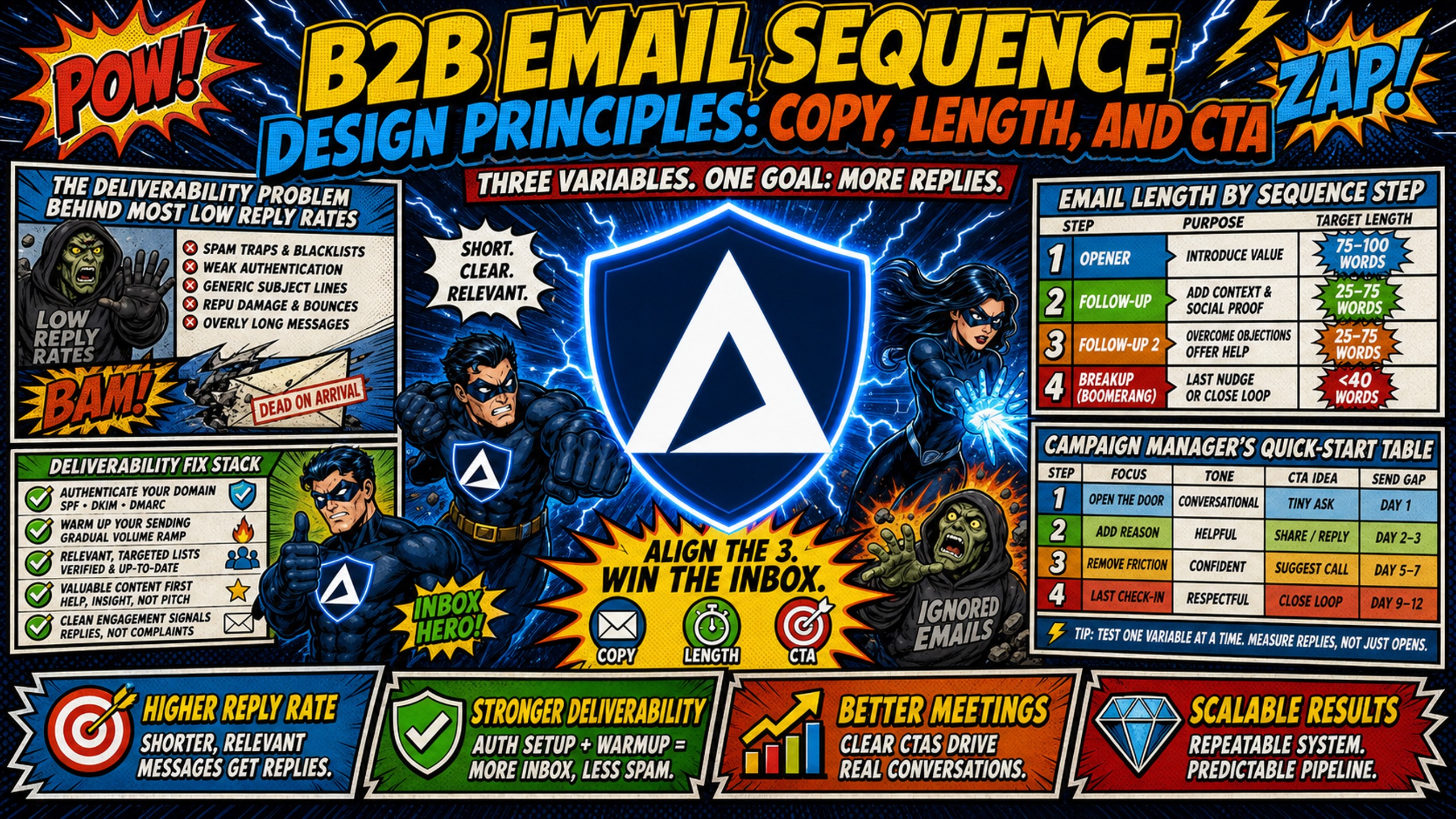
TL;DR: A B2B cold email sequence performs when three variables align. Length: keep the opener to 75-100 words, follow-ups to 25-75, and the breakup under 40. Boomerang's 2016 analysis of business email put 50-125 words as the response-rate sweet spot, and Litmus measured average time spent with an email at 8.97 seconds in 2022. CTA: use a soft, open-ended question in email 1 and save the calendar link for email 2 or 3. Personalization: Backlinko's study of 12 million outreach emails found personalized message bodies lift response rates 32.7%. None of it reaches the inbox without correct SPF, DKIM, and DMARC records and a dedicated IP rather than a shared pool. Inframail automates that DNS configuration and provides dedicated US-based IPs, the baseline these design choices depend on.
Most outbound campaign managers spend hours adjusting adjectives when the real bottleneck is structure and domain health. A cold email sent from a blacklisted domain delivers poor reply performance regardless of copy quality, because it never reaches the inbox. A 200-word email with three competing asks, sent from a healthy domain, still underperforms. Fixing one without the other wastes iteration cycles.
This playbook breaks down each variable in isolation: copy length by step, CTA friction level, personalization depth, single-topic discipline, and the technical infrastructure that determines whether any of those choices reach the inbox at all.
The deliverability problem behind most low reply rates
Low reply rates frequently trace back to deliverability problems that suppress inbox placement before the prospect ever reads a word. A sequence can have correct length, a soft CTA, and strong copy, and still fail because authentication records are wrong or the sending domain sits on a shared IP pool.
The deliverability baseline comes first. As Taylor Haren's real-world analysis of 174,000+ cold emails shows, AI spam filters can kill a sequence overnight when authentication records are wrong. Google's bulk sender requirements mandate SPF, DKIM, and DMARC for high-volume senders, and messages that fail authentication are rejected or filtered to spam. Microsoft has since introduced comparable requirements for Outlook.
Common authentication failures include duplicate SPF records, DKIM selector mismatches between DNS records and sending platforms, and missing DMARC records on sending subdomains. Manual DNS configuration for 50 domains takes many hours of registrar panel work, record creation, propagation waiting, and deliverability testing. Inframail's automated DNS provisioning removes the 12+ hours of manual panel work that 50 domains normally require, helping prevent authentication failures at setup.
When a domain does get flagged, Inframail's blacklist monitoring auto-submits delisting requests at a 68.3% success rate within 48 hours, protecting active campaigns before a client notices a drop in reply rate.
Email length by sequence step
Boomerang's 2016 analysis of business email found response rates holding above 50% for messages between 50 and 125 words, declining steadily above that to around 44% at 500 words. Two things carry across to cold outreach. The shape of the curve transfers even though the absolute rates do not, because Boomerang measured correspondence between people who often already knew each other. And the band describes a standalone message, which is why the per-step targets below tighten as the sequence progresses: a threaded follow-up inherits context the opener had to build from nothing, so it needs fewer words to do its job.
Emails over 150 words typically require scrolling on a smartphone, which pushes the CTA out of the visible screen area.
Campaign manager's quick-start table
| Email step | Recommended approach | Focus area |
|---|---|---|
| Email 1 (Opener) | Brief, 75-100 words | Core problem + soft ask |
| Email 2 (Follow-up) | Brief, 25-75 words | New angle or data point |
| Email 3 (Breakup) | Brief, under 40 words | Low-friction exit |
Email 1: the opener
The first email does one job: start a conversation, not close a deal. Keep it between 75 and 100 words, state the prospect's problem in plain language, connect it to a specific outcome, and close with a soft question. No company history, no feature list, no three-paragraph backstory.
B2B sequences targeting senior executives require shorter, more precise copy than those targeting individual contributors. Litmus's research measured the average time spent with an email at 8.97 seconds in 2022, down from 13.4 seconds in 2018. That figure covers marketing email rather than cold outreach and is an average rather than a ceiling, but nothing suggests senior recipients are more generous than the mean, which makes the 75-100 word target the safe assumption for director-level and above. Reply rates tend to drop once an email exceeds 100 words, and every sentence that does not serve the core problem competes with the CTA for the prospect's attention.
Email 2: the follow-up
The second email should not repeat the pitch from email 1. It should add a single piece of evidence: a one-sentence case study, a specific number, or a relevant observation about the prospect's business. Keep it between 25 and 75 words and thread it as a reply to email 1 so the prospect sees the prior context without searching their inbox.
Threading follow-ups (sending them as replies to the original message rather than as standalone emails) maintains conversation context and increases the human-to-human perception of the sequence. Practitioners running high-volume sequences report that threading preserves that context, though the effect is not cleanly isolated from other variables in published data. Some practitioners may recommend breaking the thread with a new subject line after step 3 to signal a fresh attempt.
Email 3: the breakup
The breakup email does more work than most campaign managers expect. At under 40 words, it should acknowledge that the timing might be off and leave the door explicitly open for the future. That honest, low-pressure exit surfaces replies from prospects who read every prior email but held back, because removing the pressure changes their calculation.
CTA strategy: when to push versus when to probe
Soft, open-ended CTAs consistently outperform calendar-link CTAs in early sequence steps, with vendor datasets covering hundreds of thousands of sends putting the gap at roughly 3x. Inframail's CEO Kidous Mahteme covers this CTA friction hierarchy in detail in his breakdown of hard vs. soft CTAs.
Defining the soft ask. A soft ask requires low cognitive commitment from the prospect. Examples include "Are you open to a quick conversation about this?" or "Would it make sense to share a 2-minute breakdown of how this works?" The prospect answers yes or no with minimal effort.
Identifying the hard ask. A hard ask requests a specific time commitment before interest is established. "Book a call on my Calendly here" or "Are you free Thursday at 2 PM?" both require the prospect to evaluate their calendar, imagine a meeting with a stranger, and commit to a block of time. Save the calendar ask for email 2 or 3, once the prospect has signaled interest by replying.
Before/after: email 1 CTA comparison
Before (high friction):
"I'd love to show you exactly how this works. Book a 20-minute call here."
After (low friction):
"Would it be worth a quick conversation to see if this applies to your setup?"
CTA placement matters too. An ask buried mid-copy competes with everything after it. Place the soft ask as the final line with no post-script, no secondary link, and no competing instruction below it.
Adapting email copy to boost reply rates
{{first_name}} alone is not personalization anymore. Every sequence uses it, and prospects have learned to recognize templated outreach by its presence. Basic name and company tokens add a modest reply lift, but contextual personalization adds significantly more by referencing something specific to the prospect's current situation: a recent hire in a relevant role, a technology in their stack, or a recent company announcement.
Surface-level tokens versus contextual personalization. Backlinko's analysis of 12 million outreach emails found that emails with personalized message bodies get a 32.7% better response rate than unpersonalized ones, and personalized subject lines add 30.5%. Vendor datasets in B2B cold email point the same way, with advanced personalization reply rates reported in the 17-18% range against 7-9% for basic templates.
The difference in practice:
- Surface-level: "Hi {{first_name}}, I noticed you're at {{company_name}}..."
- Contextual: "Saw you recently posted a Head of Sales role. That usually means you're scaling outbound, which typically surfaces the same infrastructure bottleneck most teams at your stage hit."
Matching depth to sequence stage. Contextual personalization works well in email 1, where the investment justifies higher engagement. Emails 2 and 3 should focus on adding evidence and scaling the value proposition rather than repeating the personalized hook. One well-placed contextual detail per opener is effective.
Adapting copy for persona pain. A cost-conscious operations manager responds to different language than a growth-focused VP of Sales. Operations-focused buyers respond to messaging about infrastructure spend and setup time saved. Revenue-focused buyers connect more directly with messaging about pipeline impact and booked call outcomes.
Single-topic emails and why they convert
Listing three value propositions in one email does not triple the chances of getting a reply. It cuts them. When a prospect encounters multiple competing ideas and no clear direction, deletion becomes more likely.
The reason why multi-topic emails suppress replies is simple. The easier it is to take a single action, the more likely a person takes it. A single ask is easier to act on. A 150-word email covering platform features, pricing, and a case study gives the prospect three separate tracks to evaluate before deciding whether to reply.
Before/after: three value props versus one focused benefit
Before (cluttered):
"This platform helps teams improve deliverability, reduce infrastructure costs, and spin up domains faster. It integrates with Instantly, Smartlead, and other major platforms. Would love to show you everything."
After (single focus):
"Most agencies running 50 domains on Google Workspace pay $420/month in infrastructure alone. Inframail infrastructure sits at approximately $163/month. Worth a quick look?"
The second version makes one claim, backs it with one number, and asks one question.
Checklist: editing an email down to a single idea
- Identify the one outcome this prospect cares most about right now.
- Cut every sentence that doesn't directly support that one outcome.
- Remove any secondary link, product feature, or case study that introduces a second topic.
- Read the email aloud. If it takes more than 30 seconds, cut it further.
- Confirm the CTA asks for one thing only, with no alternative action offered below it.
- Count the words. If the count exceeds 100 for email 1, cut again.
Isolating bottlenecks in your email sequence
The following tests isolate one variable at a time, covering email length, CTA friction, and personalization depth, so each result points to a single cause.
How to split-test email length
In Instantly, open your campaign and click 'Add variant' on the step you want to test. The platform supports up to 26 variants per step and balances usage across them over the campaign's lifetime, though variants added to a running campaign send preferentially until they catch up. Enable daily equal distribution in Preferences if you need a clean split from day one. To test email length, keep the subject line and CTA identical across both variants and change only the body copy: 50 words versus 120 words, with the same core message.
As a working minimum, aim for 250 sends per variant before reading a result, and closer to 1,000 before acting on a small difference. Below that, variance in list quality can mask the real effect.
Isolating CTA impact
To test CTA friction, keep the entire email body identical across both variants and change only the final line: a soft question in variant A versus a calendar link in variant B. This approach helps isolate the CTA as the primary variable affecting the reply rate differential.
Split-test setup for personalization depth
Test a deeply personalized opener (contextual detail in sentence 1) against a semi-templated opener (value proposition in sentence 1, no contextual reference) while keeping word count and CTA identical. This measures the return on personalization effort at your specific list quality. If both variants produce similar reply rates, the list may be too broad for contextual personalization to add meaningful lift, and effort is better spent on copy quality and CTA design.
Interpreting test results
Read results in this order:
- Open rate isolates subject line performance, not email body performance.
- Reply rate measures the combined effect of body copy and CTA.
- Positive reply rate isolates genuine interest from auto-replies and unsubscribes.
If open rates are healthy but reply rates sit below the 5-10% B2B average, the email body or CTA is the bottleneck. See the Inframail guide on spam detection and healthy metrics for a full breakdown of campaign performance by type.
Design principles for high-reply sequences
These principles cover the structural decisions that sit underneath copy choices: send timing, length adjustments by sector, and the infrastructure cost baseline required to support a healthy sequence at scale.
Optimal delay between sequence emails
The "Day 1, 3, 7, 14" cadence is a common approach that gives the prospect time to respond without letting the thread go cold. Day 1 is the opener. Day 3 is the first follow-up, threaded as a reply. Day 7 adds a new data point or angle, still in the same thread. Day 14 is the breakup email.
This spacing avoids crowding the prospect's inbox in a way that triggers spam complaints while maintaining enough frequency to stay top of mind across a two-week window.
Adjusting length for different sectors
B2B sequences targeting senior executives require the tighter end of the range, which is why the 75-100 word target holds for director-level and above. IC-level prospects in technical roles accept slightly more context, where a 100-word opener works when the content is highly relevant to their day-to-day workflow.
Infrastructure requirements and cost at 50 and 200 inboxes
The technical health requirements are consistent across all B2B segments. SPF, DKIM, and DMARC must be correctly configured, domains must be warmed before campaign launch, and dedicated IPs must be used to isolate reputation from other senders. Inframail provides 1 dedicated US-based IP on the Unlimited Plan and 3 on the Agency Pack, keeping sending reputation entirely under your own control.
If infrastructure costs are outside your direct control, these are the numbers to bring to your agency owner when making the case for a platform switch. For 50 inboxes, Google Workspace's Flexible Plan costs $8.40 per user per month, putting infrastructure at $420/month.
At 50 inboxes with amortized domain costs (~$34/month), total Inframail infrastructure sits at approximately $163/month, saving roughly $257/month compared to Google Workspace's Flexible Plan. Inframail charges a flat $129/month for unlimited inboxes, with domains at $5-16 per year each. (External warmup tools run $15-50/month per inbox and are an additional cost on both platforms.)
At 200 inboxes, the gap is large enough to anchor a vendor conversation with whoever holds the infrastructure budget. Google Workspace's Flexible Plan reaches $1,680/month, while Inframail holds at $129/month plus amortized domain costs, keeping infrastructure spend predictable regardless of inbox count.
Expected reply rate gains after design fixes
Applying these design principles in combination produces compounding gains. Shortening emails lifts reply rates. Switching from a calendar link to a soft question CTA is reported to improve replies by up to 3x. Threading follow-ups versus sending standalone emails increases open rates through context retention.
Moving from surface-level tokens to contextual personalization adds lift to reply rates. No single change produces outsized results alone, but combining length discipline, single-topic focus, low-friction CTAs, correct threading, and a technically healthy domain stack is what moves a sequence from underperformance to higher engagement.
Get started with Inframail
Inframail is a flat-rate Microsoft email infrastructure provider built for agencies and SDR teams running 50-200 cold email domains. Automated DNS provisioning handles SPF, DKIM, and DMARC configuration without manual registrar panel work. Dedicated IPs (1 on the Unlimited Plan, 3 on the Agency Pack) isolate sending reputation from other senders.
"InfraMail makes it remarkably easy to purchase domains, configure them correctly, create inboxes, and initiate warm-up immediately. The level of automation is exceptional and clearly designed for serious operators." - Verified user review of Inframail
The platform delivers 98%+ deliverability and resolves blacklist flags at a 68.3% success rate within 48 hours. The Unlimited Plan runs $129/month for unlimited inboxes, with domains at $5-16 each.
Sign up to Inframail and get started today.
FAQs
How long should each email in a sequence be?
Keep emails brief and focused. The first email should run 75-100 words, and follow-up emails work well in the 25-75 word range. Shorter emails perform better on mobile devices and require less cognitive effort from busy prospects, with reply performance dropping sharply past 150 words.
What is the optimal delay between sequence emails?
Use a "Day 1, 3, 7, 14" cadence to avoid crowding the prospect's inbox while maintaining consistent touchpoints across a two-week window. This spacing reduces spam complaint triggers while keeping the sequence visible across the prospect's decision cycle.
How does Inframail prevent domain blacklisting?
Inframail provides dedicated US-based IPs (1 on the Unlimited Plan, 3 on the Agency Pack) to isolate your sending reputation from other senders. The platform includes real-time blacklist monitoring and auto-submits delisting requests if a domain is flagged, achieving a 68.3% success rate within 48 hours.
Should I use a soft ask or a calendar link in email 1?
Always use a soft, interest-based question in email 1. Vendor datasets covering hundreds of thousands of sends consistently show soft CTAs outperform calendar-link CTAs by roughly 3x in early sequence steps. Save the calendar link for email 2 or 3, once the prospect has signaled interest by replying.
Does email threading increase reply rates?
Threading follow-ups as replies to the original message maintains context and signals a human-to-human conversation rather than automated outreach. Thread emails 1 through 3 together, then break the thread with a new subject line at step 4 to avoid the thread becoming too long and potentially ignored.
What is the cost difference between Inframail and Google Workspace for 50 inboxes?
Google Workspace's Flexible Plan costs $8.40 per user per month, putting 50 inboxes at $420/month. Inframail charges $129/month for unlimited inboxes plus approximately $34/month in amortized domain costs, totaling roughly $163/month and saving approximately $257/month on infrastructure before warmup costs. If infrastructure budget is owned by your agency founder or ops lead, these figures give you a concrete line-item comparison to bring to that conversation.
Key terms glossary
SPF (Sender Policy Framework): A DNS record that specifies which mail servers are authorized to send email on behalf of your domain. Without a correctly configured SPF record, receiving servers may treat your email as a likely spoof attempt.
DKIM (DomainKeys Identified Mail): An email authentication method that adds a cryptographic signature to outgoing messages, proving the email was not altered in transit. DKIM selector mismatches between the DNS record and the sending platform can cause authentication failures.
DMARC (Domain-based Message Authentication, Reporting, and Conformance): An email validation system that uses SPF and DKIM together to tell inbox providers what to do when authentication checks fail. Missing DMARC records on sending subdomains can contribute to deliverability problems in cold email infrastructure.
Email threading: The practice of sending follow-up emails as replies to the original message, keeping the entire conversation in a single chain. Threading helps maintain context for the prospect and can signal a human conversation rather than an automated blast.
Dedicated IP: An IP address used exclusively by one sender, isolating your sending reputation from other senders. Shared IP pools expose your deliverability to the behavior of other senders on the same range. Inframail provides 1 dedicated US-based IP on the Unlimited Plan and 3 on the Agency Pack.
Soft CTA: A call-to-action that asks an open-ended question requiring minimal commitment, such as "Are you open to exploring this?" Soft CTAs are reported to outperform calendar-link CTAs by roughly 3x in early sequence steps.
Inbox placement rate: The percentage of sent emails that land in the prospect's primary inbox rather than the spam folder or promotions tab. Correct SPF, DKIM, and DMARC configuration, combined with dedicated IP infrastructure and domain warmup, are the primary technical drivers of inbox placement rate.